
1. QUESTIONS
The draft BUILD America 250 Act (H.R. 8870) proposes the first federal fees on electric vehicle (EV) use: $130 per year for battery electric vehicles and $35 per year for plug-in hybrid electric vehicles, with fees increasing by $5 every 2 years until they reach $150 and $45 per year, respectively. The proposed fee only applies to personal, non-commercial vehicles.
The proposal aims to address shortfalls in the federal Highway Trust Fund. The fund relies heavily on federal motor fuel taxes (commonly called ‘gas taxes’), but the real value of the gas tax has eroded due to inflation and a shrinking tax base. The federal gas tax has not increased since 1993 and rising vehicle fuel efficiency and the increasing adoption of alternative fuel vehicles have reduced overall fuel consumption (Dumortier et al. 2017; Schank and Rudnick-Thorpe 2011; Zhao et al. 2015).
We evaluate the proposed federal EV fees from the following perspectives:
-
How do the fees compare to those paid by actual gas and diesel vehicle owners?
-
To what extent does the proposed fee address shortfalls in transportation revenue?
2. METHODS
Vehicle Data. We use unique observational vehicle ownership and use data containing every vehicle registered in the state of Vermont: including how far each vehicle is driven, its fuel economy, and where the vehicle is registered. Our data is derived from vehicle registration and inspection records provided by the Vermont Department of Motor Vehicles. We use records describing vehicle ownership and use in 2023, the latest complete year of data we can construct from the most recently provided records.
Annual federal gas tax payments are calculated as shown in Equation 1. Vehicle miles travelled (VMT) is calculated for each vehicle from the difference in odometer readings recorded at Vermont’s required annual vehicle inspections, adjusted by the number of days between inspections using inspection records that overlap with the 2023 calendar year. EPA estimated combined city-and-highway fuel economy (MPG) is looked up from FuelEconomy.gov using detailed attributes of each vehicle including, make, model, year, trim, engine displacement, and fuel type. Gas tax payments are then calculated as the federal gas tax rate (TR) – $0.184 per gallon of gasoline and $0.244 per gallon of diesel – divided by MPG and multiplied by annual VMT. The index, i, represents fuel type – gasoline or diesel.
\[ \text { Annual Federal Gas Tax Payments }=\sum_i \frac{T R_i}{M P G_i} \times V M T_i \tag{Eq. 1} \]
Using vehicle registration mailing addresses, we match vehicles to rural, suburban, or urban areas using USDA’s Rural Urban Commuting Area codes (USDA ERS 2020). The final dataset includes 255,783 light-duty vehicles (< 10,000 lbs) that were registered to residential mailing addresses in Vermont in 2023.
Evaluating Fee Equity. Federal gas taxes are intended to capture the cost of roadway construction and maintenance, which is broadly comparable across light-duty vehicle types (gas, diesel, electric) (Low et al. 2023). We therefore evaluate fee equity by testing whether fuel tax payments are equivalent across vehicle types: do gas and diesel vehicles pay the same as EVs in total annual fuel taxes and in fuel taxes per mile driven? Due to spatial variation in vehicle efficiency and vehicle use (Nelson and Rowangould 2023), we also compare fuel tax payments across geographic areas.
Revenue Projections. MOVES5.R3, the most recent release of the US EPA’s Motor Vehicle Emission Simulator (“MOVES”), is used to project annual VMT growth and vehicle fleet fuel mix for each Vermont County from 2023 to 2035. MOVES5.R3 reflects several recent federal policy changes: the elimination of EV purchase incentives, the elimination of fleet-wide average GHG emission standards from the Multipollutant Rule, and the proposed two-year delay in criteria air pollutant standards from the Multipollutant Rule (EPA 2026). We scale MOVES estimates to observed conditions in 2023 using three anchors: fleet-average fuel economy and average VMT per vehicle by fuel type from our DMV derived vehicle data, and estimated light-duty federal gas tax revenue from Vermont and federal reports (see SI).
If passed, 2027 is the first year federal EV fees are expected to be collected. Therefore, revenue projections are expressed in 2027 dollars. We use the National Highway Construction Cost Index (NHCCI) as an inflation adjustment as it reflects highway infrastructure and construction wage increases better than more common inflation measures such as the Consumer Price Index (FHWA 2021).
MOVES does not separate PHEVs from gas or diesel vehicles; therefore, our revenue projections do not account for the proposed $35 per year PHEV fee.
3. FINDINGS
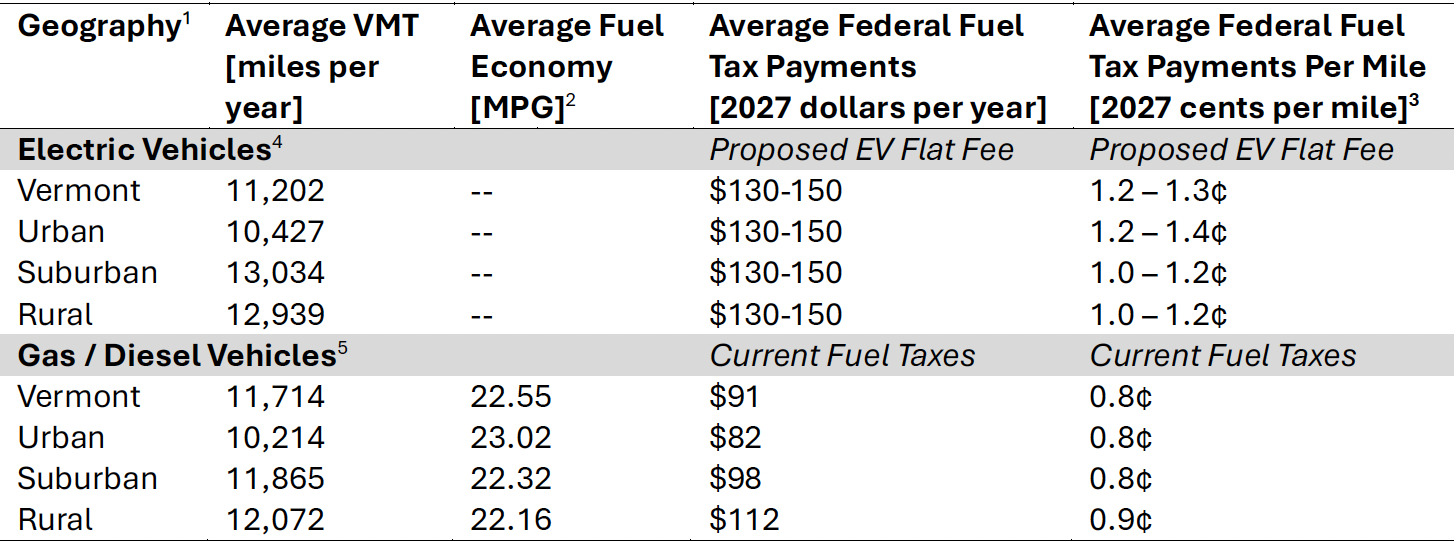
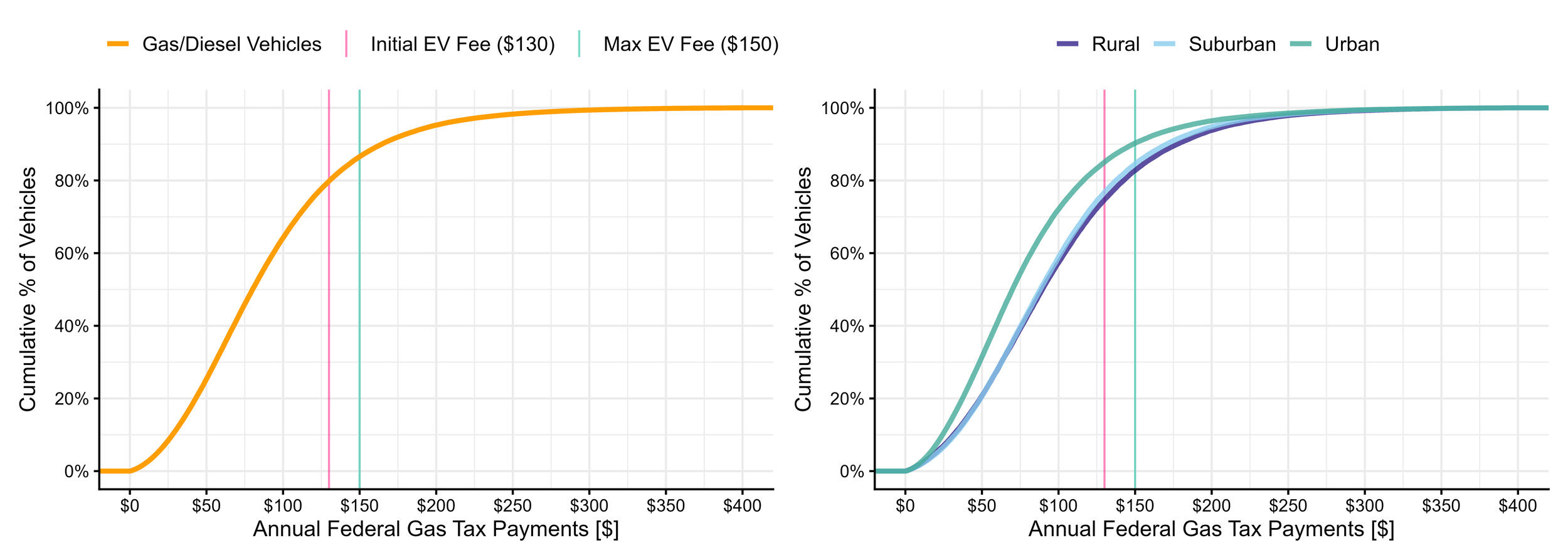
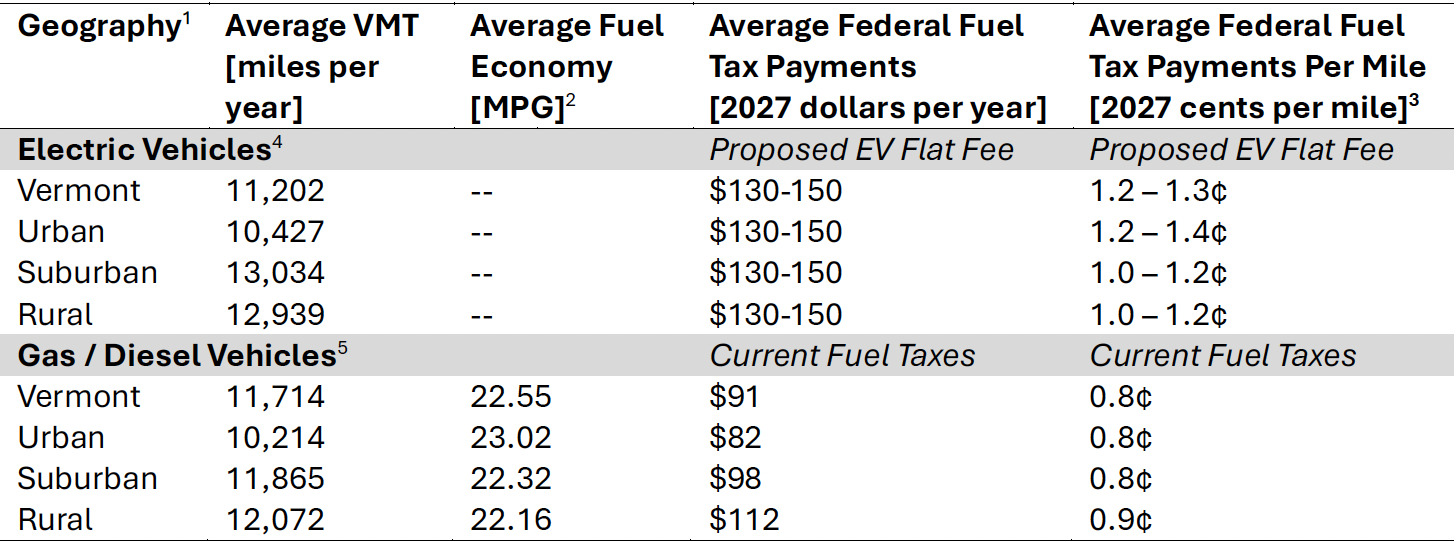
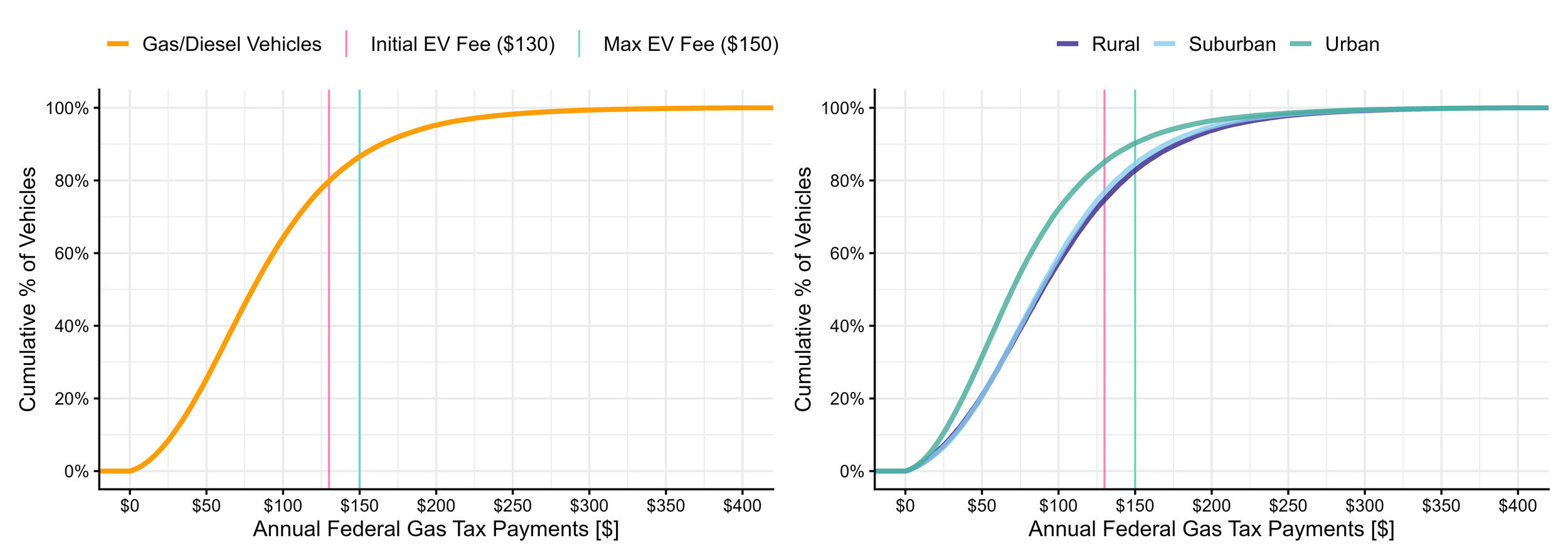
EV Fee Equity. The proposed $130 annual federal EV fee exceeds what most gas and diesel vehicle owners pay in federal gas taxes. On average, Vermont gas and diesel vehicle owners pay $91 per year (Table 1), and 80% of gas and diesel vehicles pay less than $130 per year (Figure 1). This disparity is most pronounced in urban areas, where more efficient vehicles and shorter trip distances mean 86% of gas and diesel vehicles pay less than the proposed EV fee annually. When the EV fee reaches $150 per year, these disparities widen, with 86% of Vermont gas and diesel vehicle owners expected to pay less (90% in urban areas). The same patterns hold when we compare average per mile costs (Table 1). The proposed EV fee is therefore not equivalent to what a typical gas or diesel vehicle owner contributes to the federal highway trust fund annually or per mile driven — it is substantially higher. Vermont’s relatively rural character means these findings likely understate the disparities that would occur in more urbanized regions.
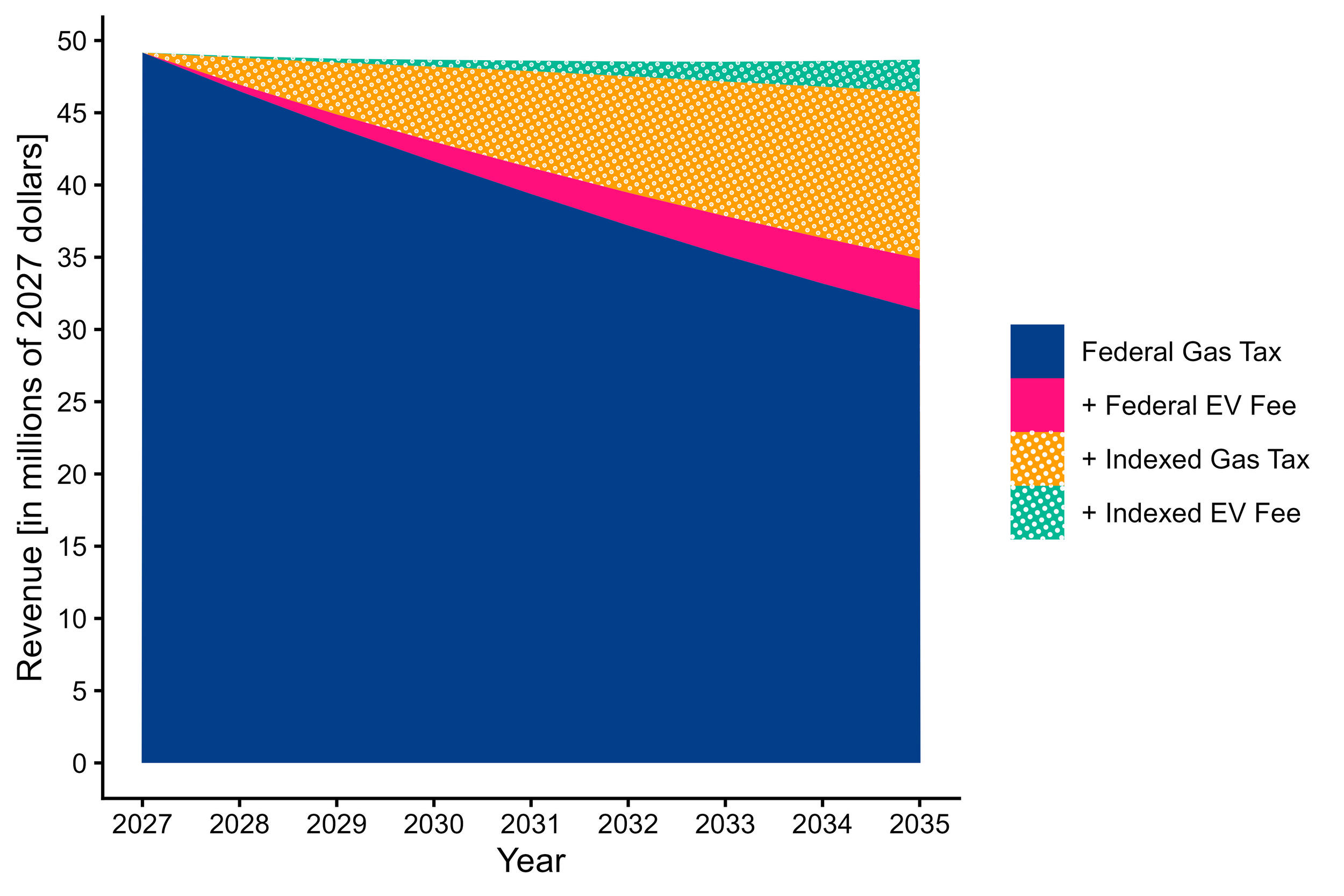
Revenue Implications. In 2023, Vermont vehicle owners paid approximately $60.3 million (2027 dollars) in federal gas taxes. Our projections show that Vermont’s EV fleet will grow substantially through 2035, gas and diesel VMT will decline modestly as EV adoption grows, and fleet-average fuel economy will increase gradually (Figure S1). By 2035, our projections indicate federal gas taxes paid by Vermont vehicle owners will fall to $30.3 million – a 50% decrease in funds over a decade (Figure 2). The EV fee only partially mitigates the revenue decline.
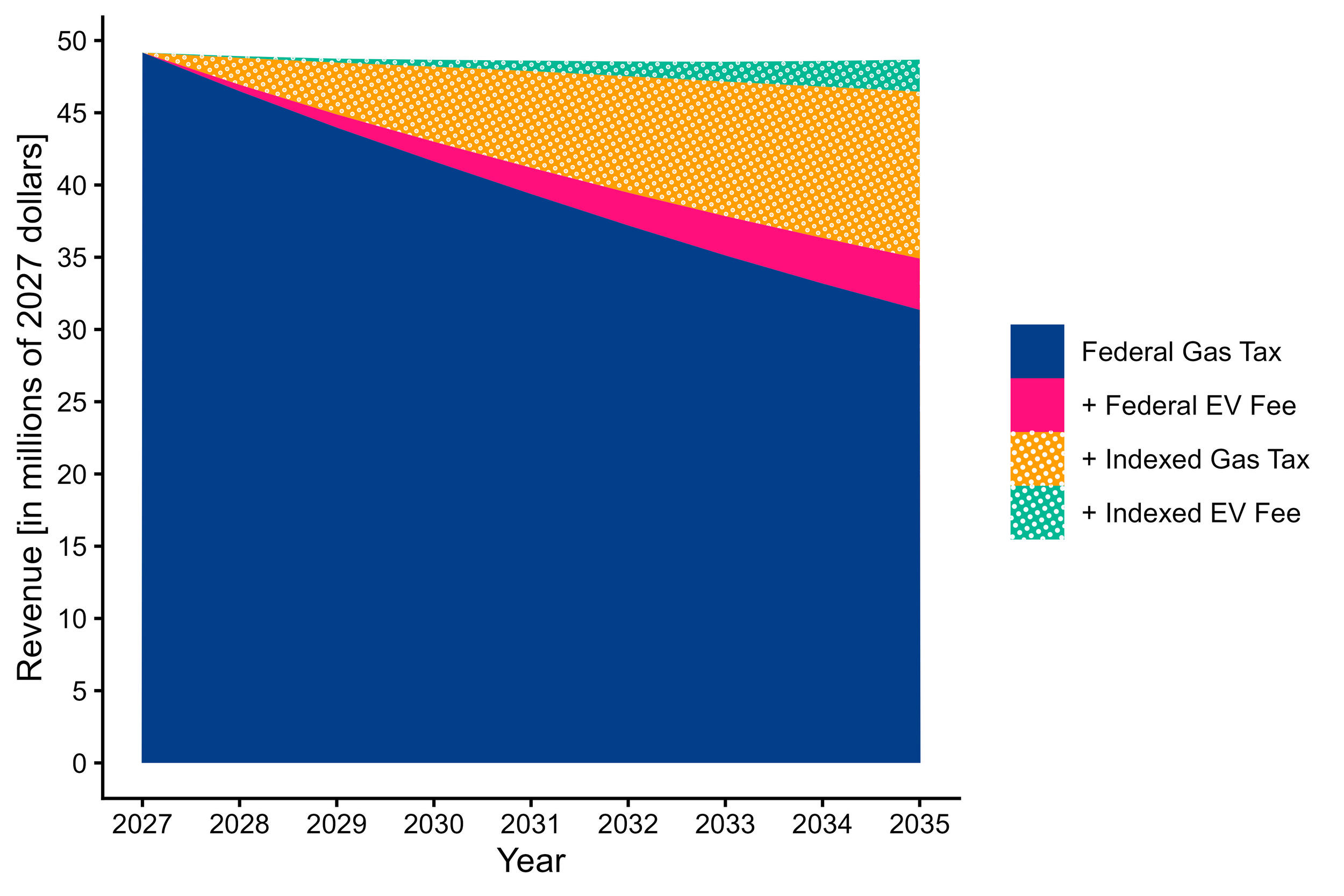
The dominant driver of revenue decline is inflation eroding the real value of the nominal $0.184 and $0.244 per gallon federal gas taxes – a problem that has compounded since their last increase in 1993. Indexing the federal gas tax to inflation (here using the NHCCI) would recover substantially more revenue than an EV fee. Indexing both the gas tax and the EV fee nearly stabilizes revenue, though it does not fully arrest the long-run revenue decline driven by improving fuel economy and declining fuel consumption. As revenue generated per VMT declines in real dollars, the gap between revenue and highway maintenance costs will continue to grow. Addressing the Highway Trust Fund shortfall requires confronting the federal gas tax’s eroding real value — the proposed EV fee, while a step toward funding recovery, is far from sufficient on its own. A mileage-based user fee or road user charge applied to all vehicles could offer a more sustainable source of highway funding if the fee is indexed to inflation and the program design addresses concerns about implementation costs and privacy (Chen et al. 2025; Duncan et al. 2017, 2020; Nelson and Rowangould 2023, 2024, 2026).