
1. Questions
Measures that limit motorized through-traffic in residential neighborhoods can improve traffic safety, promote active travel, improve air quality, and reduce traffic noise, thereby supporting health and wellbeing of urban populations (Brown et al. 2017; Cash-Gibson et al. 2024; Mueller et al. 2020). Such measures are central components of Superblocks in Barcelona, Low-Traffic Neighborhoods in London, and Kiezblocks in Berlin (Mueller et al. 2020; Tiran et al. 2025; Xiao et al. 2023). They typically involve redirecting through-traffic using interventions such as diagonal barriers, one-way streets, or school zones, and extend to the reallocation of public space previously used for motor traffic to improve local social and environmental conditions, for example through the creation of pedestrian zones, or green spaces (hereinafter Superblock measures; Nieuwenhuijsen et al. 2024; Tiran et al. 2025). Although these measures are relatively low-cost (Rammert and Hausigke 2026) and effective (Pérez et al. 2025), their implementation remains contested (Klaever et al. 2024; Marken et al. 2026), potentially hindering policymakers and municipal administrations from implementing transformational transport policies (Gärling and Schuitema 2007).
Initial evidence suggests that public support for Superblock measures is broader than indicated by public discourse or media coverage (Knie and Pfaff 2025; Traxler and Wegrich 2023). To inform the political debate as well as the evidence-based planning and implementation of Superblock measures in municipalities, we aimed to assess public support for a comprehensive set of commonly implemented measures among residents from residential neighborhoods in Berlin, Germany. In addition, we examined associations between public support and potential neighborhood, mobility, sustainability, and sociodemographic correlates based on hypotheses derived from previous research on factors influencing support for similar interventions (Bergquist et al. 2022; Ejelöv and Nilsson 2020; Schreibmüller et al. 2025).
2. Methods
We conducted a survey in four residential neighborhoods between September 2024 and May 2025. Two neighborhoods had planned Superblock measures (Nördliche Luisenstadt, Antonkiez), while two did not (Stephankiez, Westfälisches Viertel). Neighborhoods without planned Superblock measures were selected based on their comparability to the neighborhoods with planned measures in terms of built environment, size, and environmental exposure, including noise and air pollution. A random sample of 10,657 residents aged ≥18 years was drawn from the citizens’ register and invited to complete the survey online or on paper in German, English, Turkish, Arabic, or Russian. A single reminder letter was sent to non-respondents to encourage participation. A total of 1,480 citizens returned completed surveys (response rate 13.9%). Surveys with >80% item completion were considered complete (The American Association for Public Opinion Research 2023).
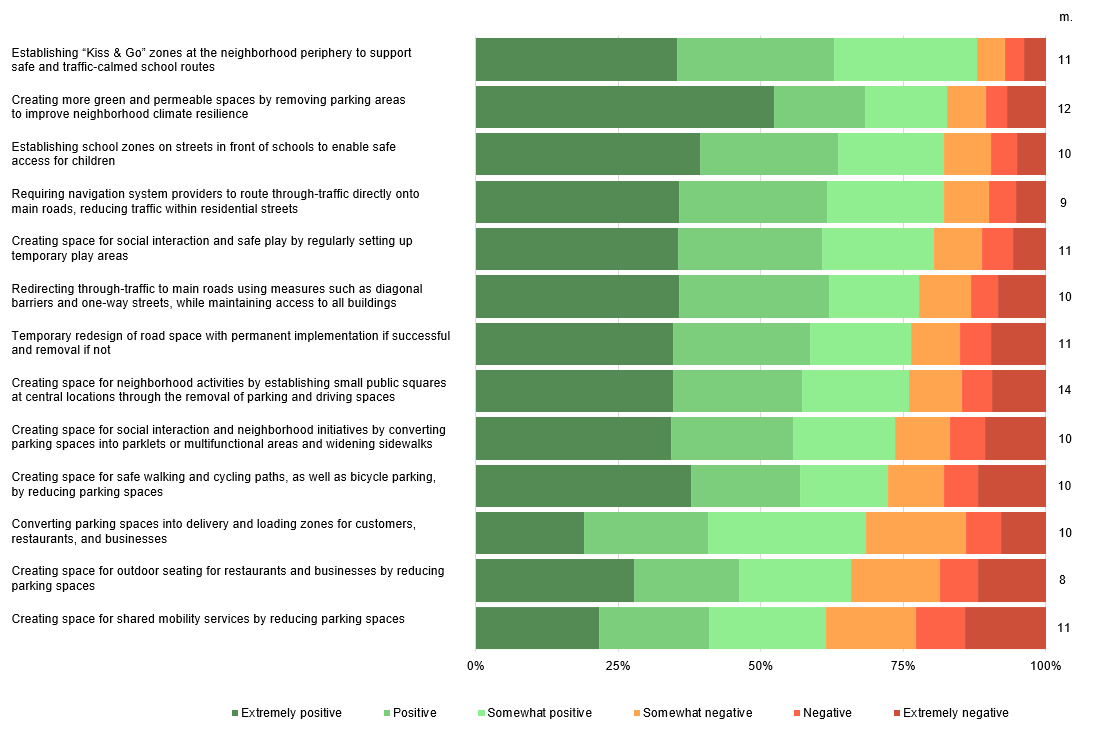
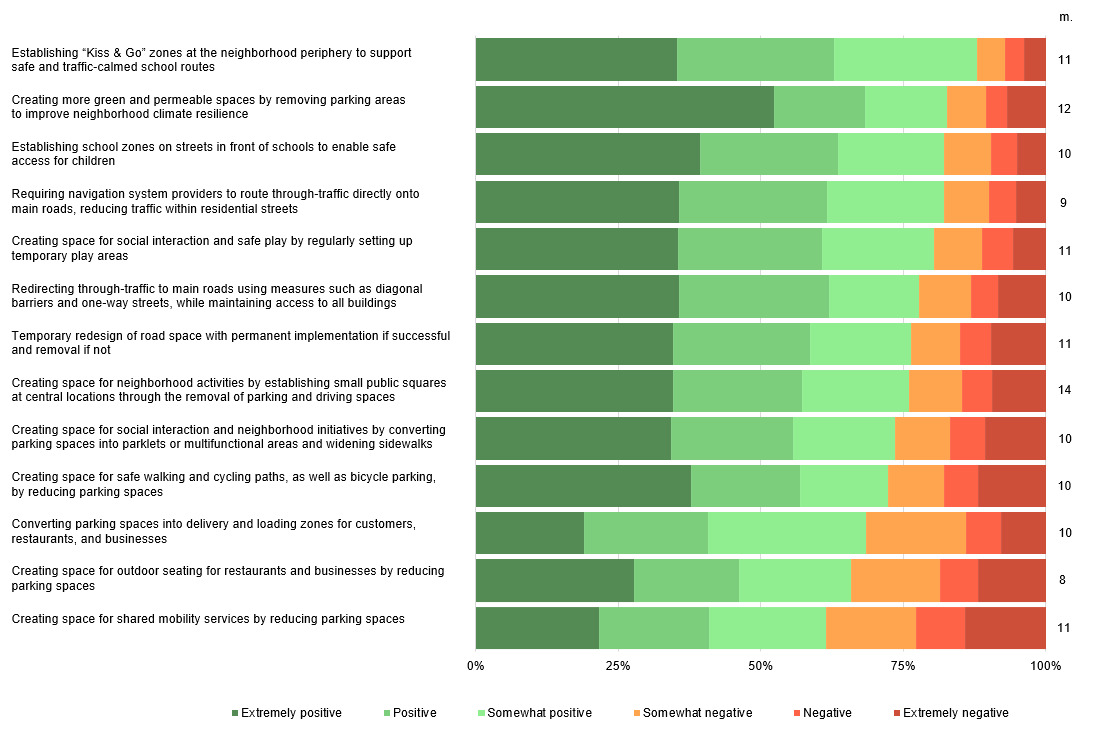
Participants rated 13 Superblock measures on a six-point Likert scale ranging from “extremely negative” to “extremely positive” (see Figure 1 and Supplement 1). The items were formulated to explicitly reflect both loss and gain framings. The measures were developed collaboratively by a transdisciplinary research team, drawing on previous research (e.g., Knie and Pfaff 2025), the authors’ own observations, and practical input from municipal administrations, with the aim of capturing a broad range of Superblock measure combinations implemented across different neighborhoods.
In addition, participants provided information on several potential correlates (see Supplement 1). Satisfaction with the neighborhood and restricted mobility due to physical limitations were investigated using single items adapted from previous studies (Ruhrort et al. 2024; Umweltbundesamt 2020). Active mobility was assessed using the transport-related physical activity indicator of the EHIS-PAQ (Finger et al. 2015). Car use was categorized as rarely or never versus at least once a month. Connectedness to nature was assessed using the CN-12 (range: 1–7), with higher scores indicating greater connectedness to nature (Hatty et al. 2020). Political orientation was categorized based on stated party preference in a hypothetical federal election (see Supplement 1). Migration background was defined as the respondent or at least one parent being born outside Germany. Equivalized disposable income was calculated in accordance with standard guidance (Eurostat 2021), using the midpoint of income categories to estimate monthly disposable income (in Euro). In addition, we assessed gender, age, and the presence of children in the household.
We analyzed support for Superblock measures descriptively and fitted a multiple linear regression model to examine associations between overall support and potential correlates. Overall support was operationalized as the mean score across all 13 items (range: 1–6), calculated when at least 10 items were completed. Higher scores indicate greater support for the Superblock measures. As 363 of the 1,480 surveys had missing data for at least one variable included in the multiple linear regression, missing values were imputed using Multiple Imputation by Chained Equations (MICE) in Stata (Version 19.5). Logistic regression was used to impute categorical variables, and Predictive Mean Matching (PMM) was used for continuous variables. Missing values were assumed to be Missing at Random (MAR). The imputation model included all variables in the regression model as well as key predictors, including education, family status, outdoor time, main mode of transport, health-related restrictions in daily life, relationship with nature, and relationship with neighbors. Twenty imputed datasets were generated using 10 iterations between imputations to ensure convergence. Regression estimates and standard errors were pooled according to Rubin’s rules. Diagnostic checks indicated satisfactory convergence and stability of the imputation process. Results from the imputed datasets were largely consistent with those from a complete-case analysis and from analyses in which the dependent variable was not imputed. As a further sensitivity analysis, we repeated the multiple linear regression excluding equivalized disposable income because of the high proportion of missing data (19.6%), which yielded similar results (see Supplement 3). Therefore, only the results from the fully imputed regression model including equivalized disposable income are presented. Reporting followed the STROBE guidelines (Vandenbroucke et al. 2007).
3. Findings
Sample characteristics are presented in Table 1. Although the sample was broadly comparable to official statistics regarding age and gender, individuals with Green party preferences were overrepresented (44% vs 27%), whereas those with centrist or right-wing preferences (28% vs 48%) and residents with migration background were underrepresented (Amt für Statistik Berlin-Brandenburg 2025; 2026). Together with the relatively low response rate, these differences indicate the potential for non-response bias and should be considered when interpreting the findings. In addition, data collection was limited to four neighborhoods in Berlin, which may affect generalizability to other urban contexts.
Public support was moderate to high across all Superblock measures (61-88%; Figure 1). Because public support varied by political party preference (see Supplement 2), the overrepresentation of participants with Green party preferences may have affected the estimated support levels and should be considered when interpreting the findings. Suitable neighborhood-level weights for post-stratification weighting were not available, and city-level weighting would not have adequately accounted for variation in voting patterns across neighborhoods. Consequently, no post-stratification weighting was performed.
The regression model explained approximately 43.9% of the variance in overall support (Table 2). It was positively associated with active mobility, connectedness to nature and children in the household. In contrast, it was negatively associated with car use, political orientation (with highest support among those with a left or green orientation), and age.
Substantial public support for Superblock measures, even when potential losses (e.g., reduced parking spaces) were explicitly framed, suggests that societal polarization around measures promoting healthier and more sustainable mobility systems may be lower than often assumed, consistent with previous findings (Knie and Pfaff 2025; Lanzendorf et al. 2023). Measures with particularly high support, such as those that create green spaces and improve safety, especially for schoolchildren, represent potential quick wins for policymakers and municipal administrations. Prioritizing their implementation can deliver tangible short-term benefits to residents, potentially fostering broader acceptance of comprehensive future mobility transitions (Rammert and Hausigke 2026) and improving electoral outcomes for parties supporting such transitions (Marquet et al. 2024). At the same time, variation in support by mobility behavior and other characteristics of residents (Lanzendorf et al. 2023), and lower support for some measures (e.g., repurposing parking spaces for sharing services), underscores the need for targeted communication and participatory approaches (Schreibmüller et al. 2025).
Corresponding author
Nicole Lünow
Center for Preventive Medicine and Digital Health
Medical Faculty Mannheim
Heidelberg University
Röntgenstraße 7
68167 Mannheim
Germany
Phone: +49 621 383 71796
Email: nicole.luenow@medma.uni-heidelberg.de
Ethics approval
The study was approved by the Medical Ethics Review Board of the Medical Faculty Mannheim, Heidelberg University (2022-636). All participants provided written informed consent prior to participation.
Acknowledgements
We thank Sebastian Gerloff and Laura Fritsche (Straßen-und Grünflächenamt Berlin-Mitte) for their contributions to neighborhood selection and their advisory role in the development of the survey.
Financial support
The KlimaKieze Study was funded by the Federal Ministry for the Environment, Climate Action, Nature Conservation and Nuclear Safety, Germany (grant number: 67DAS260C, 67DAS260E). The funder had no role in the study design, data collection, data analysis, manuscript preparation, or the decision to submit the manuscript for publication.
Conflicts of interest
Nicole Lünow, Andrea Sarafoglou and Michael Eichinger have no conflicts of interest to declare. Dirk von Schneidemesser served as a Board Member of Changing Cities e.V. from 2018-2022, a non-governmental organization that promotes climate action, traffic calming and the reallocation of public space, for example through protests or support of local Kiezblock initiatives. Immo Janssen is a mobility planner collaborating with the Berlin-Mitte district and a member of Changing Cities e.V., where he also serves in an advisory capacity. Luis Nacken is a member of The Left, a political party that supports the implementation of Kiezblocks in Berlin and related approaches to sustainable urban transformation in Germany.