
1. Questions
The transition away from fossil fuels has increased reliance on transport electrification and, with it, demand for lithium-ion batteries. As electric vehicle (EV) sales have grown, from 4% of total car sales in 2020 to 14% in 2022, questions about material availability, resource allocation, and end-of-life (EOL) management have become more salient (IEA 2023). In this context, “second-life” battery reuse for stationary energy storage has gained attention as one circular economy pathway for batteries that no longer meet vehicle performance requirements (Curtis et al. 2021).
Research and pilot projects have almost exclusively focused on retired passenger EV batteries, e.g., from the Nissan Leaf. However, shared micromobility, which use the same 18650 cell types as most passenger EVs, have outsold electric cars in the U.S. and represent an overlooked source of spent battery inventory that is more modular and potentially more available for smaller-scale applications (Li et al. 2022).
Once recovered, batteries can undergo partial disassembly and testing. Adopting EV industry precedents, batteries degrading to 80% of their original capacity become candidates for reuse, as they no longer fulfill propulsion requirements but maintain sufficient storage for stationary applications. Depending on cell health, battery packs can either be fully disassembled to extract healthy cells, or, if degradation is even, integrated packs can be repurposed intact as auxiliary or backup power solutions.
We address the following questions.
-
What is the volume of available second-life batteries in the shared micromobility market in the U.S.?
-
What is the spatial distribution that could contribute to logistics challenges and opportunities for shared micromobility battery recovery in the U.S. market?
2. Methods
To compile the market inventory, we collected deployment data on lithium-ion battery-powered micromobility fleets operating in the United States between 2021 and 2022. Because micromobility operators rarely share fleet sizes voluntarily due to competitive business models, we manually aggregated vehicle counts utilizing city permits, operator press releases, phone interviews with municipal officials, and data from trade organizations like the North American Bikeshare and Scootershare Association (NABSA 2022) and the National Association of City Transportation Officials (NACTO 2025). We analyzed deployment from seven major operators at the time: Lime, Bird, Superpedestrian, Veo, Lyft, Spin, and B-cycle. While our dataset ends in 2022, continued growth supports the core finding that the shared micromobility market is an important source of EOL batteries (NABSA 2024).
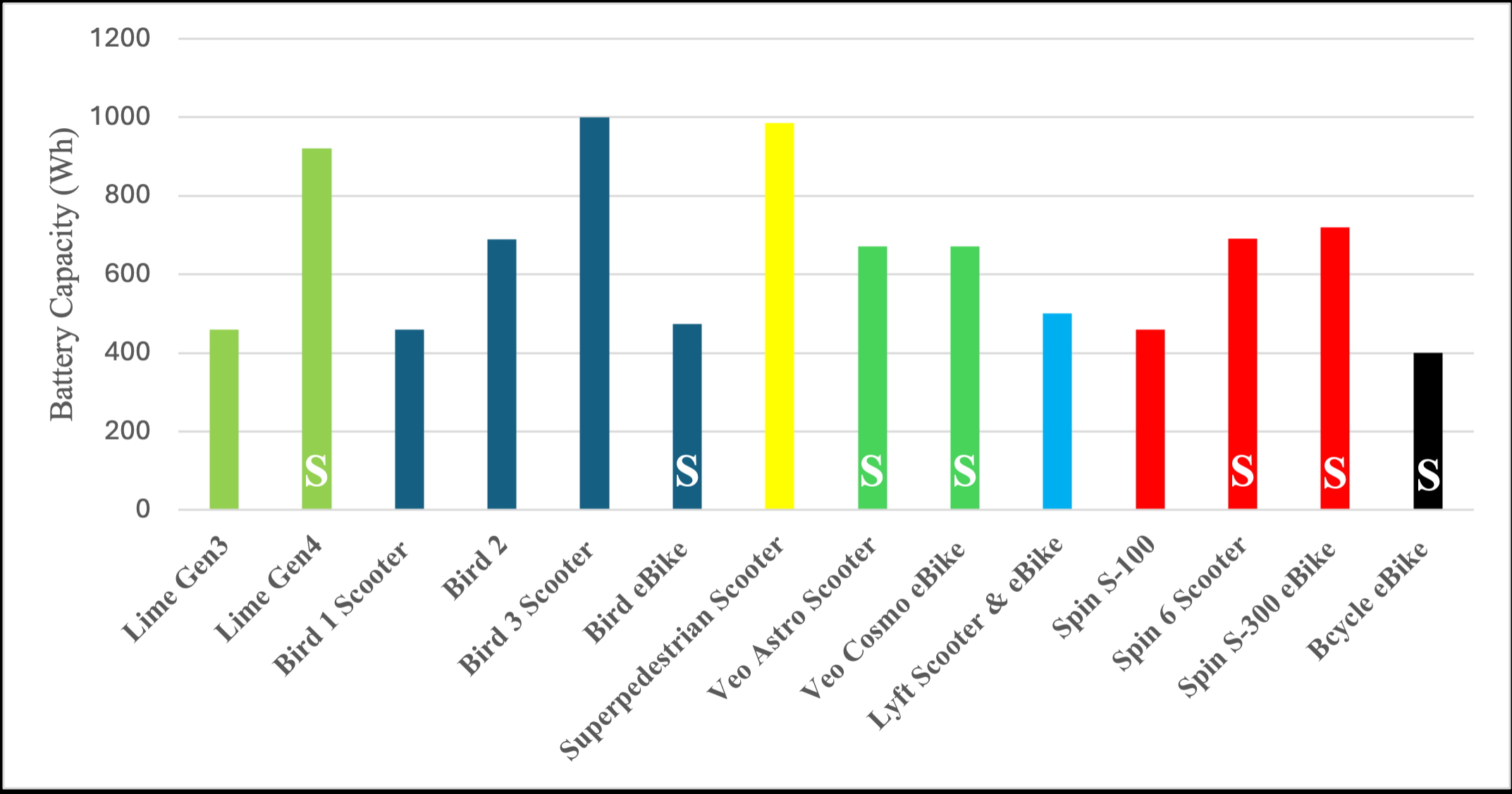
Total battery capacity in kilowatt-hours (kWh) was calculated from the recorded battery sizes of each vehicle model. While early fleet deployments (2017–2018) were characterized by small batteries (under 500 Wh) with lifespans of less than a year, the industry has rapidly transitioned to larger, more resilient packs. Current models frequently approach 1 kWh in capacity and can last between 3 and 5 years. Companies employing swappable battery strategies must maintain excess stock to support charging operations; an approximate battery-to-vehicle ratio of 1.5:1 is required. Therefore, we applied a 50% inventory increase to swappable models (Ghosh and Biswas 2016). To model future supply, we estimated EOL battery capacity using an established battery monthly churn rate of 1.69% (Brightside 2021) and a conservative annual industry growth rate of 15% that reflects double-digit growth rates since the COVID-19 pandemic (SUMC 2024).
We also examined the reverse logistics process, drawing on practices from the EV sector and the micromobility battery industry, to identify challenges specific to capturing small batteries across distributed geographies.
3. Findings
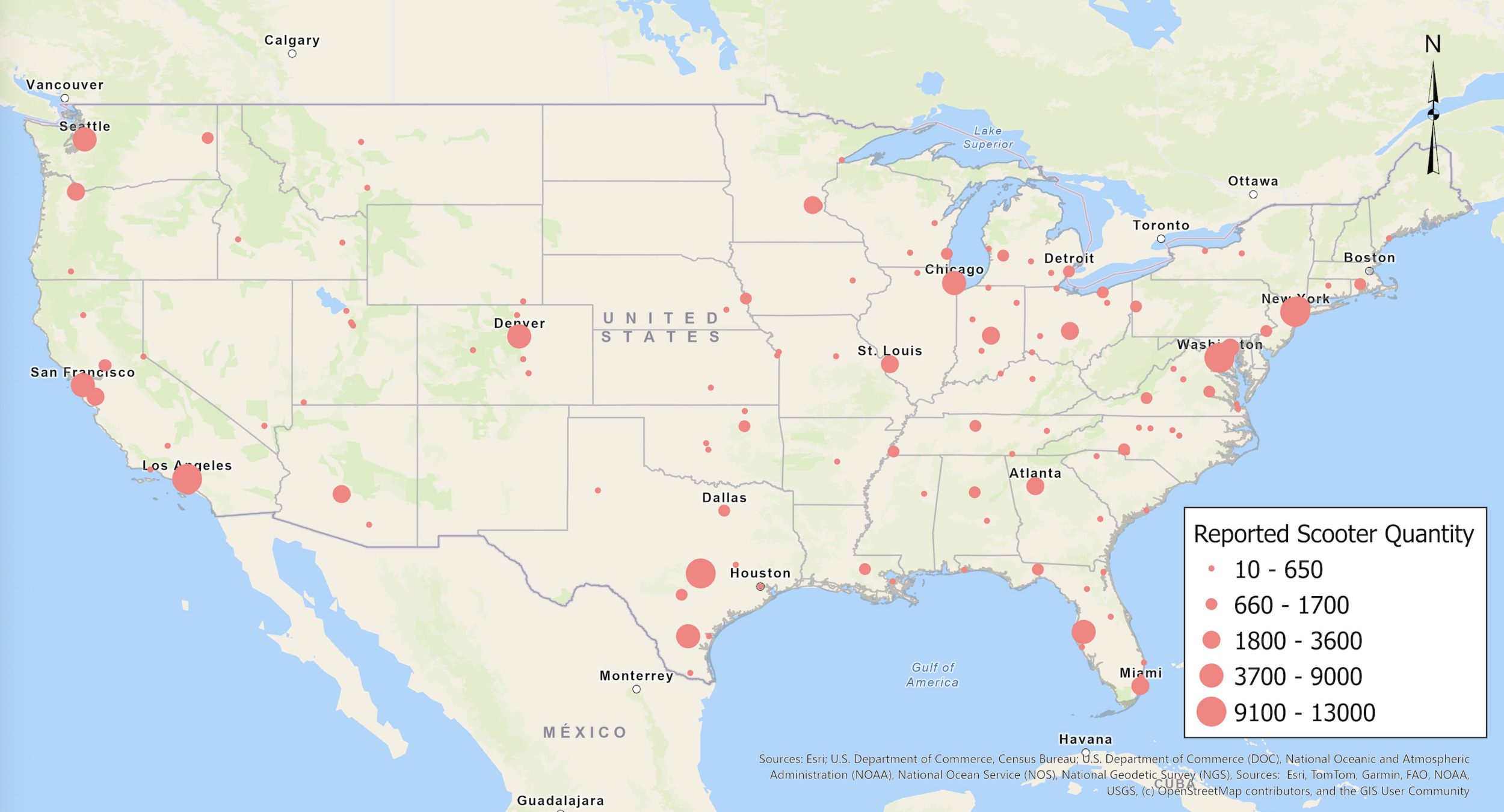
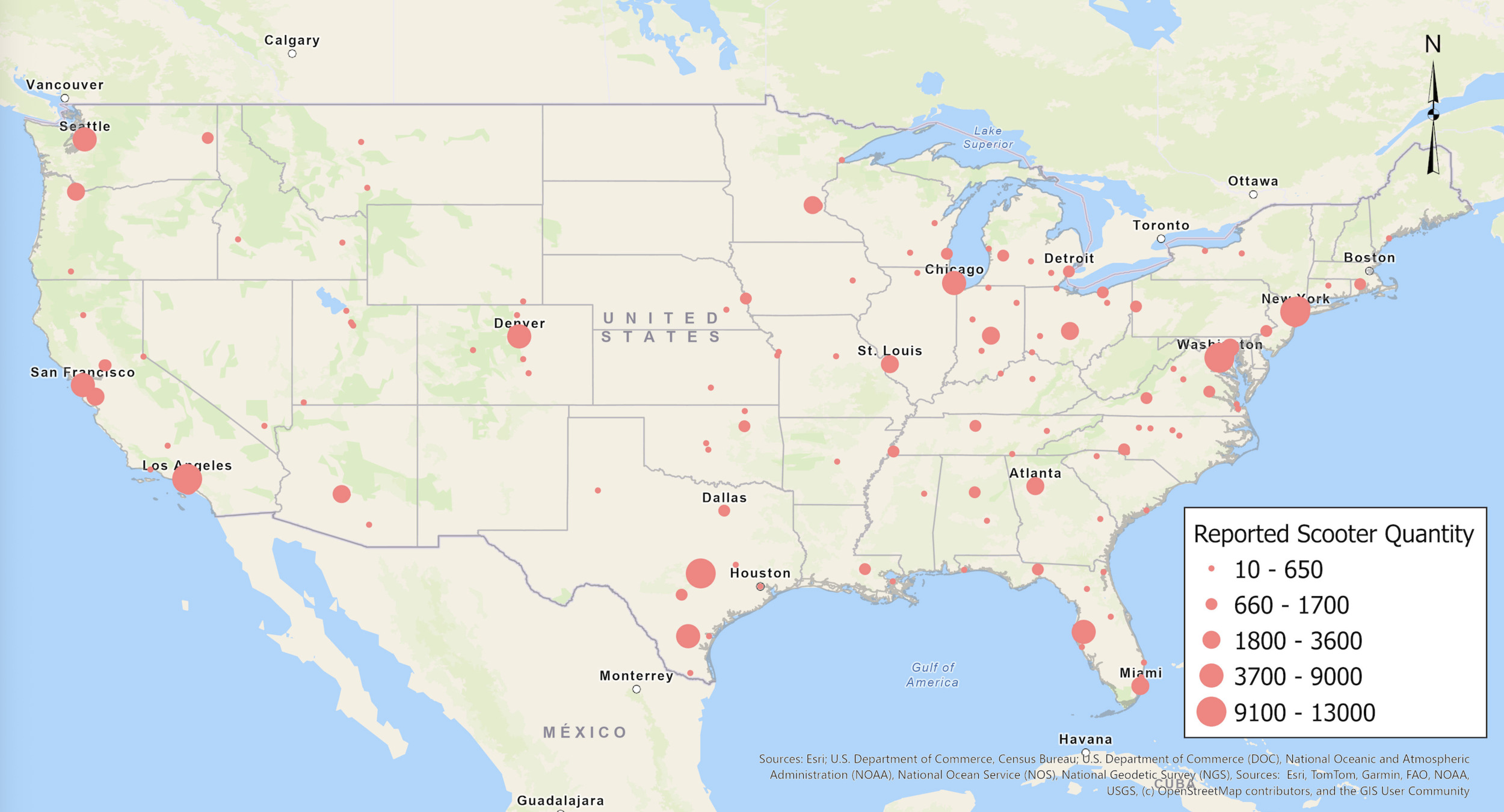
We identified a total inventory of 183,509 shared electric micromobility vehicles (Table 1) deployed across 424 systems in the United States (Figure 1). Furthermore, five of the seven leading companies have adopted swappable battery technologies.
We multiply the number of micromobility vehicles by the battery capacity of each model for a moment-in-time inventory of electric micromobility batteries in the market by operator (Figure 2). Accounting for the 50% excess required for swappable systems, we estimate an average battery capacity per vehicle of 736 Wh. This brings the total estimated U.S. inventory to 222,614 battery units, representing a cumulative moment-in-time capacity of 163,894 kWh. Applying the 1.69% monthly churn rate (decommissioning), the generated EOL battery capacity is 35,880 kWh per year in the reference year of this study 2022. An assumed 15% industry growth rate results in a doubling of capacity by 2028.
_in_2022_(co.jpg)
This is still a small amount (<1%) compared to potential electric car battery EOL capacity, which could reach 40 GWh per year by 2030 (up from 10 GWh in 2025) (Das 2025). EV battery packs are 70-100 times the size of a micromobility battery and are reserved for industrial scale applications (Gao et al. 2024). Micromobility battery packs, with smaller capacities, may be used in smaller applications, for example, household power supply applications; a Tesla Powerwall has a capacity of 13.5 kWh per unit.
Creating a profitable value chain presents significant economic challenges. The cost of new EV battery packs continued to decline to $108/kWh in 2025 (Bloomberg NEF 2025). Because micromobility batteries average less than 1 kWh, keeping the combined costs of collection, hazardous material transportation, labor-intensive disassembly, and standards recertification below $100/kWh could be difficult in a landscape of plummeting new-battery costs. Direct recycling, with its associated cost, may be a more cost-effective end-of-life pathway for operators.
The size and versatility of shared micromobility fleets warrant inclusion in EOL policy, battery reuse research, and commercial second-life development. Consideration could also be given to personally owned e-bike and e-scooter battery recovery, which number in the millions. Future work should investigate the commercial-scale viability of this overlooked energy resource.
Acknowledgements
This work is funded through a seed grant from the Institute for a Secure & Sustainable Environment at The University of Tennessee. The data was collected from micromobility partners, city agencies, and the U.S. DOT Bureau of Transportation Statistics and is available on request. Special thank you to Bailey Sawyers for research assistance in data retrieval efforts. The authors utilized Gemini 3.0 for editorial support.