This website uses cookies

We use cookies to enhance your experience and support COUNTER Metrics for transparent reporting of readership statistics. Cookie data is not sold to third parties or used for marketing purposes.

Skip to main content
null
Findings
  • Menu
  • Articles
    • Energy Findings
    • Resilience Findings
    • Safety Findings
    • Transport Findings
    • Urban Findings
    • All
  • For Authors
  • Editorial Board
  • About
  • Blog
  • search
  • X (formerly Twitter) (opens in a new tab)
  • LinkedIn (opens in a new tab)
  • RSS feed (opens a modal with a link to feed)

RSS Feed

Enter the URL below into your favorite RSS reader.

https://findingspress.org/feed
ISSN 2652-8800
Transport Findings
July 08, 2026 AEST

Right-wing Votes Relate to Delays in Bicycle Network Development

Clément Sebastiao, Michael Szell,
bicycle networkcycling politicssustainable mobility
Copyright Logoccby-sa-4.0 • https://doi.org/10.32866/001c.163938
Findings
Sebastiao, Clément, and Michael Szell. 2026. “Right-Wing Votes Relate to Delays in Bicycle Network Development.” Findings, July 7. https://doi.org/10.32866/001c.163938.
Save article as...▾
Download all (2)
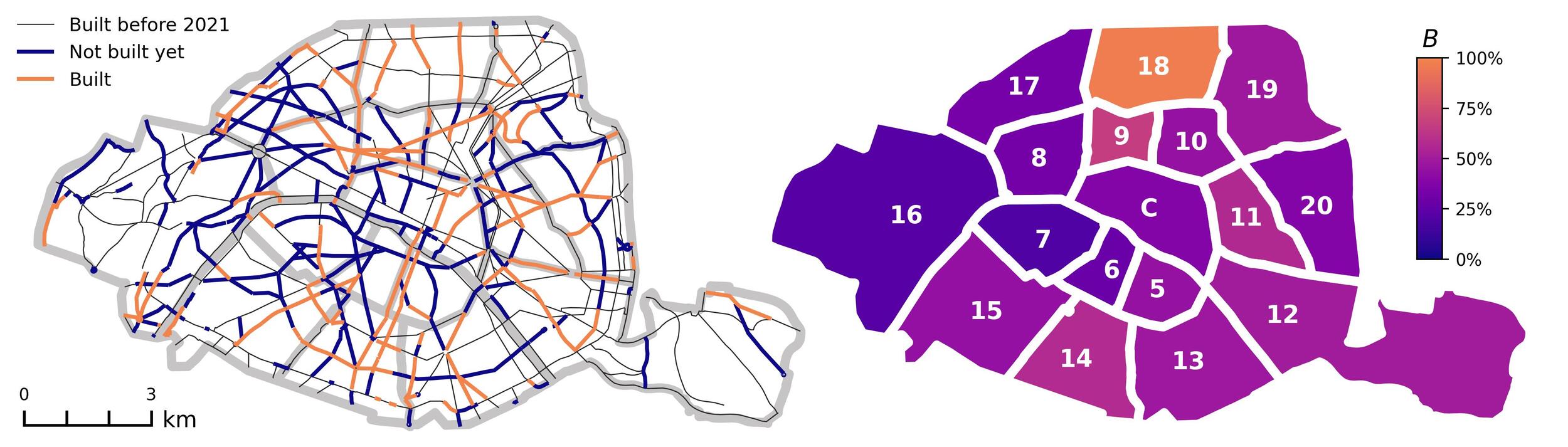
  • Figure 1. Left: Paris’ Plan Vélo 2021-2026 progress on street level, Right: share of bicycle lanes built \(B\) aggregated by political voting unit.
    Download
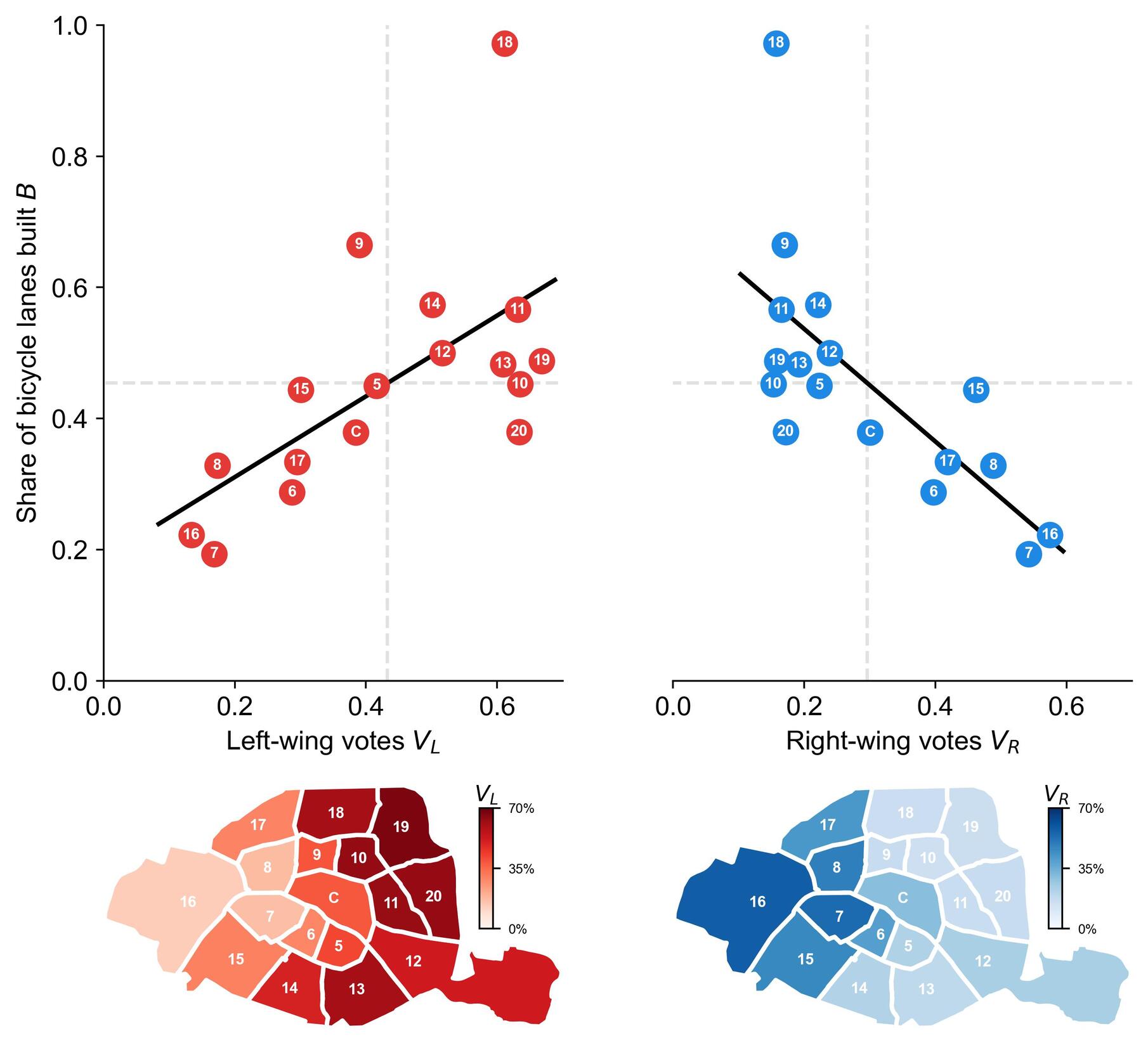
  • Figure 2. Left: Scatterplot of the share of bicycle lanes built \(B\) against left-wing votes \(V_L\), Right: against right-wing \(V_R\) votes, with corresponding maps of the voting patterns. The black lines show fitted linear regressions. Dashed gray lines show the average values for each axis.
    Download

Error

Sorry, something went wrong. Please try again.

If this problem reoccurs, please contact Scholastica Support

Error message:

undefined

View more stats

Abstract

Paris has implemented only 43% of its 2021-2026 bicycle network plan by its 2026 deadline, but the delays are not equally distributed. Correlating political voting and bicycle infrastructure data, we find that boroughs with a higher share of right-wing votes are also boroughs with the largest delays in bicycle infrastructure development. Although the number of voting units is only 17, this correlation is remarkably strong and significant. At the city scale, for each additional 1% of right-wing votes, we find 0.86% less protected bicycle lanes built.

1. Questions

Urban bicycle network development is more a political than a technical problem (Buehler 2021). Political opposition is common in motonormative societies (Walker et al. 2022; Henderson and Gulsrud 2019; Wild et al. 2018), manifested in systemic local obstructions of infrastructure development causing functional collapse on the network level (Szell et al. 2022) and stifling cycling uptake with its numerous societal benefits (Schön et al. 2024; Fosgerau et al. 2023; Gössling et al. 2019). Therefore, the political reasons for such delays must be scrutinized, to identify and fix the practical bottlenecks of bicycle network development.

Paris is a good example of a city dedicated to improve its bicycle infrastructure (Moran 2022; Liu et al. 2026). The modern push towards more cycling in France started from environmental concerns in 1994 via the creation of the Comité de suivi de la politique du vélo, during Paris’ right-wing governments of Chirac, then Tiberi, which was then more strongly supported by successive left-wing governments, first under Delanoë, then Hidalgo under the banner of the 15-minute city (Dauncey 2012; Narangoda et al. 2024; Moreno 2024). Although up to March 2026, Hidalgo was the city’s socialist mayor, the city’s different arrondissements (local administrative unit corresponding to a metropolitan borough) may be governed by arrondissement mayors and councils of different political colors.

Here we focus on the “Paris Plan Vélo 2021-2026” (Municipality of Paris 2021; Narangoda et al. 2024), a 182 km plan of protected bicycle lanes. Only 43% of the planned infrastructure has been constructed city-wide by its 2026 deadline (Paris en Selle 2026). While locally elected councils have in theory only a consulting role (Code général des collectivités territoriales 2026), public discussion has found delays and the overall bikeability to differ between boroughs depending on the local elected official (Paris en Selle 2023). Such discussions motivate us to investigate whether there is a sound statistical relationship between Paris’ voting patterns and the development progress of its bicycle network.
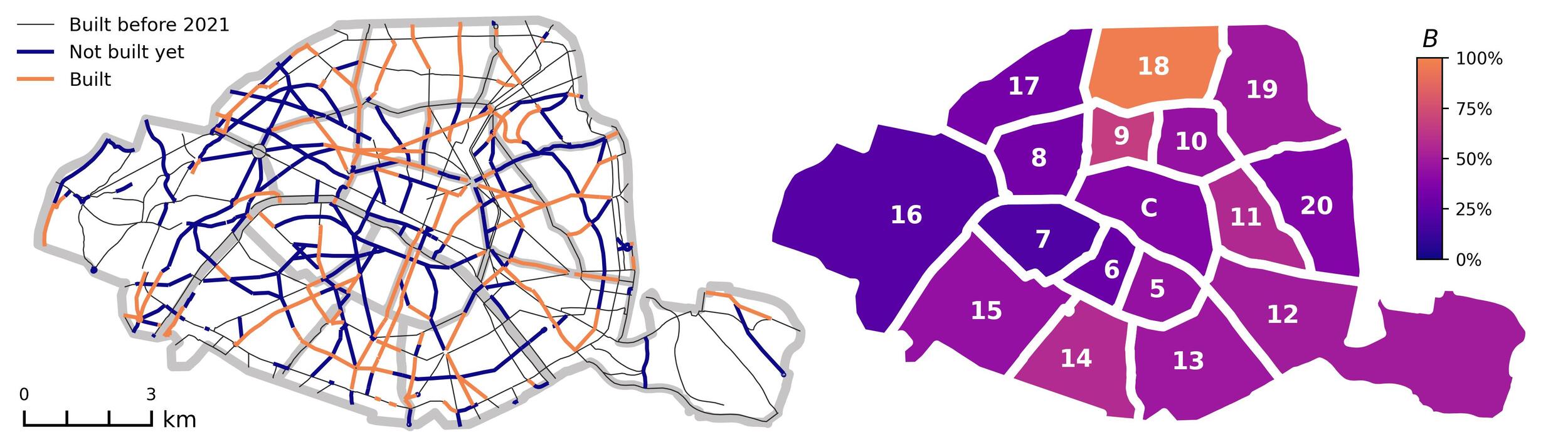
Figure 1
Figure 1.Left: Paris’ Plan Vélo 2021-2026 progress on street level, Right: share of bicycle lanes built \(B\) aggregated by political voting unit.

2. Methods

We measure the progress of the bicycle network plan using the latest street-level data, collected by the local cycling advocacy organization (Paris en Selle 2026). We aggregate the data by voting units, see below, and call this variable the share of bicycle lanes built \(B\), see Figure 1.

Voting results come from Paris Data (2020) on the municipal election of 2020, where citizens voted for their local council. Each of the 20 councils correspond to an arrondissement. The first four boroughs are aggregated in a single unit named “Centre” (denoted as “C”), leaving us with 17 voting units. We use the results of the first voting round as they best capture the voting intent of citizens, without voting system artifacts like second-round list exclusions. We classify lists using the authoritative nuance list of the Ministère de l’Intérieur (2020), subsuming the party lists LEXG, LFI, LDVG, LUG, LVEC, and LDIV as left and LUD, LDVD, LRN as right; the central lists LUC and LDVC do not belong to either class.[1]

We also use the median income \(Y\) (INSEE 2024c) and the approximated mean age \(A\) (INSEE 2024b) normalized to the range 0-1, and cycling/driving commuter shares \(M_C\) and \(M_D\) (INSEE 2024a), to investigate additional relationships. As the age data comes in age brackets we can calculate an approximation of the mean, but not a median age.

We make publicly available all code and processed data in the following repository: https://github.com/csebastiao/paris_vote_bicycle
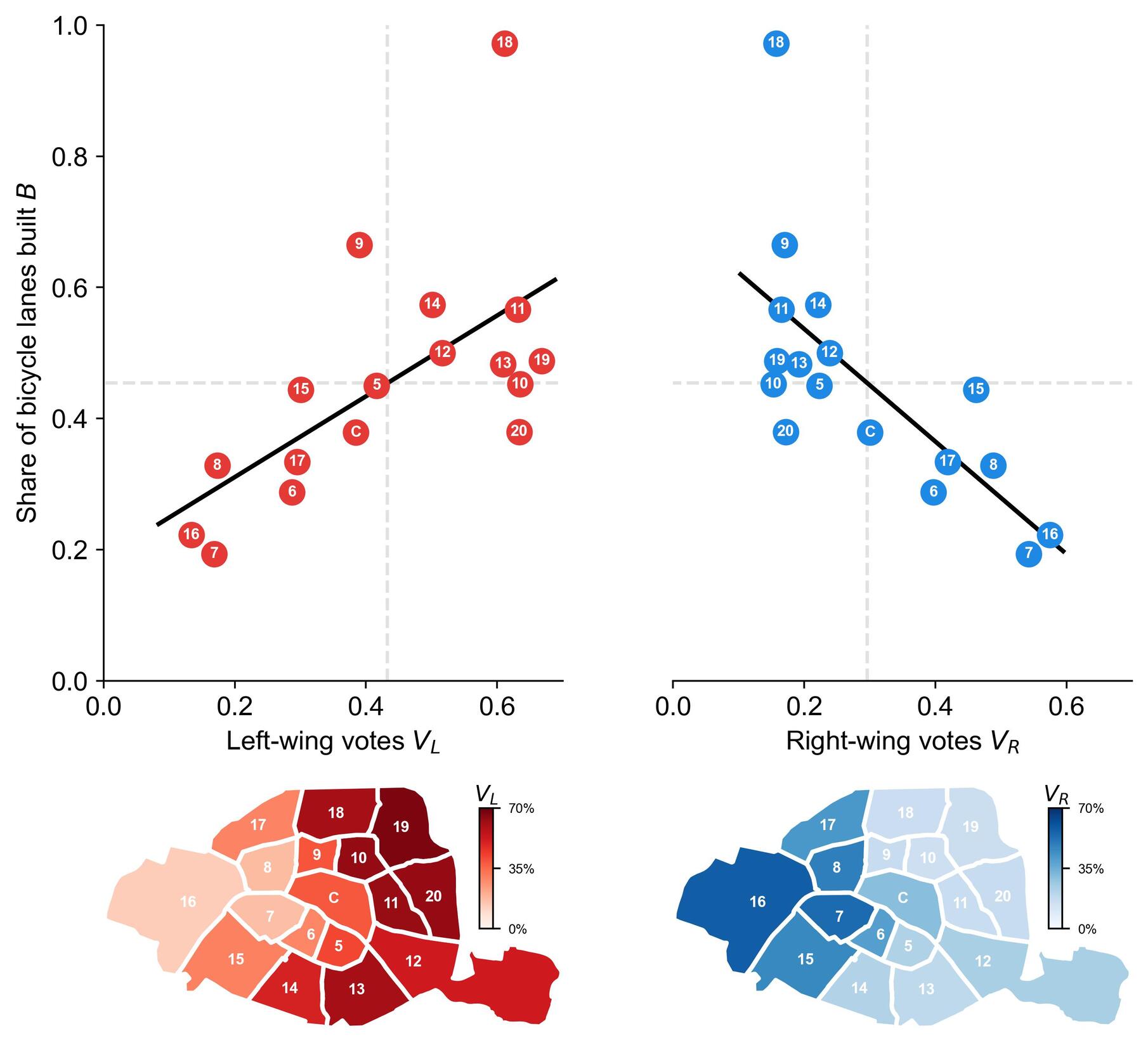
Figure 2
Figure 2.Left: Scatterplot of the share of bicycle lanes built \(B\) against left-wing votes \(V_L\), Right: against right-wing \(V_R\) votes, with corresponding maps of the voting patterns. The black lines show fitted linear regressions. Dashed gray lines show the average values for each axis.

3. Findings

We correlate built bicycle lanes \(B\) both with the votes of left and right political sides \(V_L\) and \(V_R\) and not with only one unitary left-right measure, to keep the analysis simple and to respect the inherent asymmetry due to the center parties. Further, it is worth to report different statistical indicators depending on the political side to explore potential asymmetries between opposition and support, in light of relevant psychological biases like loss aversion and status quo biases (Walker et al. 2022; Timmons et al. 2023; Kahneman and Tversky 1984).

We find a statistically significant positive correlation between left-wing votes \(V_L\) and built bicycle lanes \(B\) (Pearson \(\rho=0.62\), \(p=0.0081\)), and an even stronger negative correlation between right-wing votes \(V_R\) and \(B\) (\(\rho=-0.71\), \(p=0.0016\)), see Figure 2. The slope of \(\beta=-0.86\) for the latter implies that, on average, for each additional percent of right-wing votes, 0.86% less protected bicycle lanes are built. The significances of these correlations are remarkable considering the low \(n=17\). Borough 18 is an outlier, which had the least bicycle infrastructure planned (2.4% of the entire plan for 5.6% of the Paris area) of which it implemented 97%.

Despite the clarity of these results, they need to be interpreted with care: Correlation is not causation, small sample size makes statistical results less reliable, and there are many potential confounders possible. To this end, we explore the additional demographic variables introduced in the Methods, see Table 1. Of these, the negative correlations between \(B\) and the median income \(Y\) (\(\rho=-0.61\)), the mean age \(A\) (\(\rho=-0.67\)), and the share of commuter driving \(M_D\) (\(\rho=-0.62\)) are significant, all at \(p<0.01\). Furthermore, all variables correlate among themselves. Trivially, \(V_L\) correlates negatively with \(V_R\) (\(\rho=-0.93\), \(p=5.4 \times10^{-8}\)) as does \(M_C\) with \(M_D\) (\(\rho=-0.76\), \(p=0.00046\)). Right-wing votes \(V_R\) correlate positively with \(Y\) (\(\rho=0.80\), \(p=0.00012\)), \(A\) (\(\rho=0.69\), \(p=0.0023\)), and \(M_D\) (\(\rho=0.81\), \(p=0.000082\)). Left-wing votes \(V_L\) correlate negatively with \(Y\) (\(\rho=-0.90\), \(p=1.1 \times10^{-6}\)) and \(A\) (\(\rho=-0.61\), \(p=0.0090\)), and positively with \(M_C\) (\(\rho=0.59\), \(p=0.012\)), in line with Rérat and Ravalet (2025). \(A\) correlates also positively with \(Y\) (\(\rho=0.70\), \(p=0.0019\)) and \(M_D\). (\(\rho=0.65\), \(p=0.0050\)) In summary, driving, higher mean age, right-wing votes, and bicycle network delays are more strongly related than cycling, lower mean age, left-wing votes, and bicycle network development.

To verify that the votes data \(V_R\) carries relevant information beyond the demographic variables, we perform a hierarchical regression, comparing a multilinear regression model predicting \(B\) with all demographics variables (\(Y\), \(A\), \(M_D\), and \(M_C\)) to a model which additionally includes the independent variable \(V_R\). Both models are significant (\(p < 0.05\)) but each individual variable is not significant due to strong multicollinearity. Nevertheless, adding \(V_R\) does increase significantly the model’s \(R^2\) (\(\Delta R^2=0.031\), \(p=0.017\)) and its adjusted \(R^2\) (\(\Delta R^2_{\mathrm{adj}}=0.021\)). Although this result has to be interpreted carefully due to the few data points, it highlights the statistical relevance of the voting patterns even after controlling for demographics.

We also find a considerable positive spatial autocorrelation. Computing Moran’s \(I\) with rook contiguity, we find \(I(B)=0.17\), \(I(V_L)=0.64\), \(I(V_R)=0.61\), \(I(Y)=0.43\), \(I(A)=0.43\), \(I(M_C)=0.36\), \(I(M_D)=0.38\), all with \(p<0.01\), and a general west-east trend, which calls for further care in the interpretation.

Our correlational analysis is just a beginning which cannot consider cases of further possible confounders. For example, there could be a potential causal dependence between right-wing voting and boroughs with streets that are harder to adapt to cycling infrastructure, or cases of potential reverse causation such as car-centric boroughs attracting more right-wing inhabitants. Even if there was a causal relationship, one would need to consider counterfactuals: Instead of developing bicycle infrastructure, could the local council have generated other benefits?

Table 1.Correlations and linear regressions between the share of bicycles lanes built \(B\) and each available variable, aggregated at the voting unit level (n=17). ** \(p<0.01\).
Share of bicycle lanes built \(B\) Pearson correlation \(\rho\) Slope \(\beta\)
Left-wing votes \(V_L\) 0.62** 0.62
Right-wing votes \(V_R\) −0.71** −0.86
Median income (normalized) \(Y\) −0.61** −0.38
Mean age (normalized) \(A\) −0.67** −0.42
Share of commuter cycling \(M_C\) 0.36 3.2
Share of commuter driving \(M_D\) −0.62** −2.7

Bicycle infrastructure development is a complex process with nontransparent political responsibilities, incentives, and power structures, divided among a diverse network of actors that requires considerable efforts to untangle (Lavin 2025; Elvarsson et al. 2026). For example, while in Paris the mayor can set up city-wide cycling infrastructure plans, depending on the kind of infrastructure planned and the type of street, local arrondissement councils and other actors like the police or the Architectes des Bâtiments de France have to be consulted and can influence bicycle infrastructure development. Due to the nontransparency of the underlying processes, which are important to unveil in future research, the extent of this power is unclear.

We hypothesize a phenomenon of local obstruction, either through direct obstruction by the local arrondissement council, or through indirect effects like the city mayor targeting areas where local support is stronger. If true, this “local obstruction hypothesis” could give a causal reason for the correlations we found between votes and infrastructure delays.

Anne Hidalgo, the left-leaning mayor of Paris from 2014 to 2026, explicitly stated her objective to “exit car-dependency” in the Plan Vélo 2021-2026 (Municipality of Paris 2021), a plan criticized by Rachida Dati, Hidalgo’s right-leaning municipal opponent and mayor of the 7th borough, as it would “paralyze Paris” (BFMTV 2020). Given this ongoing polarized discussion, together with the literature reporting local obstructions elsewhere (Henderson and Gulsrud 2019; Wild et al. 2018), we interpret our result as a reasonable piece of evidence for the local obstruction hypothesis, which we call for exploring further towards a causal disentangling of decision mechanisms (Elvarsson et al. 2026) and potentially underlying psychological effects (Walker et al. 2022; Kahneman and Tversky 1984; Timmons et al. 2023). If the hypothesis is true, it might turn out counterproductive for right-wing parties to oppose new bicycle infrastructure, given the non-negligible proportion of cyclists among their supporters (Rérat and Ravalet 2025). In any case, for many reasons including environment and public health, we must better understand and fix the bottlenecks in the urgently needed development of bicycle infrastructure (Brand et al. 2021; Miner et al. 2024).


Acknowledgements

We thank all data providers, especially Paris en Selle, as well as Luca Maria Aiello, Riccardo Basilone, Roberta Sinatra, and Luca Rossi for helpful discussions and feedback on the manuscript, and Victor Parisot and Marcel E. Moran for helpful correspondence. The authors acknowledge funding from EU Horizon Project JUST STREETS (Grant ID: 101104240).


  1. LEXG: Extrême gauche, LFI: La France insoumise, LDVG: Divers gauche, LUG: Union de la gauche, LVEC: Europe Ecologie-Les Verts, LDIV: Divers | LUD: Union de la droite, LDVD: Divers droite, LRN: Rassemblement National | LUC: Union du centre, LDVC: Divers centre

Submitted: May 27, 2026 AEST

Accepted: June 25, 2026 AEST

References

BFMTV. 2020. “Municipales à Paris: pour Rachida Dati, Anne Hidalgo va créer la ‘paralysie’ avec son plan vélo.” https:/​/​web.archive.org/​web/​20260519141509/​https:/​/​www.bfmtv.com/​politique/​elections/​municipales/​municipales-a-paris-pour-rachida-dati-anne-hidalgo-va-creer-la-paralysie-avec-son-plan-velo_AN-202001290035.html.
Brand, Christian, Evi Dons, Esther Anaya-Boig, et al. 2021. “The Climate Change Mitigation Effects of Daily Active Travel in Cities.” Transportation Research Part D: Transport and Environment, 102764. https:/​/​doi.org/​10.1016/​j.trd.2021.102764.
Google Scholar
Buehler, Ralph. 2021. “The Politics of Cycling Infrastructure. Spaces and (In)Equality.” European Planning Studies. https:/​/​doi.org/​10.1080/​09654313.2020.1845427.
Google Scholar
Code général des collectivités territoriales. 2026. “Article L2511-30.” https:/​/​www.legifrance.gouv.fr/​codes/​article_lc/​LEGIARTI000036588432.
Dauncey, Hugh. 2012. French Cycling: A Social and Cultural History. Liverpool University Press.
Google Scholar
Elvarsson, Arnor, David Zani, and Bryan T. Adey. 2026. “Fast-Lane for Planning Cycling Infrastructure: On the Effectiveness and Efficiency of Cycling Infrastructure Planning Processes.” Journal of Cycling and Micromobility Research. https:/​/​doi.org/​10.1016/​j.jcmr.2025.100103.
Google Scholar
Fosgerau, Mogens, Mirosława Łukawska, Mads Paulsen, and Thomas Kjær Rasmussen. 2023. “Bikeability and the Induced Demand for Cycling.” Proceedings of the National Academy of Sciences. https:/​/​doi.org/​10.1073/​pnas.2220515120.
Google Scholar
Gössling, Stefan, Andy Choi, Kaely Dekker, and Daniel Metzler. 2019. “The Social Cost of Automobility, Cycling and Walking in the European Union.” Ecological Economics. https:/​/​doi.org/​10.1016/​j.ecolecon.2018.12.016.
Google Scholar
Henderson, Jason, and Natalie Marie Gulsrud. 2019. Street Fights in Copenhagen : Bicycle and Car Politics in a Green Mobility City. Routledge. https:/​/​doi.org/​10.4324/​9780429444135.
Google Scholar
INSEE. 2024a. “Activité des résidents en 2021.” https:/​/​www.insee.fr/​fr/​statistiques/​8268843.
INSEE. 2024b. “Population en 2021.” https:/​/​www.insee.fr/​fr/​statistiques/​8268806.
INSEE. 2024c. “Revenus, pauvreté et niveau de vie en 2021.” https:/​/​www.insee.fr/​fr/​statistiques/​8229323.
Kahneman, Daniel, and Amos Tversky. 1984. “Choices, Values, and Frames.” American Psychologist.
Google Scholar
Lavin, Carter. 2025. If You Want to Win, You’ve Got to Fight: A Guide to Effective Transportation Advocacy. Island Press.
Google Scholar
Liu, Xinge, Ziang Chen, Yanjie Ji, Dounan Tang, and Calvin Thigpen. 2026. “Assessing the Impact of the Paris 2024 Olympic Games on Bicycle Lane Utilization with Electric Bike-Sharing Data.” Transportation Research Part A: Policy and Practice. https:/​/​doi.org/​10.1016/​j.tra.2026.104996.
Google Scholar
Miner, Patrick, Barbara M. Smith, Anant Jani, Geraldine McNeill, and Alfred Gathorne-Hardy. 2024. “Car Harm: A Global Review of Automobility’s Harm to People and the Environment.” Journal of Transport Geography 115 (February): 103817. https:/​/​doi.org/​10.1016/​j.jtrangeo.2024.103817.
Google Scholar
Ministère de l’Intérieur. 2020. “Nuance Des Listes.” https:/​/​www.archives-resultats-elections.interieur.gouv.fr/​resultats/​municipales-2020/​nuances.php.
Moran, Marcel E. 2022. “Treating COVID with Bike Lanes: Design, Spatial, and Network Analysis of ‘Pop-up’ Bike Lanes in Paris.” Transport Findings. https:/​/​doi.org/​10.32866/​001c.33765.
Google Scholar
Moreno, Carlos. 2024. The 15-Minute City: A Solution to Saving Our Time and Our Planet. John Wiley & Sons.
Google Scholar
Municipality of Paris. 2021. “A New Cycling Plan for a 100% Bikeable City.” https:/​/​web.archive.org/​web/​20260519143331/​https:/​/​www.paris.fr/​en/​pages/​a-new-cycling-plan-for-a-100-bikeable-city-28350.
Narangoda, Kesan Virantha, Mai Nguyen, and Sara Thaichon. 2024. Cycling in the City of Velo. Springer International Publishing. https:/​/​doi.org/​10.1007/​978-3-030-14449-4_170-1.
Google Scholar
Paris Data. 2020. “Elections - Municipales 2020 - 1er Tour.” https:/​/​opendata.paris.fr/​explore/​dataset/​elections-municipales-2020-1ertour/​information/​.
Paris en Selle. 2023. “Mi-mandat : qu’ont fait les maires d’arrondissement de Paris pour le vélo ?” https:/​/​web.archive.org/​web/​20260519143740/​https:/​/​parisenselle.fr/​2023/​10/​20/​mi-mandat-quont-fait-les-maires-darrondissement-de-paris-pour-le-velo/​.
Paris en Selle. 2026. “Observatoire vélo.” https:/​/​observatoire.parisenselle.fr/​?date=2026-01-28.
Rérat, Patrick, and Emmanuel Ravalet. 2025. “Do Left-Wing Voters Cycle More than Right-Wing Voters?” Findings, February. https:/​/​doi.org/​10.32866/​001c.129401.
Google Scholar
Schön, Peter, Eva Heinen, and Bendik Manum. 2024. “A Scoping Review on Cycling Network Connectivity and Its Effects on Cycling.” Transport Reviews. https:/​/​doi.org/​10.1080/​01441647.2024.2337880.
Google Scholar
Szell, Michael, Sayat Mimar, Tyler Perlman, Gourab Ghoshal, and Roberta Sinatra. 2022. “Growing Urban Bicycle Networks.” Scientific Reports. https:/​/​doi.org/​10.1038/​s41598-022-10783-y.
Google Scholar
Timmons, Shane, Ylva Andersson, Féidhlim McGowan, and Pete Lunn. 2023. Using Behavioural Science to Design and Implement Active Travel Infrastructure: A Narrative Review of Evidence. ESRI Working Paper No. 745. The Economic and Social Research Institute (ESRI). https:/​/​doi.org/​10.2139/​ssrn.4365989.
Walker, Ian, Alan Tapp, and Adrian Davis. 2022. “Motornomativity: How Social Norms Hide a Major Public Health Hazard.” International Journal of Environment and Health. https:/​/​doi.org/​10.1504/​IJENVH.2023.135446.
Google Scholar
Wild, Kirsty, Alistair Woodward, Adrian Field, and Alex Macmillan. 2018. “Beyond ‘Bikelash’: Engaging with Community Opposition to Cycle Lanes.” Mobilities. https:/​/​doi.org/​10.1080/​17450101.2017.1408950.
Google Scholar

Attachments

Powered by Scholastica, the modern academic journal management system