This website uses cookies

We use cookies to enhance your experience and support COUNTER Metrics for transparent reporting of readership statistics. Cookie data is not sold to third parties or used for marketing purposes.

Skip to main content
null
Findings
  • Menu
  • Articles
    • Energy Findings
    • Resilience Findings
    • Safety Findings
    • Transport Findings
    • Urban Findings
    • All
  • For Authors
  • Editorial Board
  • About
  • Blog
  • search
  • X (formerly Twitter) (opens in a new tab)
  • LinkedIn (opens in a new tab)
  • RSS feed (opens a modal with a link to feed)

RSS Feed

Enter the URL below into your favorite RSS reader.

https://findingspress.org/feed
ISSN 2652-8800
Transport Findings
July 01, 2026 AEST

Braess’s Paradox Implies Reduced Demand

David Levinson, Ph.D.,
Braess Paradoxinduced demandelastic demandlatent demanduser equilibriumnetwork design
Copyright Logoccby-sa-4.0 • https://doi.org/10.32866/001c.162821
Findings
Levinson, David. 2026. “Braess’s Paradox Implies Reduced Demand.” Findings, June 30. https://doi.org/10.32866/001c.162821.
Save article as...▾
Download all (3)
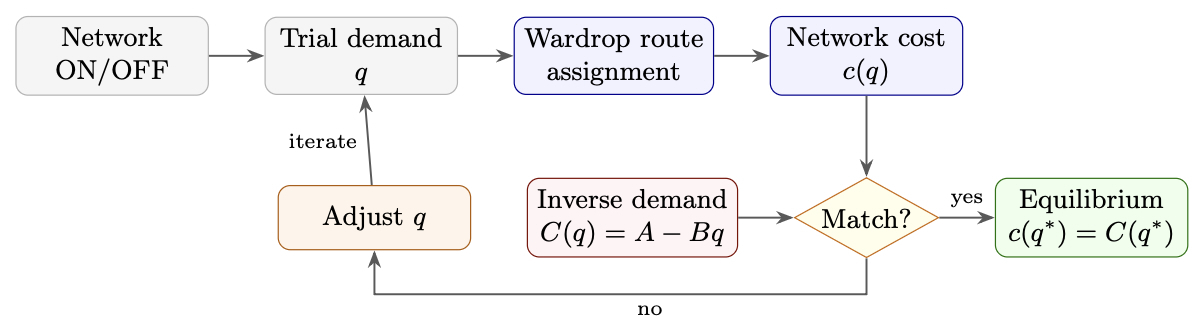
  • Figure 1. Elastic-demand feedback. The numerical method iterates over trial quantities, but the object being solved is the fixed point where user-equilibrium generalized cost equals willingness to pay
    Download
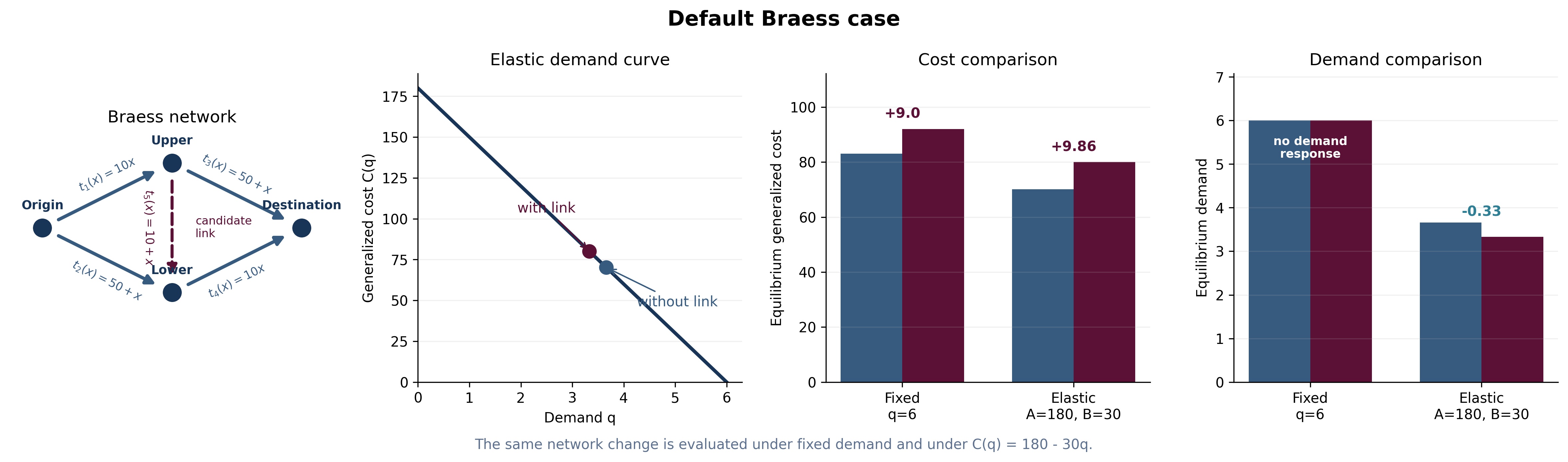
  • Figure 2. Default Braess comparison. The first panel shows the directed Braess network and link performance functions; the demand-curve panel places the OFF and ON elastic equilibria on \(C(q)\); the remaining panels compare cost and demand under fixed and elastic assumptions.
    Download
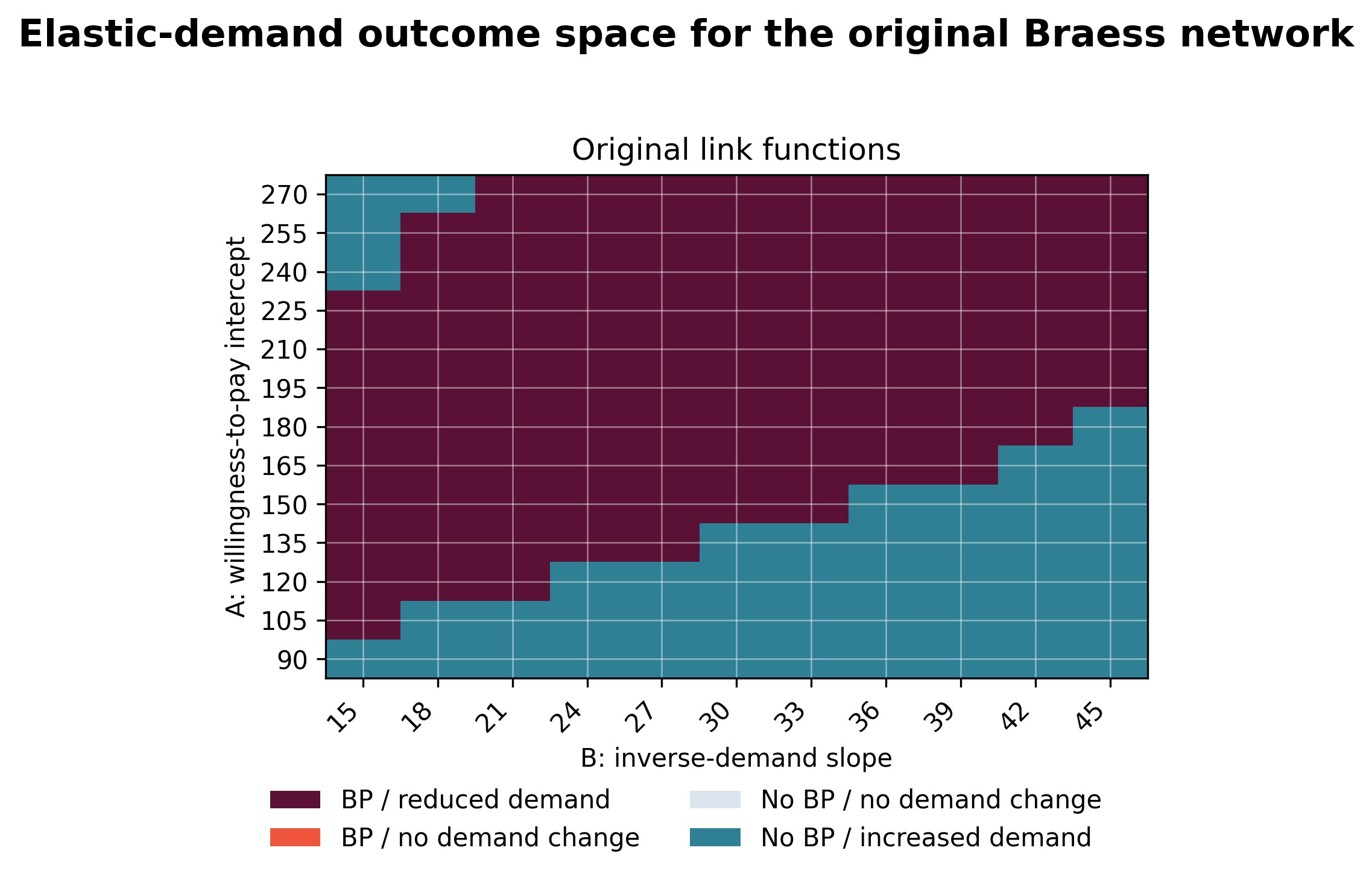
  • Figure 3. Elastic-demand outcome space over inverse-demand intercept \(A\) and inverse-demand slope \(B\), holding Braess’s original link functions fixed. The substantive object is the Braess region; reduced demand follows in that region under the strictly decreasing inverse-demand curve.
    Download

Error

Sorry, something went wrong. Please try again.

If this problem reoccurs, please contact Scholastica Support

Error message:

undefined

View more stats

Abstract

Induced demand is usually interpreted as additional capacity reducing generalized cost and producing more travel. When a network exhibits Braess’s paradox, an added link raises user-equilibrium cost, and we would thus expect demand to fall. I show this in Braess’s original four-node numerical network with linear link costs and inverse demand. In the default case, the added link raises elastic equilibrium cost from 70.14 to 80.00 and reduces demand from 3.66 to 3.33. The reported 143-point sweep maps the Braess region in inverse-demand space; no sign-inconsistent cells appear. The accompanying browser implementation reproduces the reported comparison and sweep.

1. Questions

Induced demand is commonly described as the response of travel to lower generalized cost. Lee, Klein, and Camus define induced traffic as movement along a travel-demand curve, where price includes travel time and other user costs (Lee et al. 1999). The same demand curve has a reverse implication: if generalized cost rises, equilibrium travel should fall. Empirical studies of capacity reduction describe related outcomes as reduced, suppressed, or disappearing traffic (Goodwin et al. 1998; Cairns et al. 2002; Behrens and Kane 2004; Zhu et al. 2010).

Braess paradox supplies one network mechanism for this reverse case. Under user equilibrium, adding a link can increase travelers’ costs rather than reduce them (Braess 1968; Braess et al. 2005; Murchland 1970; Yang and Bell 1998). Prior work gives tests for equilibrium cost changes under demand changes and added routes (Dafermos and Nagurney 1984), shows that the paradox can disappear at higher demand when the Braess link is no longer used (Nagurney 2010), and examines elastic-demand traffic paradoxes (Hallefjord et al. 1994; Tu et al. 2019; Nagurney and Nagurney 2020). Related network and demand paradoxes also appear in the Downs–Thomson/Pigou–Knight–Downs tradition and in empirical induced-demand and road-capacity literatures (Downs 1962; Thomson 1977; Pigou 1920; Knight 1924; Hansen and Huang 1997; Noland 2025).

This note connects those strands by making one sign implication explicit and by mapping where the Braess cost increase occurs in Braess’s original numerical network. The contribution is conceptual and classificatory, not a general network-design theorem. With a strictly decreasing inverse-demand curve, reduced demand follows once the added link raises equilibrium cost. The point of the sweep is therefore to map where that premise holds. I ask: where, in the original Braess network with downward-sloping inverse demand, does the added link raise equilibrium cost?

2. Methods

The model is Braess’s original directed four-node network with one origin-destination pair (Braess 1968; Braess et al. 2005). This numerical example is the case repeated in early discussions of the paradox (Murchland 1970; Frank 1981; Pas and Principio 1997). The topology is also a minimal critical topology used to analyze the magnitude of Braess penalties (Penchina 1997). Link 1 runs from Origin to Upper, link 3 from Upper to Destination, link 2 from Origin to Lower, and link 4 from Lower to Destination. Link 5 is the candidate Upper-to-Lower connector. The upper path is links 1–3, the lower path is links 2–4, and the added-link path is links 1–5–4. The link performance functions are:

\[\small t_1(x)=10x,\quad t_4(x)=10x,\quad t_2(x)=50+x,\quad t_3(x)=50+x,\quad t_5(x)=10+x,\] with fixed demand \(q=6\). The candidate link is solved both off and on.

For each scenario, the model enumerates all simple origin-destination paths and solves static Wardrop user equilibrium by Method of Successive Averages (Sheffi 1985). At each iteration, link costs are evaluated from current flows, all demand is assigned to the current shortest path, and path flows are averaged using the diminishing step size \(1/k\). This averaging is the convergence device: it damps path switching. The stopping tolerance is \(10^{-6}\) after at least five iterations, with a 120-iteration maximum. For the nonnegative affine and Bureau of Public Roads-style separable link costs used here, this is the standard monotone user-equilibrium setting.

Elastic demand uses inverse demand \[C(q)=A-Bq.\] The default elastic case sets \(A=180\) and \(B=30\), so the zero-cost demand intercept remains \(A/B=6\). Computationally, the model uses an outer bisection on \(q\); for each trial quantity, it solves Wardrop equilibrium and compares the resulting network cost with \(A-Bq\). Bisection is appropriate when \(c(q)-C(q)\) is monotone over the bracket, as it is for the downward-sloping inverse demand and monotone link costs used in the reported sweeps. Reported elastic costs are network costs \(c(q^*)\); they equal \(C(q^*)\) at the exact fixed point, apart from numerical tolerance and rounding. Conceptually, the elastic-demand solution is a fixed point where route flows and demand agree simultaneously: \(c(q^*)=C(q^*)\) (Fig. 1). Here \(c(q)\) is the network-side equilibrium cost relation, and \(C(q)\) is the demand-side willingness-to-pay relation.

Table 1.Nomenclature for the model equations and comparison tests.
Symbol Definition
\(A\) Zero-trip willingness-to-pay intercept in \(C(q)=A-Bq\).
\(B\) Inverse-demand slope; larger \(B\) means willingness to pay falls faster with \(q\).
\(C(q)\) Inverse-demand generalized cost, or willingness to pay, at quantity \(q\).
\(c(q)\) Wardrop equilibrium origin-destination cost after assigning quantity \(q\).
\(c_s(q_s^*)\) Elastic equilibrium network cost in scenario \(s\).
\(c_{\mathrm{on}}, c_{\mathrm{off}}\) Equilibrium costs with the candidate link on and off.
\(q\) Origin-destination demand in a fixed-demand or trial elastic-demand solve.
\(q^*\) Elastic-demand equilibrium quantity.
\(q_{\mathrm{on}}, q_{\mathrm{off}}\) Elastic equilibrium quantities with the candidate link on and off.
\(s\) Scenario index, either candidate link off or candidate link on.
\(t_i(x)\) Travel time on link \(i\) when its flow is \(x\).
\(x\) Flow on a link.
Figure 1
Figure 1.Elastic-demand feedback. The numerical method iterates over trial quantities, but the object being solved is the fixed point where user-equilibrium generalized cost equals willingness to pay

Proposition. For scenario \(s\in\{\mathrm{off},\mathrm{on}\}\), elastic equilibrium satisfies \(c_s(q_s^*)=C(q_s^*)\). If \(C\) is strictly decreasing and the added link raises elastic equilibrium cost, \(c_{\mathrm{on}}(q_{\mathrm{on}}^*)>c_{\mathrm{off}}(q_{\mathrm{off}}^*)\), then \(q_{\mathrm{on}}^*<q_{\mathrm{off}}^*\). Reduced demand is therefore the logical implication when Braess’s paradox raises equilibrium cost under this demand specification. Cells classified as “demand unchanged” are numerical-tolerance or unused-link boundary cases, not a separate behavioral outcome.

The interest is therefore not the sign of the demand response, which follows once equilibrium cost rises. The interest is where the added link raises equilibrium cost in the first place.

The Braess flag is \(c_{\mathrm{on}}-c_{\mathrm{off}}>10^{-5}\). The reported sweep varies \(A\in[90,270]\) and \(B\in[15,45]\) over 13 by 11 evenly spaced grid values, for 143 grid points, while holding Braess’s original link functions fixed. The numerical results were generated in the browser implementation described in the Data Availability section.

3. Findings

The fixed-demand default reproduces the original Braess paradox. Without the added link, equilibrium cost is 83.00. With the added link, equilibrium cost is 92.00, a 9.00-unit increase. Total travel time rises from 498.00 to 552.00.

The elastic-demand default converts the same network effect into reduced demand. With \(A=180\) and \(B=30\), the added link raises equilibrium cost from 70.14 to 80.00 and lowers equilibrium demand from 3.66 to 3.33 (Fig. 2). The result is the induced-demand comparative static with the network-cost sign reversed: the added link changes the network equilibrium cost relation, and demand adjusts until generalized cost equals willingness to pay.

Figure 2
Figure 2.Default Braess comparison. The first panel shows the directed Braess network and link performance functions; the demand-curve panel places the OFF and ON elastic equilibria on \(C(q)\); the remaining panels compare cost and demand under fixed and elastic assumptions.

The outcome-space sweep is descriptive rather than inferential: it locates the Braess region in the reported A-B grid. In that grid, the added link raises equilibrium cost in 97 of 143 cells (67.8%), and demand is lower in every one of those cells. Where the added link does not raise cost, demand increases in all 46 cells. The two sign-inconsistent cases under a downward-sloping inverse-demand curve, Braess with increased demand and no Braess with reduced demand, have zero grid points (Fig. 3).

Figure 3
Figure 3.Elastic-demand outcome space over inverse-demand intercept \(A\) and inverse-demand slope \(B\), holding Braess’s original link functions fixed. The substantive object is the Braess region; reduced demand follows in that region under the strictly decreasing inverse-demand curve.

The outcome map gives a compact diagnostic for interpreting added links under elastic demand. The “No BP / increased demand” class is the familiar induced-demand case: the added link does not worsen equilibrium cost and demand increases. The “BP / reduced demand” class is the reverse case: the added link worsens equilibrium cost through Braess paradox and demand falls. The same inverse-demand relation appears in both regions; the network determines whether the added link lowers equilibrium cost and induces demand or raises equilibrium cost and reduces demand.


Data Availability

The Braess Explorer app, model code, export scripts, CSV files, and figures are at https://github.com/dlevinson/braess-js. The app runs in the browser from https://transportlab.sydney.edu.au/wp-content/uploads/braess/documentation.html.

AI Acknowledgment

The author used OpenAI ChatGPT/Codex as an editorial and computational assistant during writing and revision, for figure styling, replication-package organization, and drafting support. The author reviewed, verified, and takes full responsibility for all analyses, interpretations, text, figures, and submitted materials.

Submitted: May 06, 2026 AEST

Accepted: June 03, 2026 AEST

References

Behrens, Roger B., and Lisa A. Kane. 2004. “Road Capacity Change and Its Impact on Traffic in Congested Networks: Evidence and Implications.” Development Southern Africa 21 (4): 587–602. https:/​/​doi.org/​10.1080/​0376835042000288806.
Google Scholar
Braess, Dietrich. 1968. “Über Ein Paradoxon Aus Der Verkehrsplanung.” Unternehmensforschung 12 (1): 258–68. https:/​/​doi.org/​10.1007/​BF01918335.
Google Scholar
Braess, Dietrich, Anna Nagurney, and Tina Wakolbinger. 2005. “On a Paradox of Traffic Planning.” Transportation Science 39 (4): 446–50. https:/​/​doi.org/​10.1287/​trsc.1050.0127.
Google Scholar
Cairns, Sally, Stephen Atkins, and Phil Goodwin. 2002. “Disappearing Traffic? The Story So Far.” Proceedings of the Institution of Civil Engineers – Municipal Engineer 151 (1): 13–22. https:/​/​doi.org/​10.1680/​muen.2002.151.1.13.
Google Scholar
Dafermos, Stella, and Anna Nagurney. 1984. “On Some Traffic Equilibrium Theory Paradoxes.” Transportation Research Part B: Methodological 18 (2): 101–10. https:/​/​doi.org/​10.1016/​0191-2615(84)90023-7.
Google Scholar
Downs, Anthony. 1962. “The Law of Peak-Hour Expressway Congestion.” Traffic Quarterly 16 (3): 393–409.
Google Scholar
Frank, Marguerite. 1981. “The Braess Paradox.” Mathematical Programming 20 (1): 283–302. https:/​/​doi.org/​10.1007/​BF01589354.
Google Scholar
Goodwin, Phil, Carmen Hass-Klau, and Sally Cairns. 1998. “Evidence on the Effects of Road Capacity Reduction on Traffic Levels.” Traffic Engineering & Control 39 (6): 348–54.
Google Scholar
Hallefjord, Åsa, Kurt Jörnsten, and Sverre Storøy. 1994. “Traffic Equilibrium Paradoxes When Travel Demand Is Elastic.” Asia-Pacific Journal of Operational Research 11 (1): 41–50.
Google Scholar
Hansen, Mark, and Yuanlin Huang. 1997. “Road Supply and Traffic in California Urban Areas.” Transportation Research Part A: Policy and Practice 31 (3): 205–18.
Google Scholar
Knight, Frank H. 1924. “Some Fallacies in the Interpretation of Social Cost.” The Quarterly Journal of Economics 38 (4): 582–606. https:/​/​doi.org/​10.2307/​1884592.
Google Scholar
Lee, Douglass B., Lisa A. Klein, and Gregorio Camus. 1999. “Induced Traffic and Induced Demand.” Transportation Research Record 1659 (1): 68–75. https:/​/​doi.org/​10.3141/​1659-09.
Google Scholar
Murchland, J. D. 1970. “Braess’s Paradox of Traffic Flow.” Transportation Research 4 (4): 391–94. https:/​/​doi.org/​10.1016/​0041-1647(70)90196-6.
Google Scholar
Nagurney, Anna. 2010. “The Negation of the Braess Paradox as Demand Increases: The Wisdom of Crowds in Transportation Networks.” EPL 91 (4): 48002. https:/​/​doi.org/​10.1209/​0295-5075/​91/​48002.
Google Scholar
Nagurney, Anna, and Ladimer S. Nagurney. 2020. “The Braess Paradox.” In International Encyclopedia of Transportation, edited by Roger Vickerman. Elsevier. https:/​/​supernet.isenberg.umass.edu/​articles/​braess-encyc.pdf.
Google Scholar
Noland, Robert B. 2025. “Measuring Induced Travel Elasticities Associated with Local Roads from Trip Generation.” Findings, June. https:/​/​doi.org/​10.32866/​001c.140725.
Google Scholar
Pas, Eric I., and Susan L. Principio. 1997. “Braess’ Paradox: Some New Insights.” Transportation Research Part B: Methodological 31 (3): 265–76. https:/​/​doi.org/​10.1016/​S0191-2615(96)00024-0.
Google Scholar
Penchina, Claude M. 1997. “Braess Paradox: Maximum Penalty in a Minimal Critical Network.” Transportation Research Part A: Policy and Practice 31 (5): 379–88. https:/​/​doi.org/​10.1016/​S0965-8564(96)00032-8.
Google Scholar
Pigou, A. C. 1920. The Economics of Welfare. Macmillan.
Google Scholar
Sheffi, Yosef. 1985. Urban Transportation Networks: Equilibrium Analysis with Mathematical Programming Methods. Prentice-Hall.
Google Scholar
Thomson, J. Michael. 1977. Great Cities and Their Traffic. Victor Gollancz.
Google Scholar
Tu, Qiang, Lin Cheng, Dawei Li, Jie Ma, and Chao Sun. 2019. “Traffic Paradox Under Different Equilibrium Conditions Considering Elastic Demand.” Promet – Traffic & Transportation 31 (1): 1–9. https:/​/​doi.org/​10.7307/​ptt.v31i1.2795.
Google Scholar
Yang, Hai, and Michael G. H. Bell. 1998. “A Capacity Paradox in Network Design and How to Avoid It.” Transportation Research Part A: Policy and Practice 32 (7): 539–45. https:/​/​doi.org/​10.1016/​S0965-8564(98)00017-2.
Google Scholar
Zhu, Shanjiang, David Levinson, Henry X. Liu, and Kathleen A. Harder. 2010. “The Traffic and Behavioral Effects of the I-35W Mississippi River Bridge Collapse.” Transportation Research Part A: Policy and Practice 44 (10): 771–84. https:/​/​doi.org/​10.1016/​j.tra.2010.07.001.
Google Scholar

Attachments

Powered by Scholastica, the modern academic journal management system