
1. Questions
The Twin Cities travel surveys have long been used to test whether daily travel time and commute time are stable, rising, or reorganised as the region changes. Earlier studies covered shorter slices of the record: Zahavi and Ryan (1980) examined 1958–1970 through travel time budgets, Levinson and Wu (2005) compared 1990–2000 under the Rational Locator frame (Levinson and Kumar 1994), and Levinson et al. (2015) extended the series to 1990–2010.
Those studies frame two related questions. Travel time budget arguments emphasise the relative stability of daily time spent travelling, while time-allocation perspectives ask how travel competes with work, home, and other activities inside a fixed twenty-four-hour day. The Rational Locator argument shifted the commute question away from a universal travel-time law and toward the joint geography of homes, jobs, and opportunities. Extending the Twin Cities record back to 1970 and forward to 2023 makes it possible to revisit these questions over a longer period, including the post-2019 work-at-home shift.
Recovering the 1970 Travel Behavior Inventory (TBI) and extending the series to 2023 makes two substantive questions visible. First, how did daily time allocation vary across home, travel, on-site work, work-related activity, and telework? Second, did peak commute times rise steadily, or did the apparent rise reverse after the work-at-home shock of 2019–2023? A third contribution is methodological: the Supplemental Information documents how the 1970 survey was recovered and how far the legacy benchmark tables can be reproduced. The recovery of 1970 is an archival contribution that allows it to serve as a peer data source to later household travel surveys.
2. Methods
The analysis builds a harmonised adult diary-day series from the Twin Cities Travel Behavior Inventory, combining recovered historical waves with the recurrent 2019–2023 surveys. All trend estimates use a fixed seven-county geography and adults ages 18–65. For 1970–2010, person-days are reconstructed from linked trips; for 2019–2023, the recurrent day files provide the complete-day denominator and linked trips provide the activity timing, which retains zero-trip complete days in the modern waves. Survey administration changed substantially across the record. The 1970 TBI was a household home-interview survey: sampled households were assigned a 24-hour travel day, interviewers collected trips for household members age 5 and older, and the completed forms were coded and keypunched for machine processing (Mid-Continent Surveys, Inc. 1970a, 1970b). The 1982–2010 waves remain household travel-diary/interview waves in the legacy TBI lineage. The 2019–2023 recurrent TBI used address-based mail recruitment supplemented by targeted outreach, with diaries collected through the rMove smartphone app, web diaries, or a call center; smartphone households could provide multi-day diaries, while web/call-center households generally provided one-day diaries (RSG, Inc. 2024). These methodological changes are one reason the Supplemental Information keeps denominator, weighting, and modern-wave sensitivity checks explicit.
Table 1 classifies each adult diary day into three groups: worked that day, employed but did not work that day, and not employed, and reports combined on-site work. “Worked that day” includes any observed out-of-home workplace stay, out-of-home work-related stay, or separately observed telework/work-at-home on the diary day. Panels B and C should be read as diary-day status groups rather than as a causal decomposition of employment status. The available harmonized fields do not consistently separate full-time from part-time work, nor do they identify all reasons for non-employment, such as homemaking, schooling, unemployment, or early retirement, across every wave. The lower 1982 travel values for the nonworking panels should also be read cautiously because 1982 does not preserve a separate shopping bucket. The table therefore shows the descriptive diary-day allocation, while the interpretation is kept at the level supported by all waves.
Table 3 shows that the 2019 worked-that-day workplace level still reflects a modern purpose-classification shift, not only a behavioral break.
Peak-travel estimates in Table 2 are worker-only trip means for direct home-to-work and work-to-home commute trips by mode. To standardize the directional comparison as much as possible, all years use the same fixed departure windows: 06:00–08:59 for the AM home-to-work direction and 15:00–18:29 for the PM work-to-home direction. Transit combines bus, light rail, and commuter rail where present. The table reports mean minutes and unweighted trip counts in separate columns. Published benchmarks are reported where available. Very sparse directional cells are suppressed in the main-text table.
The Supplemental Information documents the archival recovery, validation checks, and remaining wave-specific compromises in full.
3. Findings
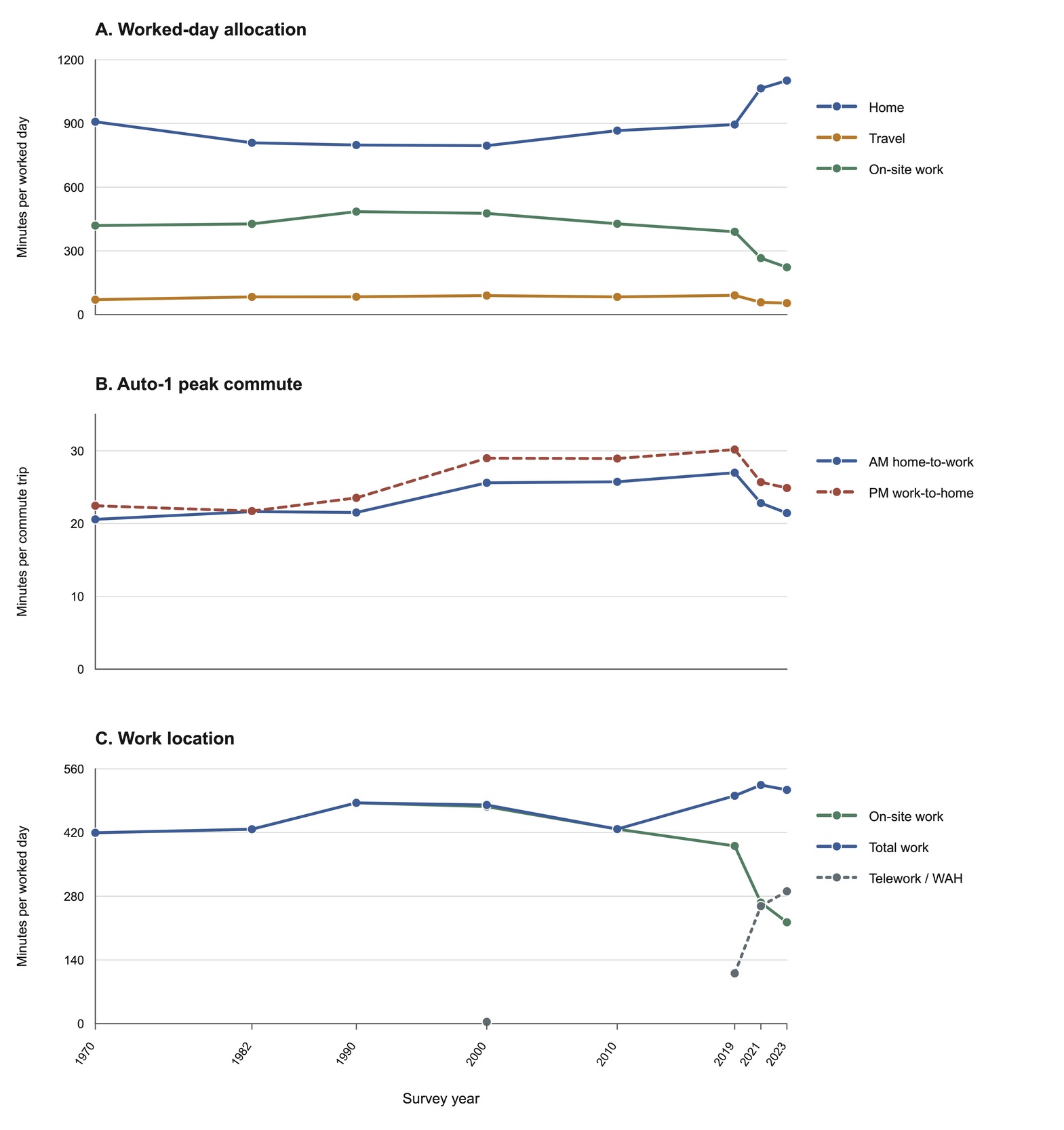
In Table 1 Panel A, time at home rises from 908.2 minutes in 1970 to 1102.7 in 2023, an increase of 194.5 minutes per day. Over the same period, travel falls from 70.5 to 54.4 minutes, while combined on-site work falls from 419.6 to 222.7 minutes, a decline of 196.9 minutes. Relative to 2019, worked-that-day home time rises by 207.3 minutes by 2023, travel falls by 36.3 minutes, and on-site work falls by 167.7 minutes.
Panels B and C show employed adults who did not work on the diary day are distinct. In 2019, travel averages 58.5 minutes for employed adults who did not work that day and 48.3 minutes for adults who were not employed.
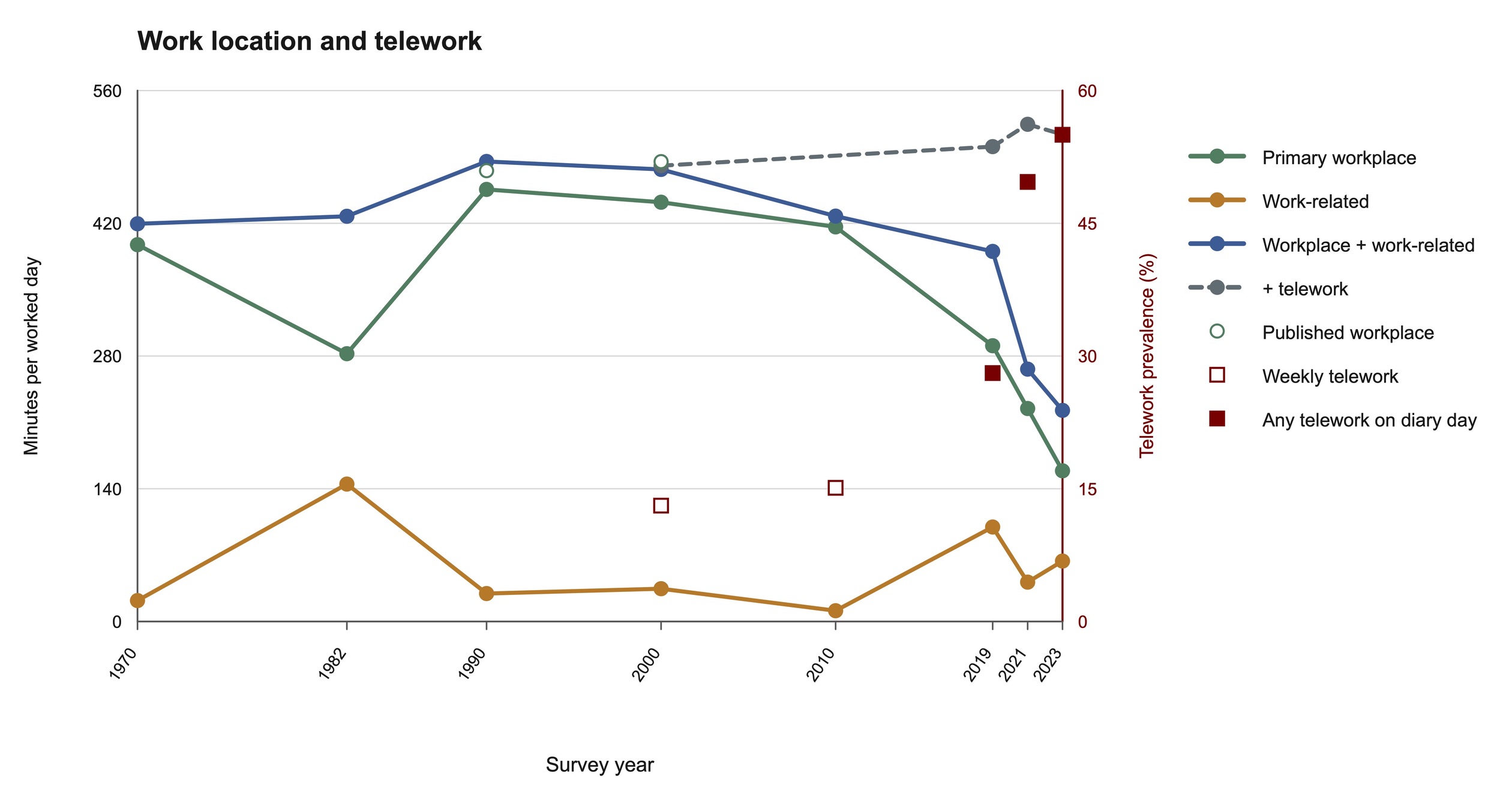
The 2019 worked-that-day workplace level still reflects a modern purpose-classification shift, not only a behavioral break. In the harmonized worked-that-day comparison, workplace minutes fall from 416.2 in 2010 to 290.8 in 2019, but work-related minutes rise from 11.4 to 99.6. The modern public files explicitly separate primary workplace from work-related destinations such as meetings, deliveries, and worksites, so part of the apparent 2010-to-2019 drop reflects category reallocation within work activity rather than a clean apples-to-apples fall in time at work. The combined on-site measure therefore falls from 427.6 in 2010 to 390.4 in 2019, which is materially smaller than the workplace line alone suggests.
It should be noted that even though the 7-county geography is retained for analysis, typical workers in 2023 lived much farther from the Minneapolis or St. Paul central business districts than their 1970 counterpart as the metro area increased population from about 1.7M to 3.0M for this geography over the period, and outer counties suburbanized, and many more commuters live outside these 7 counties.
The longer record still does not support a clean monotonic-rise story for commute travel times, and the directional split makes that clearer. Table 2 reports worker-only trip means for direct AM home-to-work and PM work-to-home commute trips by mode under one common AM/PM window for every year, with sample sizes shown. For drive-alone travelers (Auto 1), the AM series rises from 20.6 minutes in 1970 to 25.6 in 2000, rises again to 27.0 in 2019, and then falls back to 21.4 in 2023 as congestion dissipates with the rise in work-at-home, and more scheduling flexibility in general. The PM Auto 1 return-commute series is even clearer, moving from 22.4 in 1970 to 29.0 in 2000, staying near 28.9 in 2010, rising to 30.2 in 2019, and then falling to 24.9 in 2023. Carpool with one passenger (Auto 2) shows the same broad pattern.
The post-2019 (i.e. post-COVID) decline is consistent with lower peak congestion, more schedule flexibility, and the removal of some commute trips through work-at-home, but this table cannot observe the counterfactual commute lengths of workers who stayed home.
The post-2019 phase shift is easier to interpret by disaggregating primary workplace, work-related, and telework. Figure 2 and Table 3 show that workplace minutes fall from 416.2 in 2010 to 290.8 in 2019, but work-related minutes rise from 11.4 to 99.6 over the same interval. The 2019 break is therefore not only behavioral; it also reflects a reallocation within the modern purpose taxonomy. The combined on-site measure of workplace plus work-related falls from 427.6 in 2010 to 390.4 in 2019, which is a much smaller drop than the workplace line alone suggests.
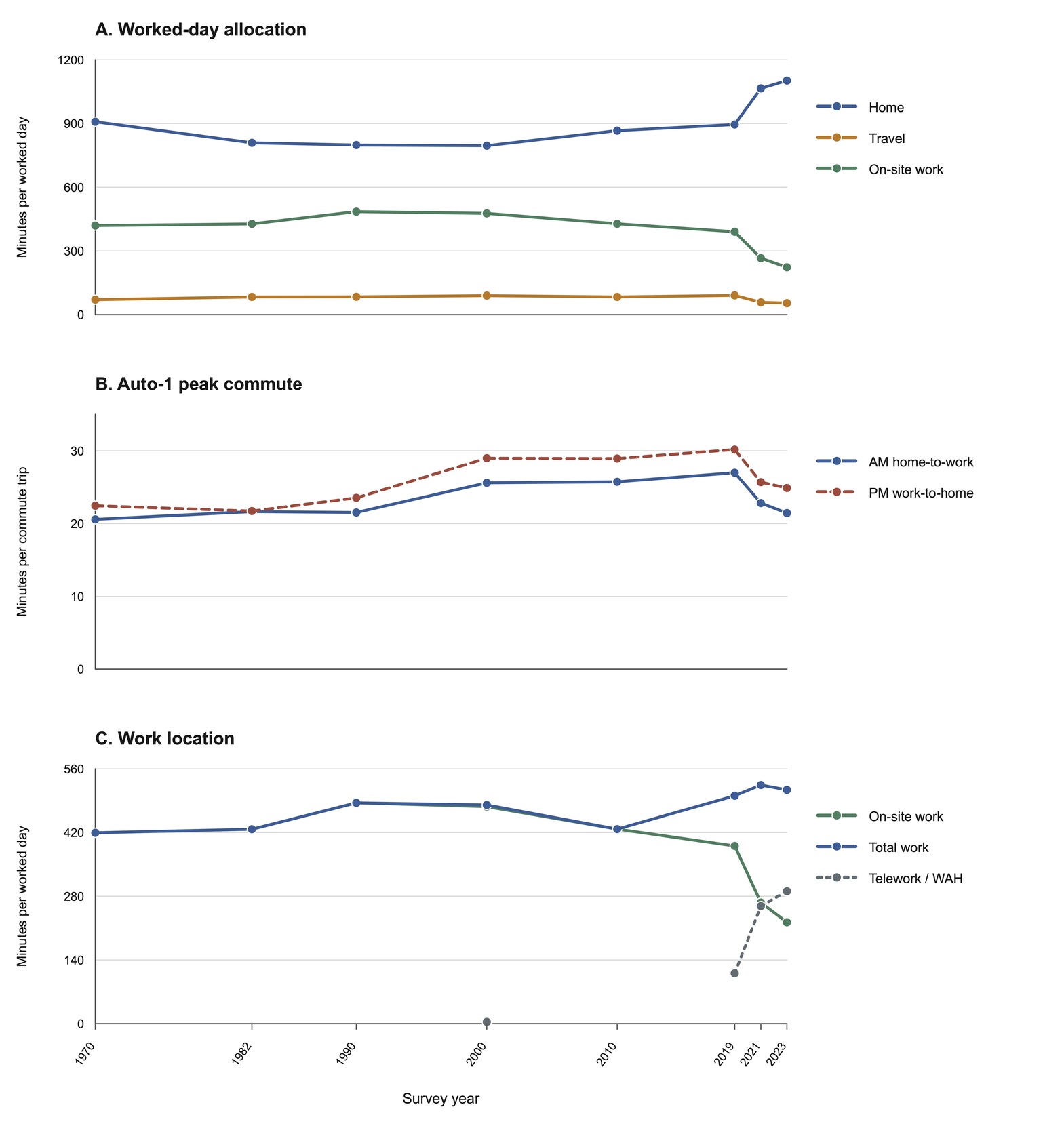
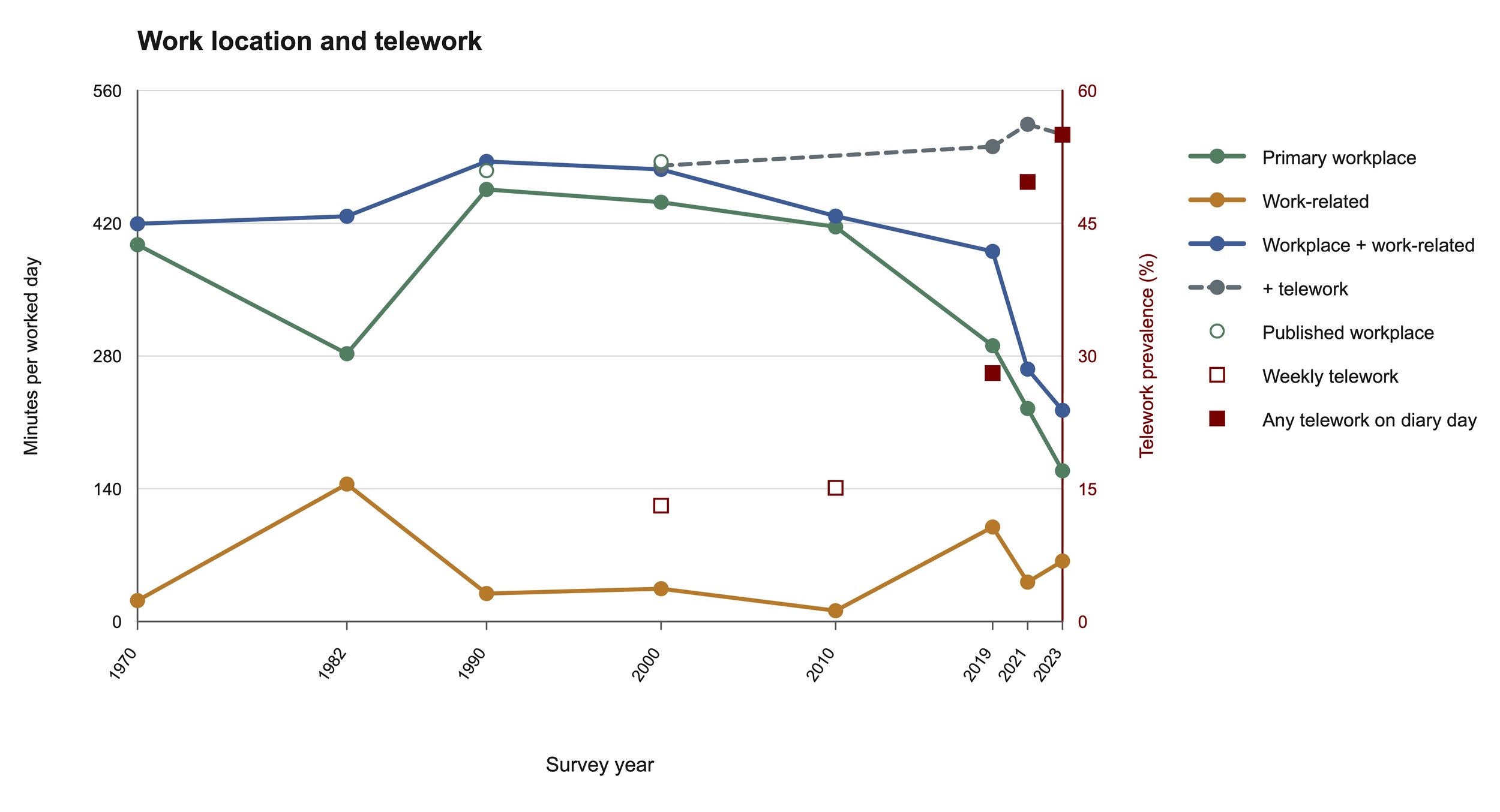
When telework is added back in, 2019 no longer looks low relative to the earlier benchmark years. Telework averages 110.5 minutes in 2019, so the telework-aware total reaches 500.9 minutes, above the 2000 value of 480.7 and well above the Global Financial Crisis-affected 2010 on-site total of 427.6. By 2021 and 2023, total work reaches 524.4 and 513.7 minutes respectively.
Published telecommuting frequencies point in the same direction before the recurrent waves. In one-worker households, telecommuters working from home at least once per week rise from 13.1% in 2000 to 15.1% in 2010 (Levinson et al. 2015). The recurrent TBI then shows employed-adult diary-day telework shares of 28.1% in 2019, 49.7% in 2021, and 55.0% in 2023. The main modern change is therefore where work happens. Travel-derived workplace presence falls sharply, but much of that decline reflects substitution toward telework rather than less total work. That interpretation is also consistent with the recurrent TBI public report, which separately tracks telework, teleconferencing, and no-travel work-at-home behavior (RSG, Inc. 2024).
Data Availability
The archival recovery steps, reconstructed series, benchmark comparisons, and wave-specific caveats are documented in the Supplemental Information. Data and code supporting the paper are available in the public GitHub repository at: https://github.com/dlevinson/TBOT (https://dx.doi.org/10.5281/zenodo.19842361).
AI Acknowledgment
The author used OpenAI ChatGPT/Codex as an editorial and computational assistant during writing and revision, for figure styling, replication-package organization, and drafting support. The author reviewed, verified, and takes full responsibility for all analyses, interpretations, text, figures, and submitted materials. The 1970 data recovery also made extensive use of ChatGPT as described in the Supplemental Information.