
1. QUESTIONS
This paper explores how social media can be used to analyse public perceptions of e-scooters. Facebook and Instagram, in particular, are widely used to share real-time feedback about micromobility.
The e-scooter policy in Almaty has evolved from minimal oversight to strict regulation. In September 2025, President Kassym-Jomart Tokayev addressed the issue directly. He noted that despite 2023 regulations, which introduced a 6 km/h sidewalk speed limit and licensing for road use, the situation in public places has not changed much and citizens remain at risk. Persistent safety concerns, evidenced by 386 accidents in Almaty in 2025 alone, led to a radical legislative shift. Starting July 1, 2026, Kazakhstan will implement a total ban on e-scooters on sidewalks. Under these new rules, riding will be permitted only on cycle paths and lanes. If such infrastructure is unavailable, users may ride in a single row along the right edge of the carriageway or on the roadside.
Research on micromobility perceptions mainly focuses on safety issues and regulatory conflicts, with limited attention to how public meanings and evaluations are formed (Badia and Jenelius 2023; Wallgren et al. 2023). Social media studies often capture immediate reactions but are usually tied to specific policy events, such as local bans (Aman and Smith-Colin 2021). Long-term and discourse-level analyses remain rare, as do studies that systematically connect themes with sentiment (An et al. 2023; Jafarzadehfadaki and Sisiopiku 2024). In addition, existing evidence is concentrated in Western cities, leaving other urban contexts underrepresented (An et al. 2023).
I explored a set of Facebook and Instagram posts from Almaty, Kazakhstan, which provides a new empirical context for addressing three research questions:
-
What themes dominate public discussions of e-scooters in Almaty?
-
How are these themes associated with policy-relevant frames?
-
How does sentiment vary across themes?
2. METHODS
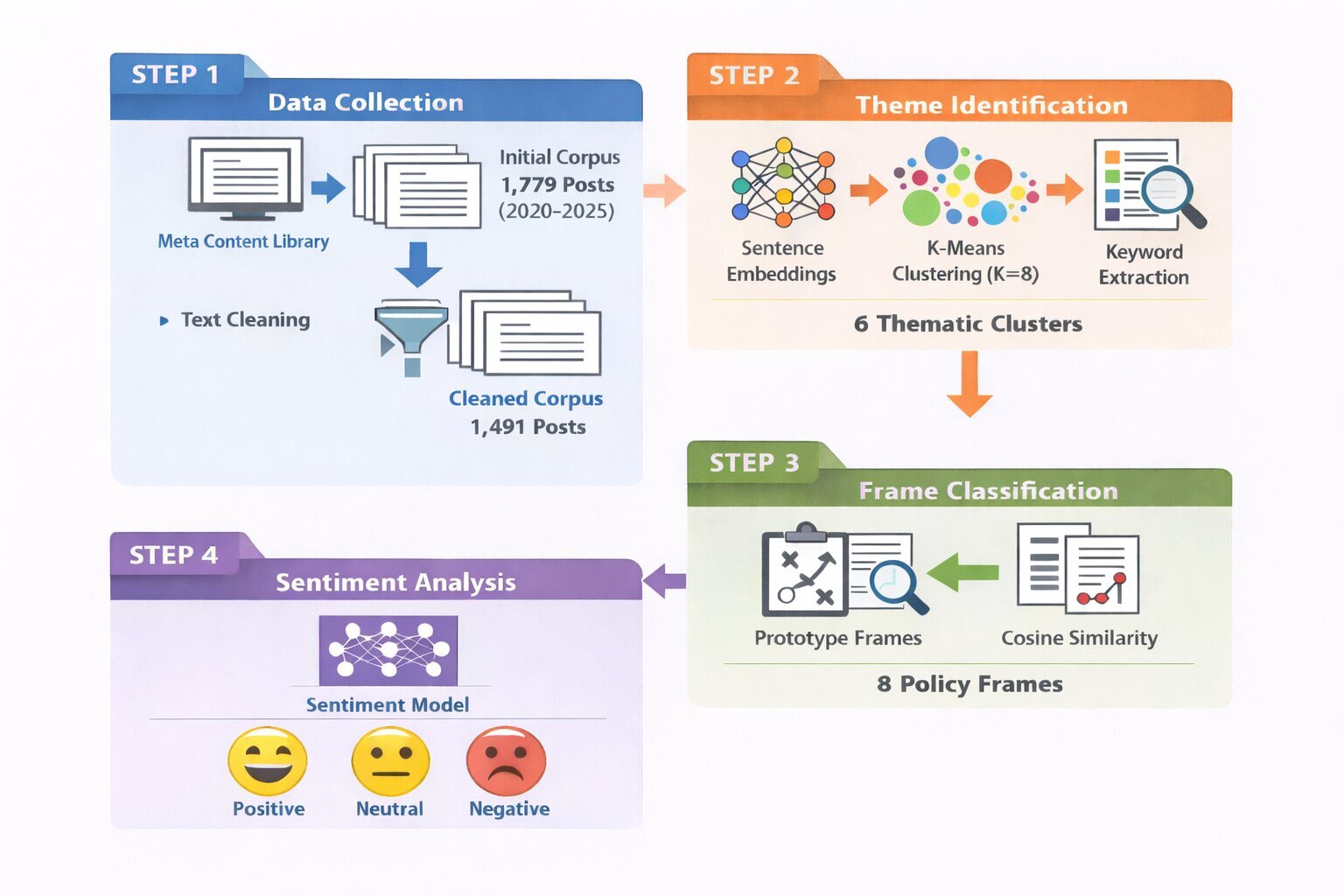
Figure 1 presents the methodology used to create the study dataset, a collection of posts describing e-scooter discussions. I extracted from the Meta Content Library 1,779 posts from 2020 to 2025 that contained keywords related to e-scooters in Almaty.
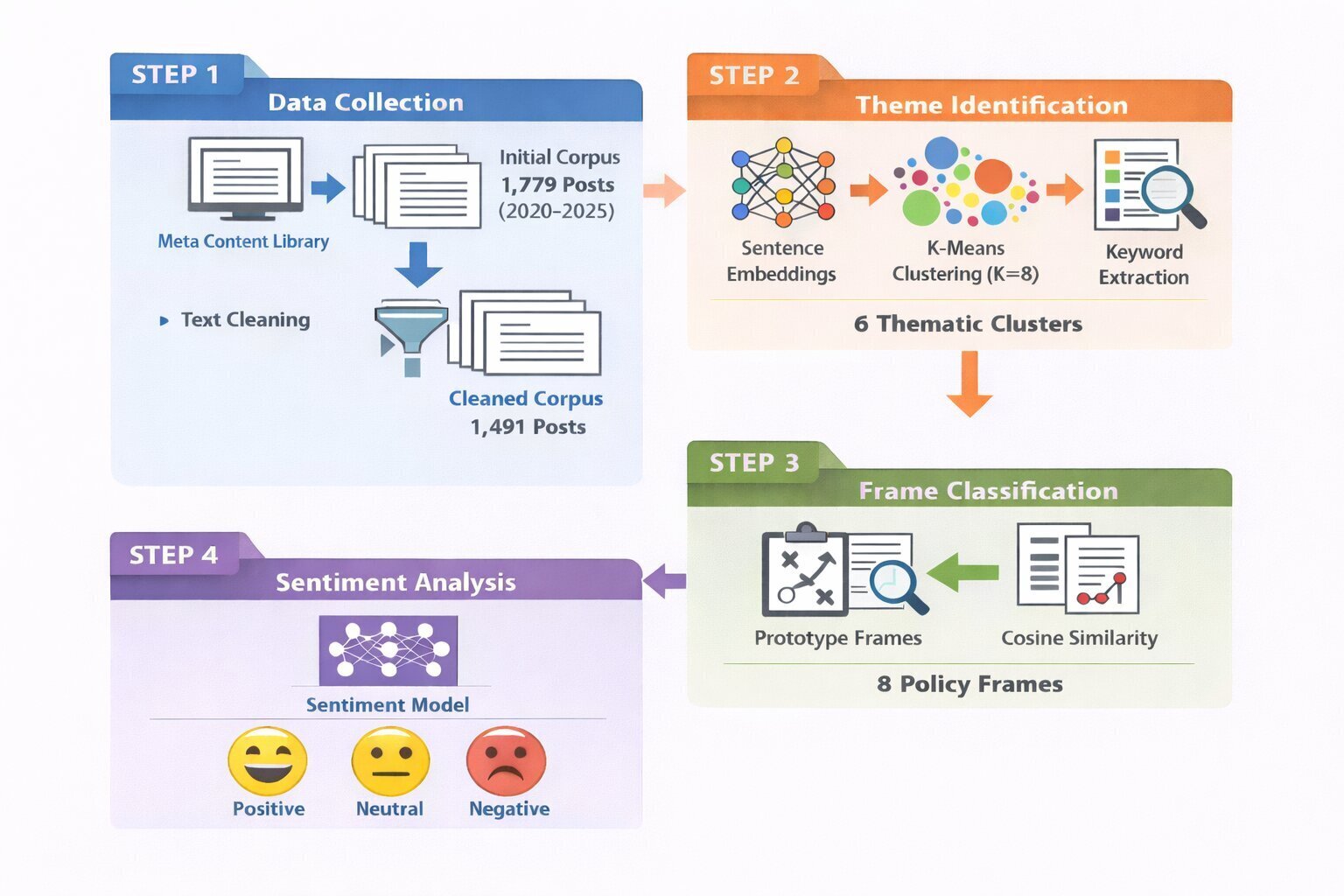
Data preprocessing included reducing commercial content, exclusion operators filtered posts containing terms associated with pricing, discounts, and retail activity.
Shared rental services (Yandex Go, Jet, Whoosh, Bolt etc.), operate in Almaty alongside privately owned e-scooters. However, the corpus does not permit a systematic distinction between the two. Keyword analysis shows that only around 20% of posts explicitly reference rental services, around 2% explicitly reference private ownership, and the remaining 79% are ambiguous. Most public discourse treats e-scooters as a category rather than distinguishing by ownership model, which itself reflects how the debate is framed in Almaty.
With the final data set of 1,491 posts, I conducted sentiment analysis and thematic classification. Raw post content cannot be redistributed due to platform policies, but remains accessible through the Meta Content Library following approval. Further details, including specific filtering steps and exclusion counts, are available in the Supplementary Materials.
3. FINDINGS
Theme Distribution
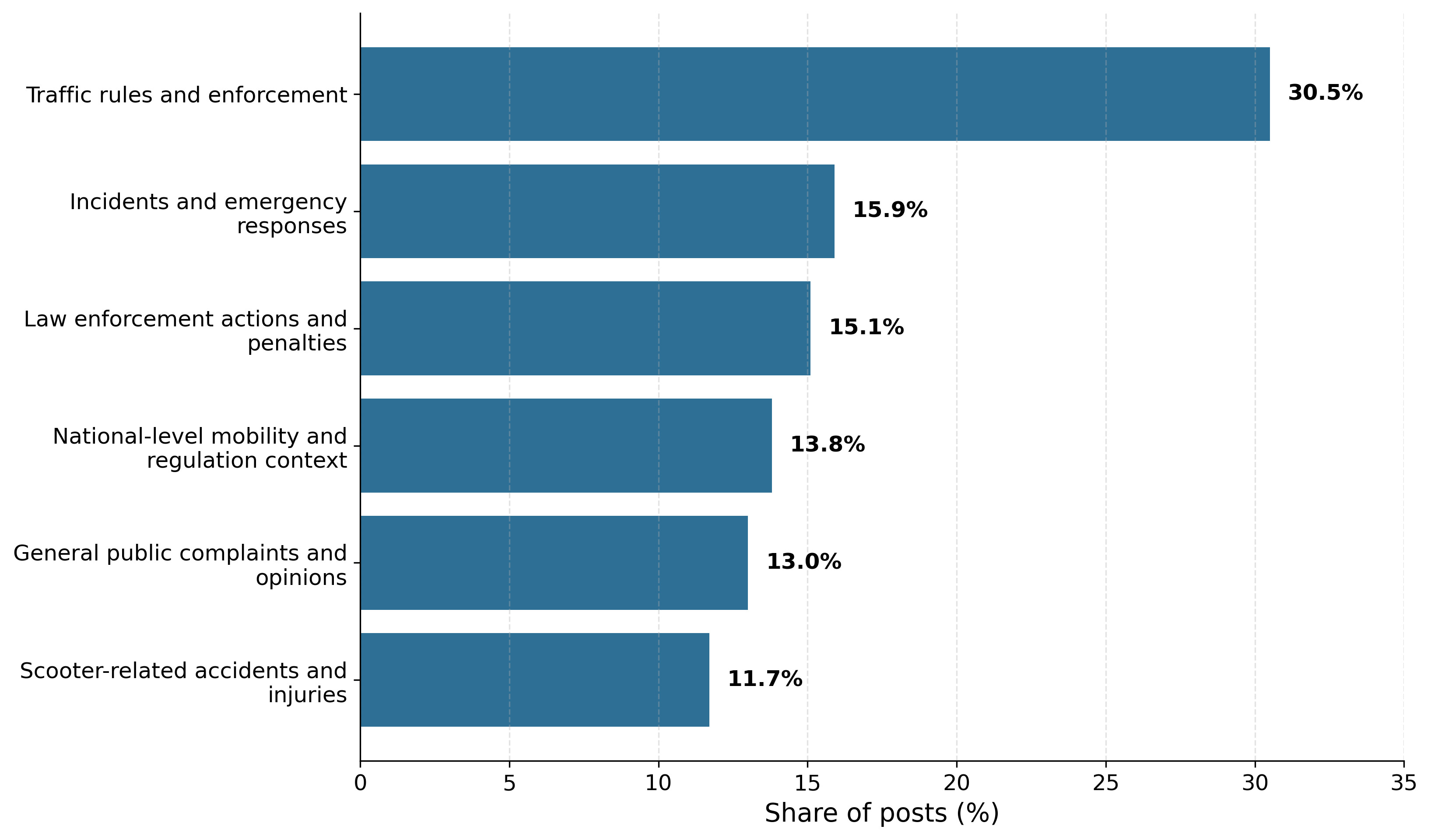
The thematic distribution identifies six main topics in public discussions of e-scooters. Traffic Rules and Enforcement forms the largest group of posts and dominates the overall structure of the discourse, placing regulatory compliance and control at the centre of public attention.
A second cluster of themes relates to safety and institutional response. Discussions of Incidents and Emergency Responses and Law Enforcement Actions and Penalties appear with similar frequency and reflect ongoing concern with risk management and formal intervention.
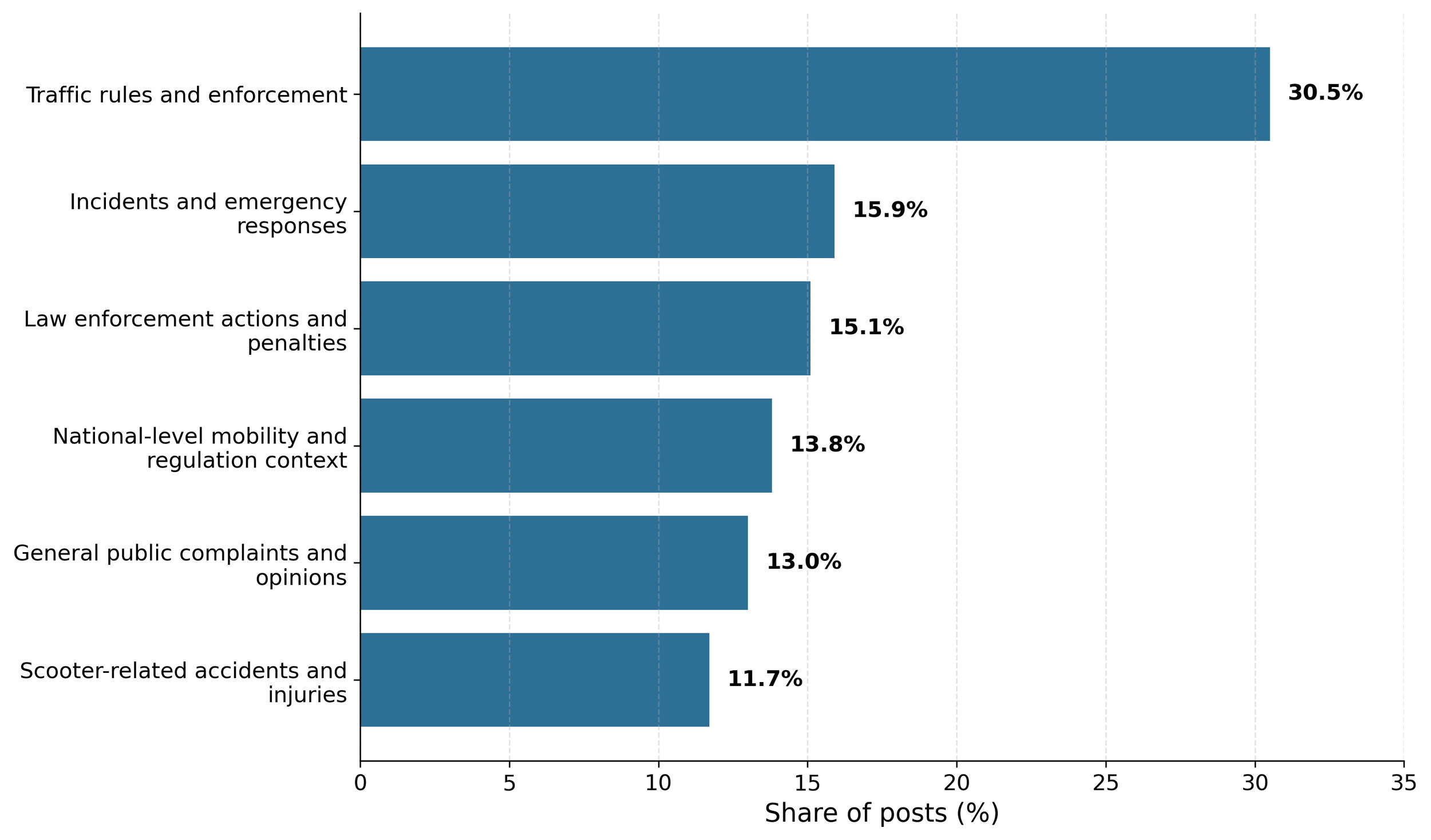
Posts addressing the National-Level Mobility and Regulatory Context focus on broader policy debates that extend beyond local events. General Public Complaints and Opinions capture everyday reactions and personal evaluations, highlighting how e-scooter use is experienced in daily urban life.
The least frequent theme concerns Scooter-Related Accidents and Injuries. Despite its smaller share, this topic remains closely connected to discussions of physical safety and vulnerability in shared urban spaces.
Although “Incidents and emergency responses” and “Scooter-related accidents and injuries” themes concern harmful events, they differ in focus and framing. The “Incidents and emergency responses” category captures posts centered on the institutional reaction to events, including emergency service involvement, official statements, and immediate public order concerns. These posts typically describe situations where scooters were part of a broader urban disruption. In contrast, “Scooter-related accidents and injuries” refers to posts focused specifically on physical harm to individuals, such as collisions, falls, or injuries described in concrete terms. This distinction is supported by the framing data (Table 1). The accidents theme is strongly associated with the Pedestrian-scooter conflict frame at 58.6%, while the incidents theme is dominated by the Urban order frame at 40.5%, reflecting the different analytical emphases of each cluster.
Themes and Frames
Table 1 shows differences in how pre-determined frames are used across themes. Each theme is associated with a distinct framing profile rather than a shared or uniform structure. Posts classified as general public complaints focus largely on accessibility and environmental issues.
The eight frame prototypes were developed through a two-step process. First, a set of policy-relevant frames was drawn from the recurring themes identified in prior work (e.g., Badia and Jenelius 2023; Wallgren et al. 2023), including themes from the broader urban transport and micromobility policy literature. Second, each frame was operationalised as a short keyword string serving as its semantic anchor — for example, “accidents injuries crashes dangerous road safety scooter” for Road Safety, or “sidewalk pedestrians collision near miss stroller child elderly scooter” for Pedestrian–Scooter Conflict. Each post embedding was then compared to the embedding of these keyword strings using cosine similarity, and assigned to the closest frame.
Content related to incidents and emergency responses concentrates on urban order and traffic regulation. Attention is directed to disruption in public space and immediate control, with limited reference to service quality or long-term governance.
The theme of law enforcement actions combines several frames within the same discussion. Accessibility, environmental concerns, conflict, and urban order appear together, placing enforcement debates at the intersection of different policy perspectives.
Posts addressing the national mobility and regulatory context rely on a broader mix of frames. Alongside accessibility and environmental aspects, governance-related frames and references to public transport integration are more visible here than in other themes.
Discussions of accidents and injuries remain tightly focused on pedestrian–scooter conflict and road safety. These posts concentrate on physical risk and vulnerability, while broader policy considerations remain marginal.
Finally, traffic rules and enforcement posts follow a procedural logic. The discussion centres on rules, compliance, and the organisation of urban space, with limited attention to social or environmental dimensions.
Sentiment Patterns
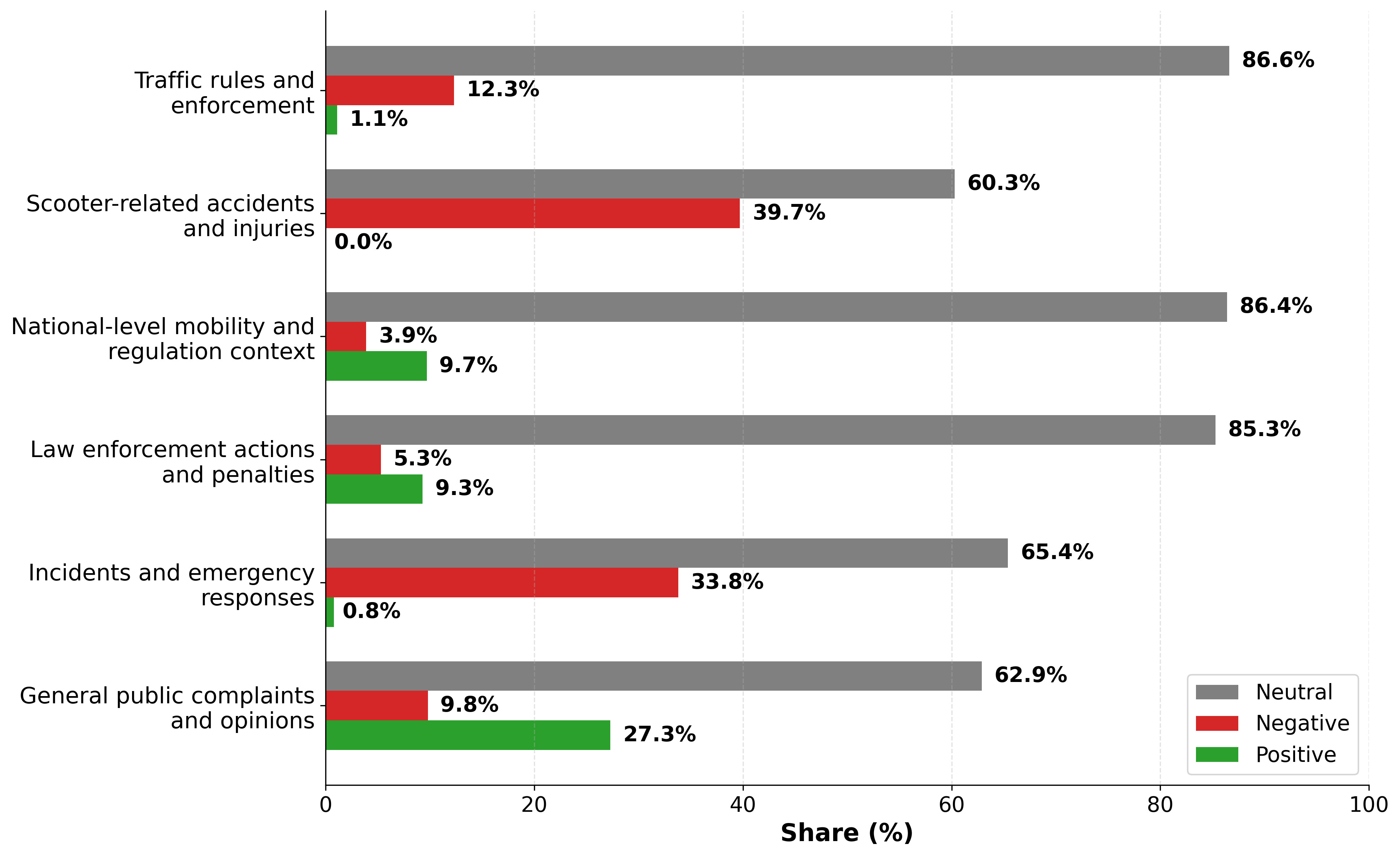
Sentiment across the dataset is predominantly neutral (76.9%), followed by negative (16.4%) and positive (6.8%) evaluations. At the same time, sentiment differs noticeably between themes (Figure 3), suggesting a close link between topic and emotional tone.
The highest levels of negative sentiment are found in posts related to scooter-related accidents and injuries (39.7%) and incidents and emergencies (33.8%). These discussions deal directly with issues of physical safety, which helps explain their more emotionally charged and critical tone.
By contrast, posts on traffic rules and enforcement are largely neutral. They tend to describe regulations and procedures in an informational manner, with limited reference to personal experience. Notably, general public complaints and opinions show the highest share of positive sentiment (27.3%), a finding that contrasts with the largely negative views of micromobility reported in many survey-based studies.
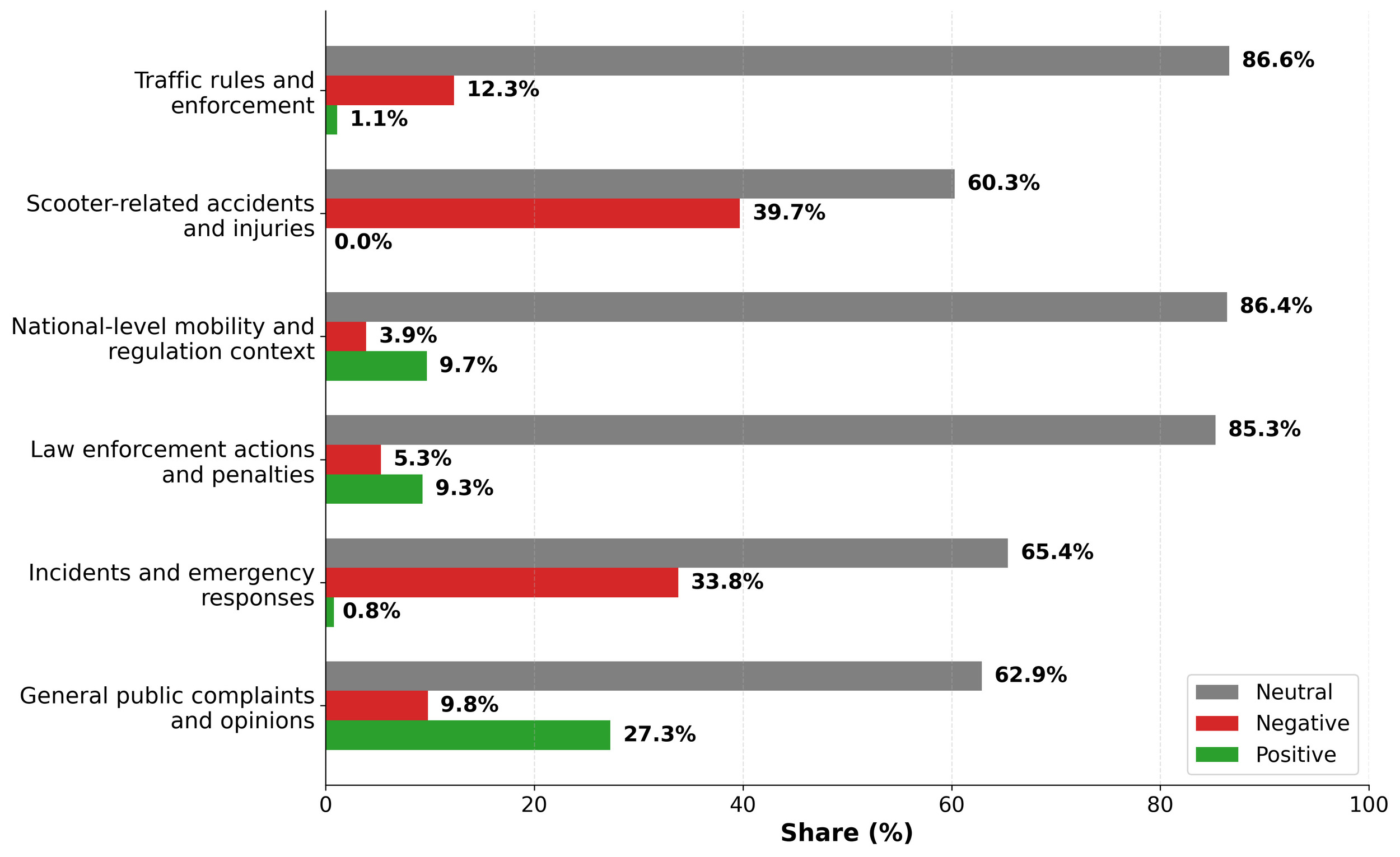
The predominance of neutral sentiment reflects the thematic structure of the corpus. The largest cluster, Traffic Rules and Enforcement, consists largely of procedural and rule-describing content that generates a neutral tone regardless of source. This is reinforced by the presence of news media and institutional accounts, which account for approximately 25% of posts. These sources produce descriptive content such as enforcement statistics, event reports, and official announcements, which a sentiment classifier naturally categorises as neutral.
Across themes, negative sentiment is concentrated in discussions involving physical risk and conflict, whereas regulatory and enforcement-related posts tend to adopt a neutral, administrative tone. This asymmetry suggests that emotional responses are driven primarily by safety-related experiences rather than by the existence of formal rules or regulations.
ACKNOWLEDGMENTS
Publicly available data were accessed through the Meta Content Library.