This website uses cookies

We use cookies to enhance your experience and support COUNTER Metrics for transparent reporting of readership statistics. Cookie data is not sold to third parties or used for marketing purposes.

Skip to main content
null
Findings
  • Menu
  • Articles
    • Energy Findings
    • Resilience Findings
    • Safety Findings
    • Transport Findings
    • Urban Findings
    • All
  • For Authors
  • Editorial Board
  • About
  • Blog
  • search
  • X (formerly Twitter) (opens in a new tab)
  • LinkedIn (opens in a new tab)
  • RSS feed (opens a modal with a link to feed)

RSS Feed

Enter the URL below into your favorite RSS reader.

https://findingspress.org/feed
ISSN 2652-8800
Transport Findings
April 21, 2026 AEST

Understanding Public Preferences for Urban Transportation: Evidence from Montréal

Ella Osdoba, B.A., Jérôme Laviolette, Ph.D., Lexi Kinman, Master's Candidate, Kevin Manaugh, Ph.D., E. Owen Waygood, Ph.D.,
active transportationsustainable transportationtransportation planningurban mobility
Copyright Logoccby-sa-4.0 • https://doi.org/10.32866/001c.160007
Findings
Osdoba, Ella, Jérôme Laviolette, Lexi Kinman, Kevin Manaugh, and E. Owen Waygood. 2026. “Understanding Public Preferences for Urban Transportation: Evidence from Montréal.” Findings, April 20. https://doi.org/10.32866/001c.160007.
Download all (7)
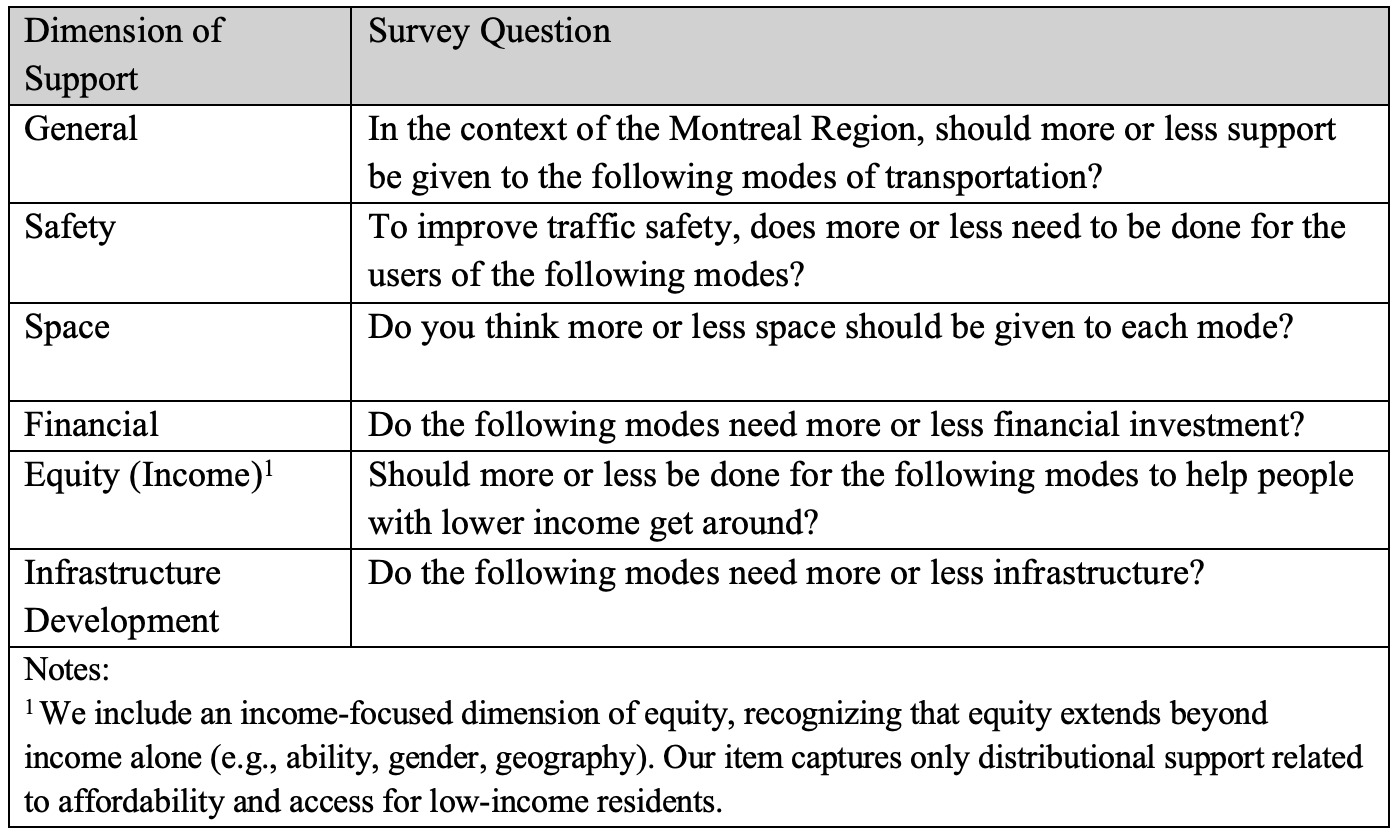
  • Table 1. Survey questions for each dimension of support.
    Download
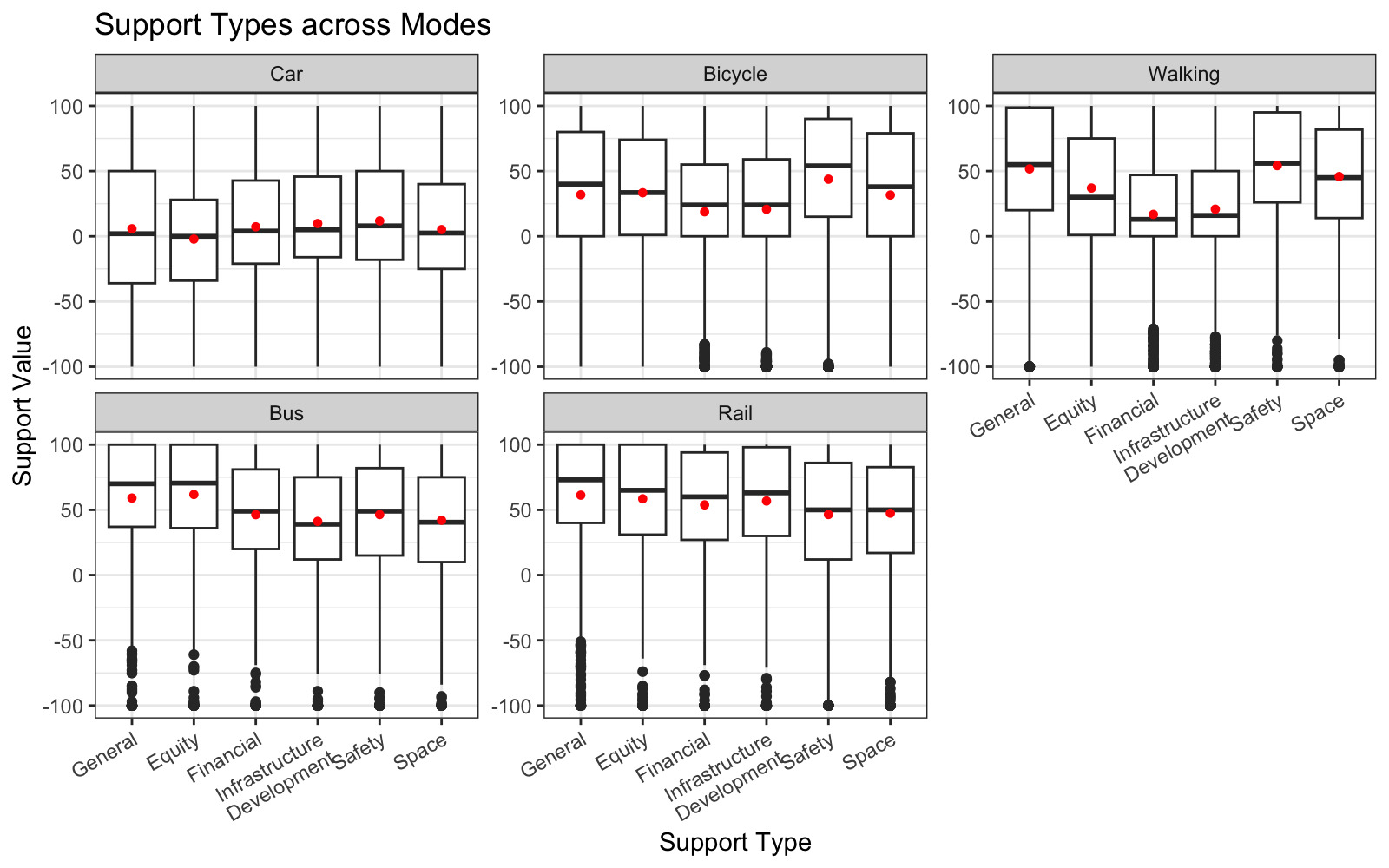
  • Figure 1. Box plots of each support type for each mode with a point showing mean values.
    Download
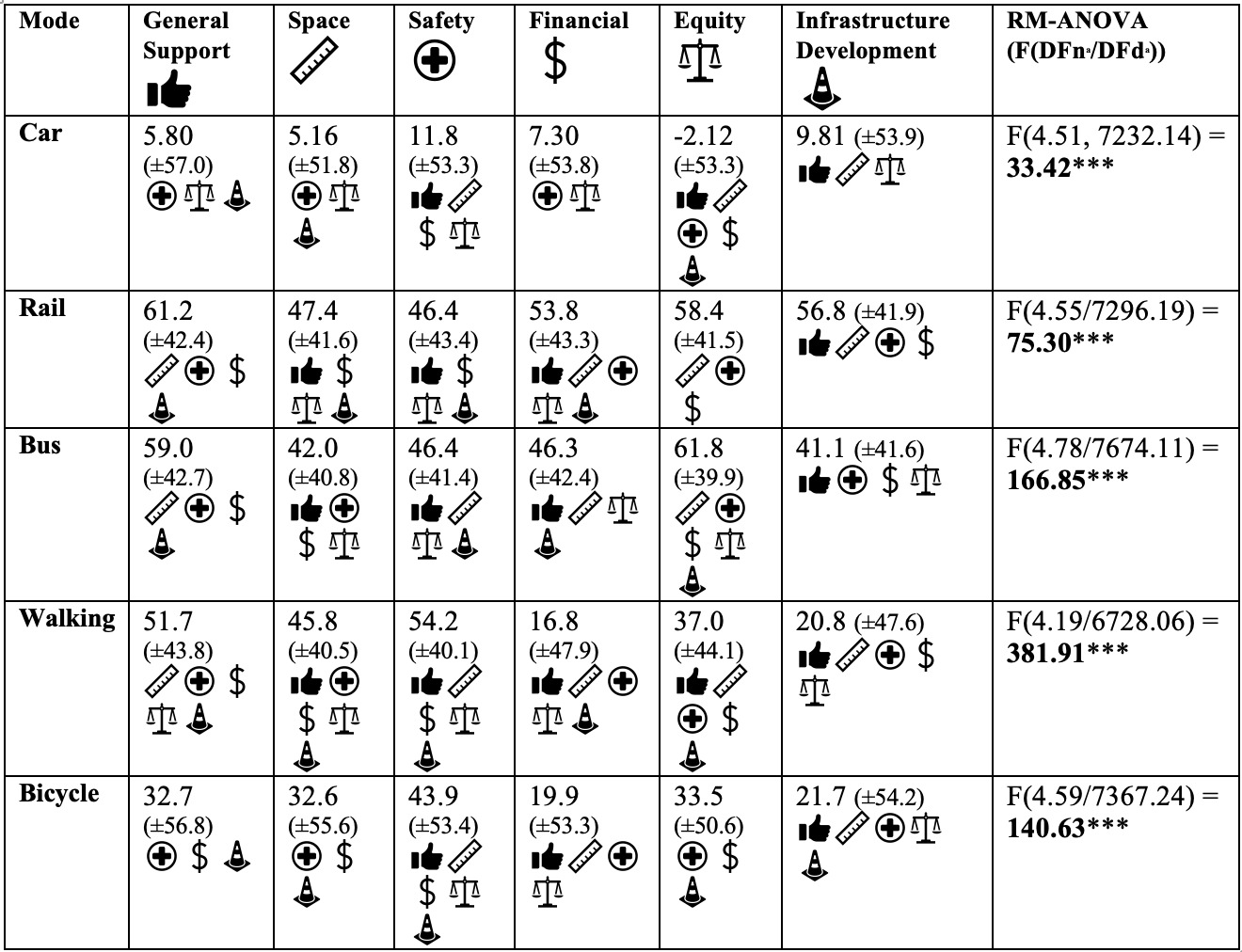
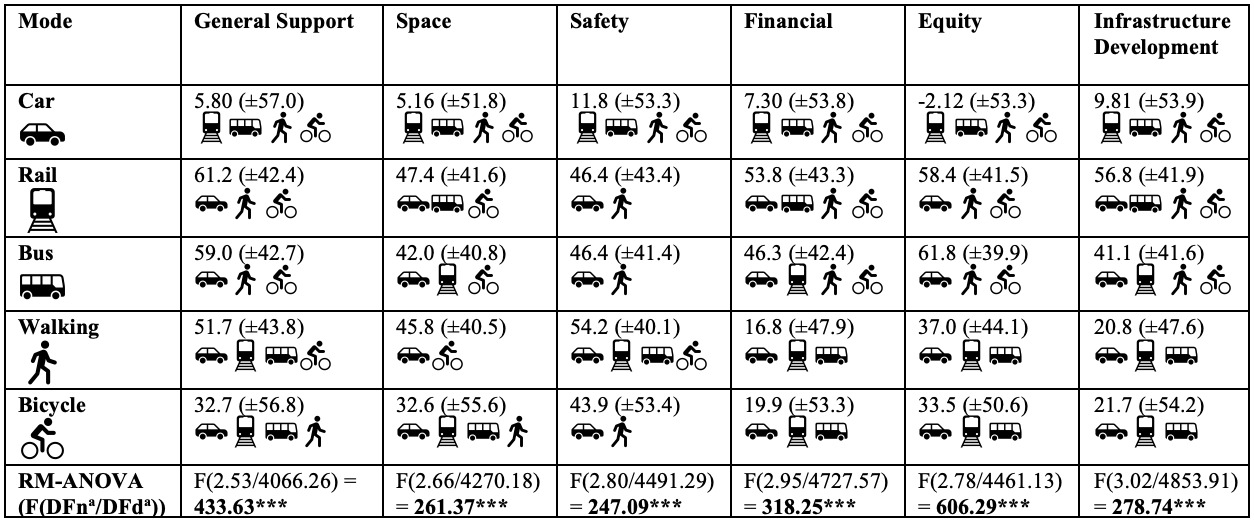
  • Table 2. Mean support ratings for each mode (± standard deviation). RM-ANOVA column showing output of support type variance per mode.
    Download
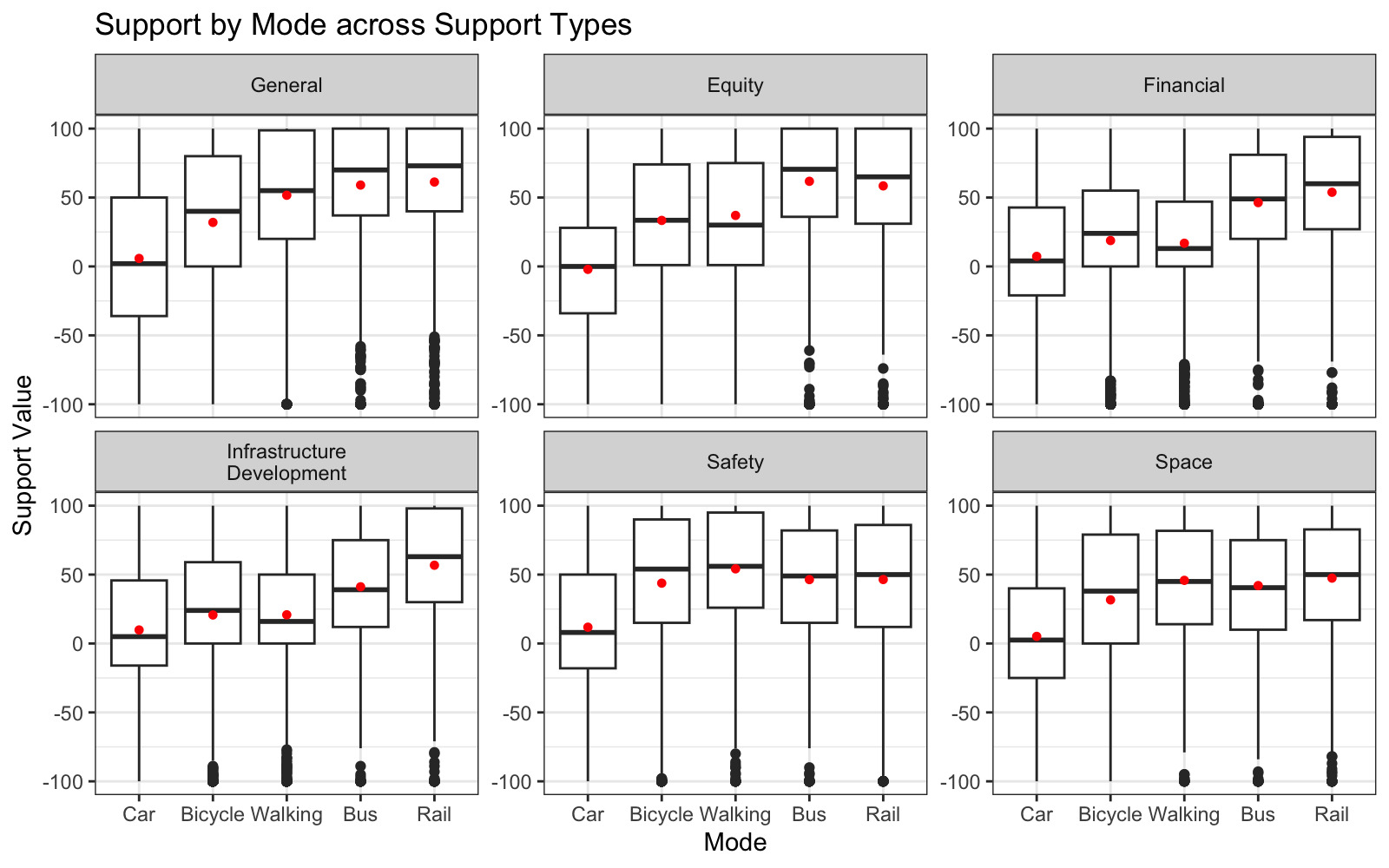
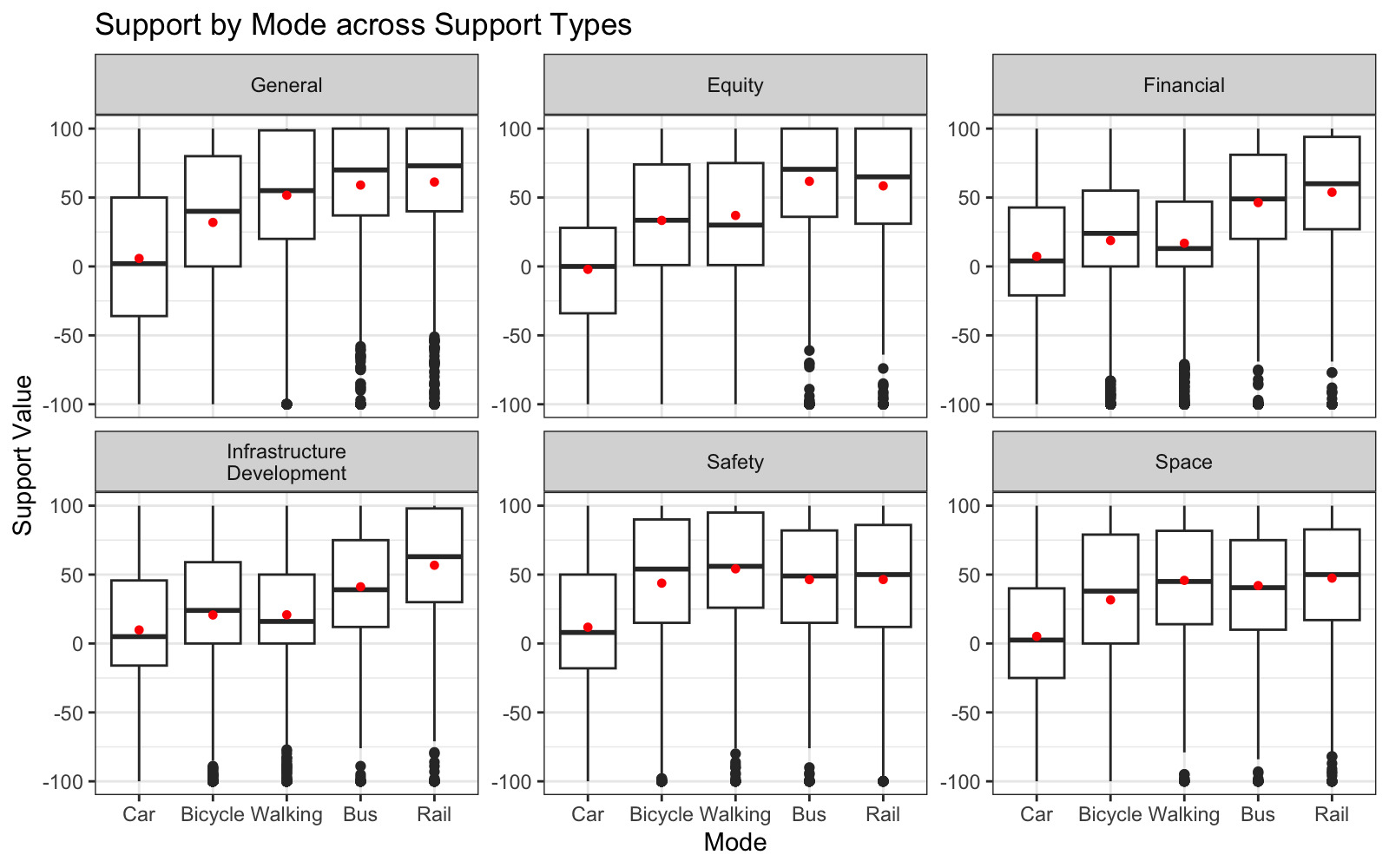
  • Figure 2. Box plots of each mode for each support type with a point showing mean values.
    Download
  • Table 3. Mean support ratings for each mode (± standard deviation). RM-ANOVA row showing output of modal support variance per support type.
    Download
  • Anonymized Dataset
    Download
  • Analysis Script
    Download

Error

Sorry, something went wrong. Please try again.

If this problem reoccurs, please contact Scholastica Support

Error message:

undefined

View more stats

Abstract

While transportation investment is often contested, there is limited empirical evidence on how public support varies across modes and investment dimensions. Using survey data from the Montréal region, this study examines public support for five modes – car, bus, rail, walking, and cycling – across six dimensions: general support, safety, space, financial investment, equity (by income), and infrastructure. Repeated-measure ANOVA reveals that support varies significantly both by mode and support dimension. Public transit receives consistently high support across all dimensions, while car-oriented investment is broadly unsupported. Active modes show strong safety support but weaker financial and infrastructure backing relative to public transit.

1. Question

Transport investment continues to be a subject of debate in North America. In Canada, for example, bike lanes and tramway projects have become the subject of contentious debates at both the provincial and city-levels in recent elections. The current mayor of New York City promised to eliminate bus fares as part of his successful campaign. These North American cases show transportation issues are often contested electorally. However, election results on their own do not always provide a clear understanding of what local populations want improved about their transportation systems. This research answers two questions to address this: how does public support vary by mode of transportation, and does public support vary when modes are considered in general terms versus in relation to safety, space, cost, equity, or infrastructure?

2. Methods

Survey

This study uses data collected in May 2024 through an online survey distributed across the Montréal Metropolitan Area using a well-known Canadian research firm’s online panel (Léger Opinion). Individuals aged 18 years or older were recruited using quotas to ensure representation across subregions by age and gender. Data quality was ensured by using embedded attention check questions designed to identify negligent responses. 1650 respondents completed the survey and a sample of 1606 respondents was retained after an extensive data cleaning process detailed in Kinman et al. (2025).

Respondents were asked to answer the 6 questions presented in Table 1. Each question was on a different page, and respondents used a slider scale from -100 (Much less) to 100 (Much more), with 0 being Unchanged for each of the following modes of transportation: Bus, Walking, Rail (metro, train, tram, etc.), Bicycle, and Private car. Respondents had to move the slider for their response to be recorded.
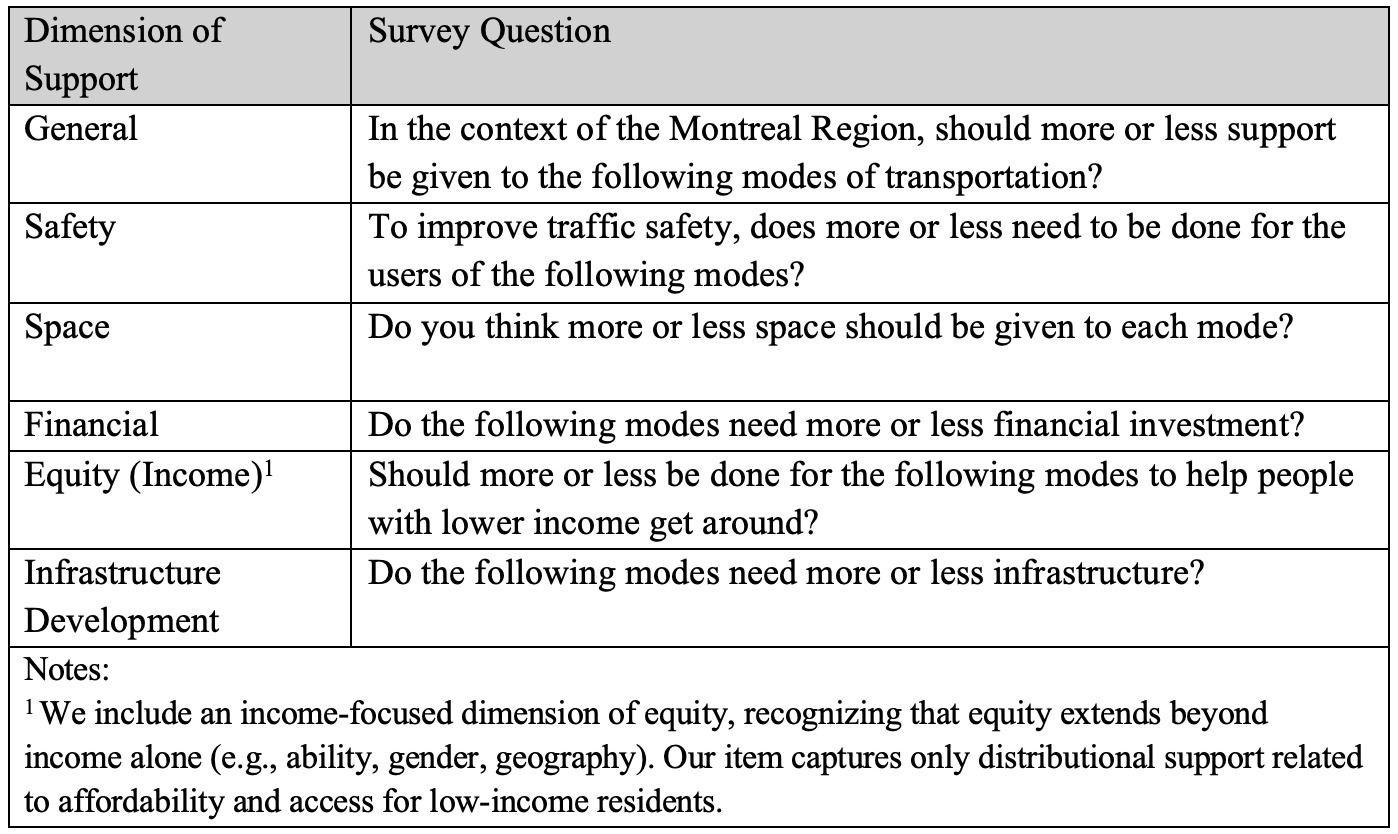
Table 1
Table 1.Survey questions for each dimension of support.

Analysis

Using R’s ez package (Lawrence 2016), we used a repeated-measure ANOVA to test the variance of respondents’ support ratings for each type of support across modes, and for each mode across support types. As the assumptions of normality and ‘sphericity’ were violated, we applied RM-ANOVA with a Greenhouse-Geisser epsilon correction (Blanca et al. 2023a; 2023b). We then estimated marginal means post-hoc testing with a Holm-Bonferroni adjustment to identify which specific types of support varied for each mode.

3. Findings

We found that, for each mode, support ratings were statistically significantly different across support types (Figure 1). Support varied for modes depending on the type of support (Table 2). For some modes such as public transit modes (rail and bus), all support types were consistently high, suggesting strong public interest in giving more support—in all forms—to these modes. Meanwhile, active modes of transportation (walking and bicycles) saw larger gaps between support for financing or infrastructure and other forms of support.
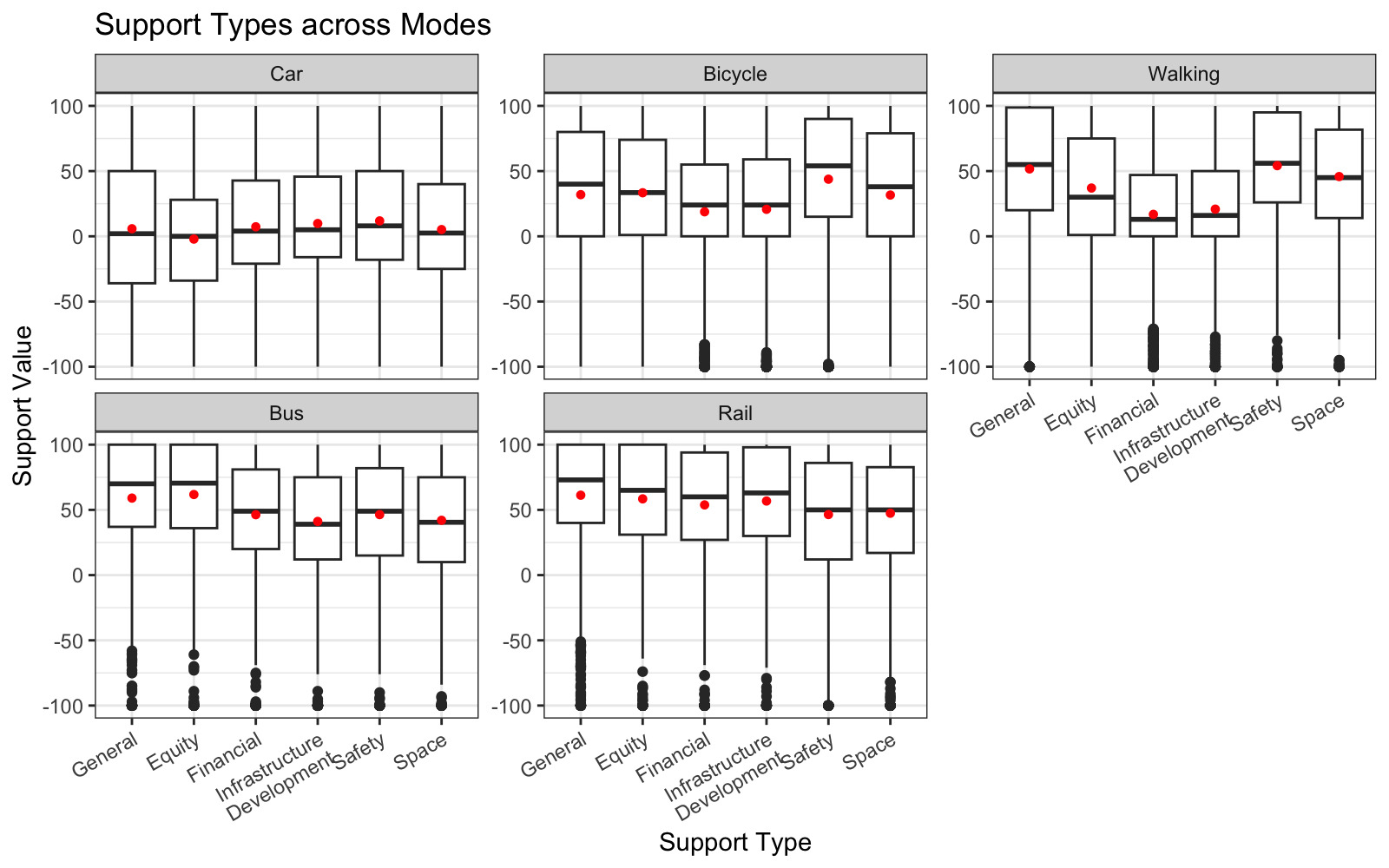
Figure 1
Figure 1.Box plots of each support type for each mode with a point showing mean values.
Table 2
Table 2.Mean support ratings for each mode (± standard deviation). RM-ANOVA column showing output of support type variance per mode.

a - Greenhouse-Geisser epsilon correction for sphericity
Signif. codes: *** p < 0.001; ** p < 0.01; * p < 0.05; . p < 0.1; p ≥ 0.1
Note: Each cell contains symbols corresponding to the support types which were found to be statistically different from the tested support type for a given mode. An effect size threshold of |Cohen’s D| > 0.1 was applied to pairwise differences.

In analyzing support ratings between modes (and within a support type; Figure 2), car support is statistically significantly lower than all other modes, and this trend is consistent across all types of support, suggesting that most Montreal region residents do not think cars need more investment. Public transit modes (bus and rail) have consistently higher support across support types, except for safety, where bicycles and walking also receive high support (> 50). Statistical differences between modes can be seen in Table 3.
A group of boxes with text AI-generated content may be incorrect.
Figure 2.Box plots of each mode for each support type with a point showing mean values.
Table 3
Table 3.Mean support ratings for each mode (± standard deviation). RM-ANOVA row showing output of modal support variance per support type.

a - Greenhouse-Geisser epsilon correction for sphericity
Signif. codes: *** p < 0.001; ** p < 0.01; * p < 0.05; . p < 0.1; p ≥ 0.1
Note: Each cell contains symbols corresponding to the mode which were found to be statistically different from the tested mode for a given support type. An effect size threshold of |Cohen’s D| > 0.1 was applied to pairwise differences.

Thus, we conclude that public transportation modes have very high public support on all levels, and that all modes have statistically significantly higher support than the car, also on all levels. The gap observed between high support for safety improvements for active modes and lower support in terms of financing or infrastructure for these modes may be attributed to the public’s awareness of relatively lower costs of infrastructure for these modes, concerns about reallocation of road space, or public unawareness of the relationship between active transport infrastructure and safety for these modes. However, this research does not elucidate the reasons for different levels of support depending on specific dimensions.

We also conclude that conflating all dimensions of support identified into generalized support by mode may eliminate critical insight into public opinion. Investigation into the tension of tradeoffs for different modes and types of support could clarify how people weigh different dimensions of support. Additional factors pertaining to people’s travel behavior, their built environment, and sociodemographic characteristics may also add nuance to the understanding of variance in types of support for different modes. This research lays a foundation in understanding support for different modes of transportation and the different dimensions of that support, establishing that dimensions of support vary across modes, which future research should consider.

Submitted: January 24, 2026 AEST

Accepted: April 02, 2026 AEST

References

Blanca, M. J., J. Arnau, F. J. García-Castro, R. Alarcón, and R. Bono. 2023a. “Non-Normal Data in Repeated Measures ANOVA: Impact on Type I Error and Power.” Psicothema 35 (1): 21–29. https:/​/​doi.org/​10.7334/​psicothema2022.292.
Google Scholar
Blanca, M. J., J. Arnau, F. J. García-Castro, R. Alarcón, and R. Bono. 2023b. “Repeated Measures ANOVA and Adjusted F-Tests When Sphericity Is Violated: Which Procedure Is Best?” Frontiers in Psychology 14 (1192453). https:/​/​doi.org/​10.3389/​fpsyg.2023.1192453.
Google Scholar
Kinman, L., J. Laviolette, K. Manaugh, and O. Waygood. 2025. “Understanding Support for Cycling Infrastructure through Moral Foundations Theory.” Journal of Cycling and Micromobility Research 6 (100095). https:/​/​doi.org/​10.1016/​j.jcmr.2025.100095.
Google Scholar
Lawrence, Michale A. 2016. Ez: Easy Analysis and Visualization of Factorial Experiments. R package version 4.4-0. https:/​/​CRAN.R-project.org/​package=ez.
Google Scholar

Attachments

Powered by Scholastica, the modern academic journal management system