
1. Questions
This paper addresses the following questions:
-
Which transportation modes complement or substitute for microtransit trips?
-
Are shifts in mode frequency consistent with which modes complement or substitute for microtransit?
Microtransit or demand-responsive transit (DRT) is an emerging transit mode that typically consists of shuttle sized vehicles providing service on-demand to one or more passengers. Questions exist about the benefits, drawbacks and potential mode shifts resulting from microtransit.
We examine the MARTA Reach pilot DRT service in Atlanta GA, which started in March 2022. We conduct exploratory analysis of which modes complemented MARTA Reach, which modes were displaced and how varying use levels of MARTA Reach shifted the mode choices of its users. MARTA Reach fares were the same as MARTA bus fare i.e. $2.50 one-way[1].
2. Methods
We use data collected from two longitudinal surveys and one trip survey of MARTA Reach users (Drake and Watkins 2024)[2]. A registration survey (n = 178) was administered before the Reach pilot, between March and September 2022. A trip survey was administered while the pilot was active (n=200 with 323 recorded trips). An evaluation survey (n = 210) was administered at the closing of the pilot, for users that used Reach at least once between August and September 2022.
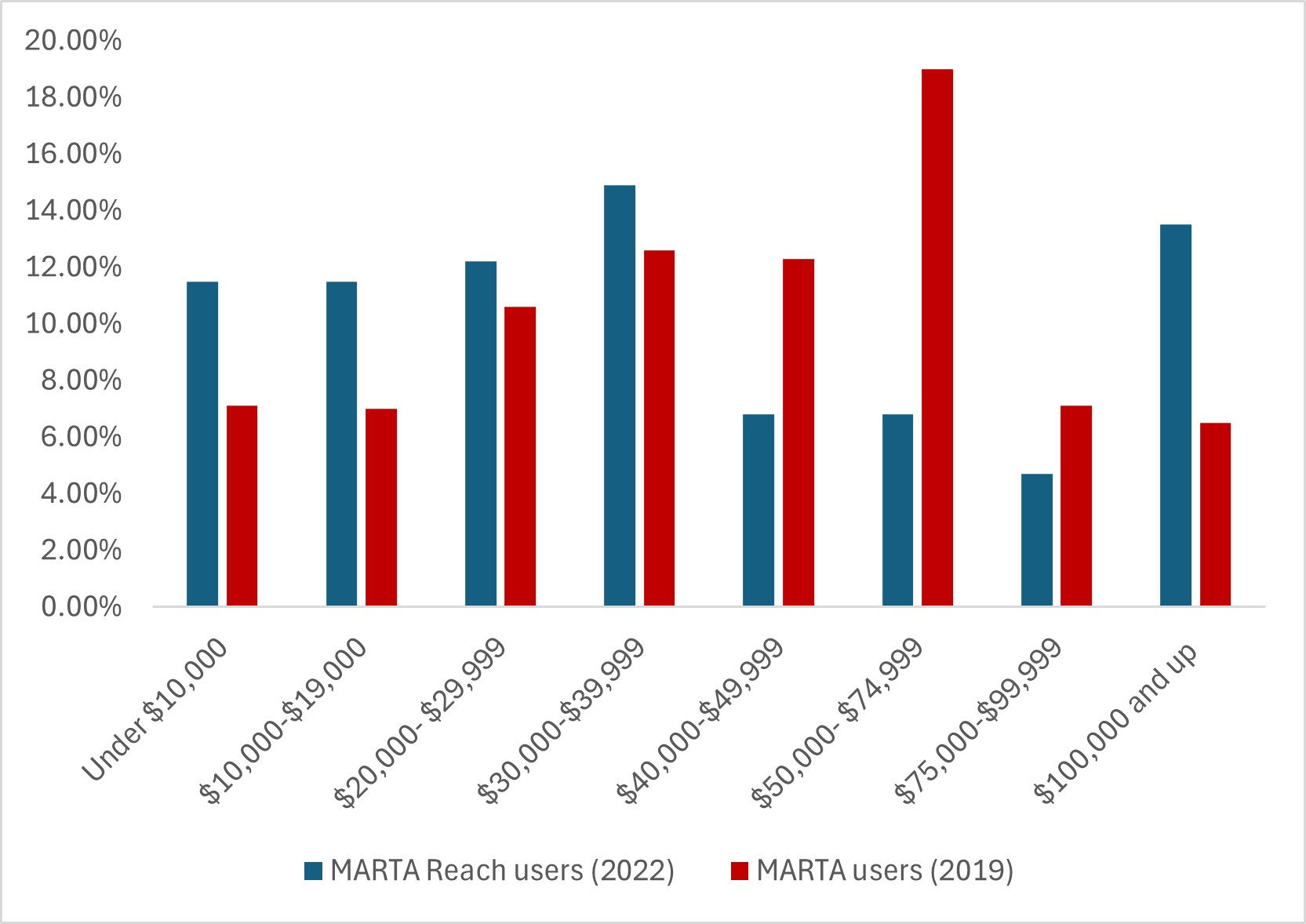
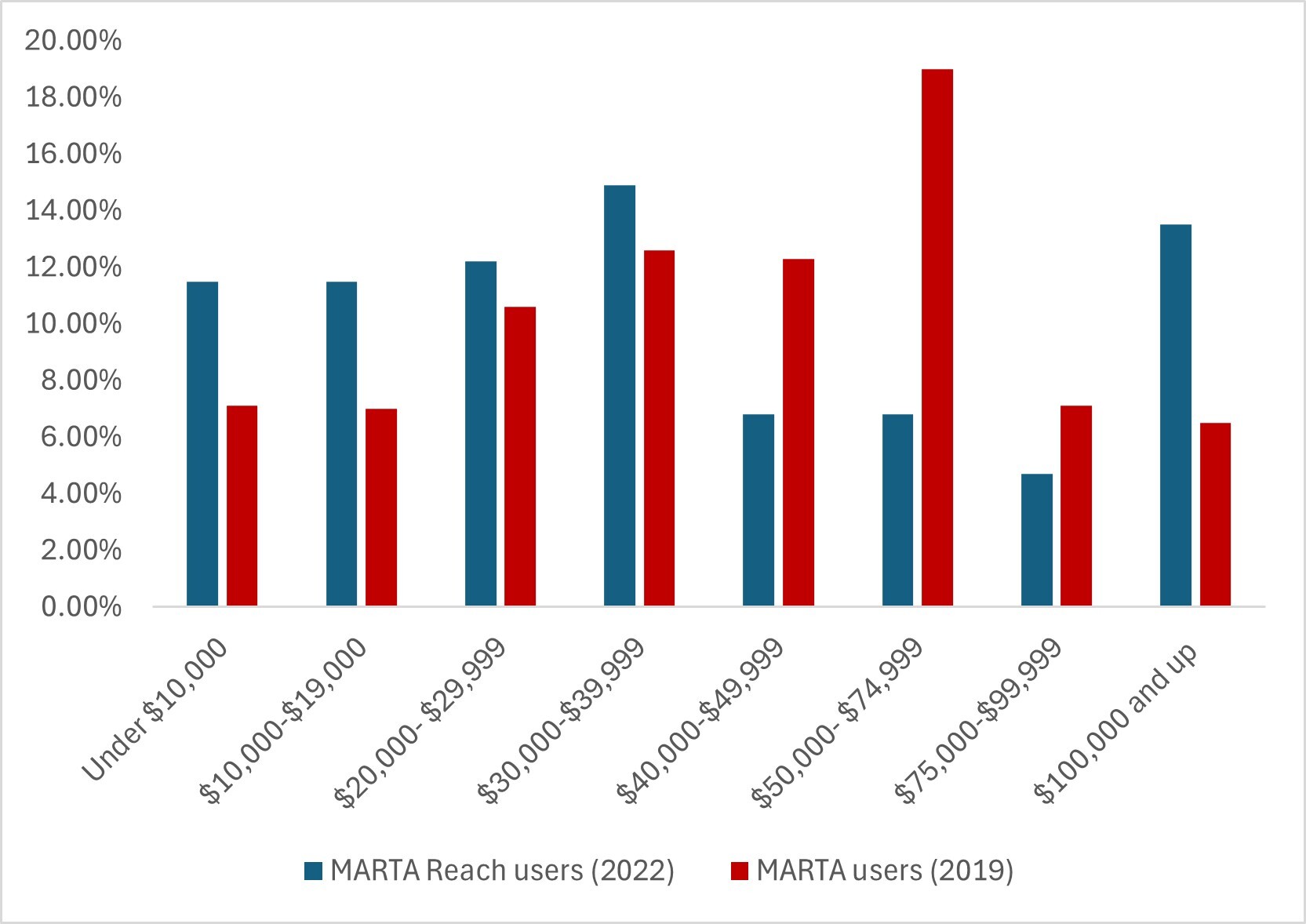
Our analysis includes all respondents that completed the survey and indicated they had used Reach at least once when taking the evaluation survey. We compare our respondents’ demographics to those of MARTA riders from a 2019 survey administered by the Atlanta Regional Commission (ARC) and found ethnicity to be generally similar, but there are some differences in income (Figure 1).
Respondents were asked which other modes were used during their MARTA Reach trip and which modes they would have used if Reach were not available. Both surveys consisted of questions about the use of various modes for work/school trips, and shopping/social trips, and were mostly identical between the two surveys.
3. Findings
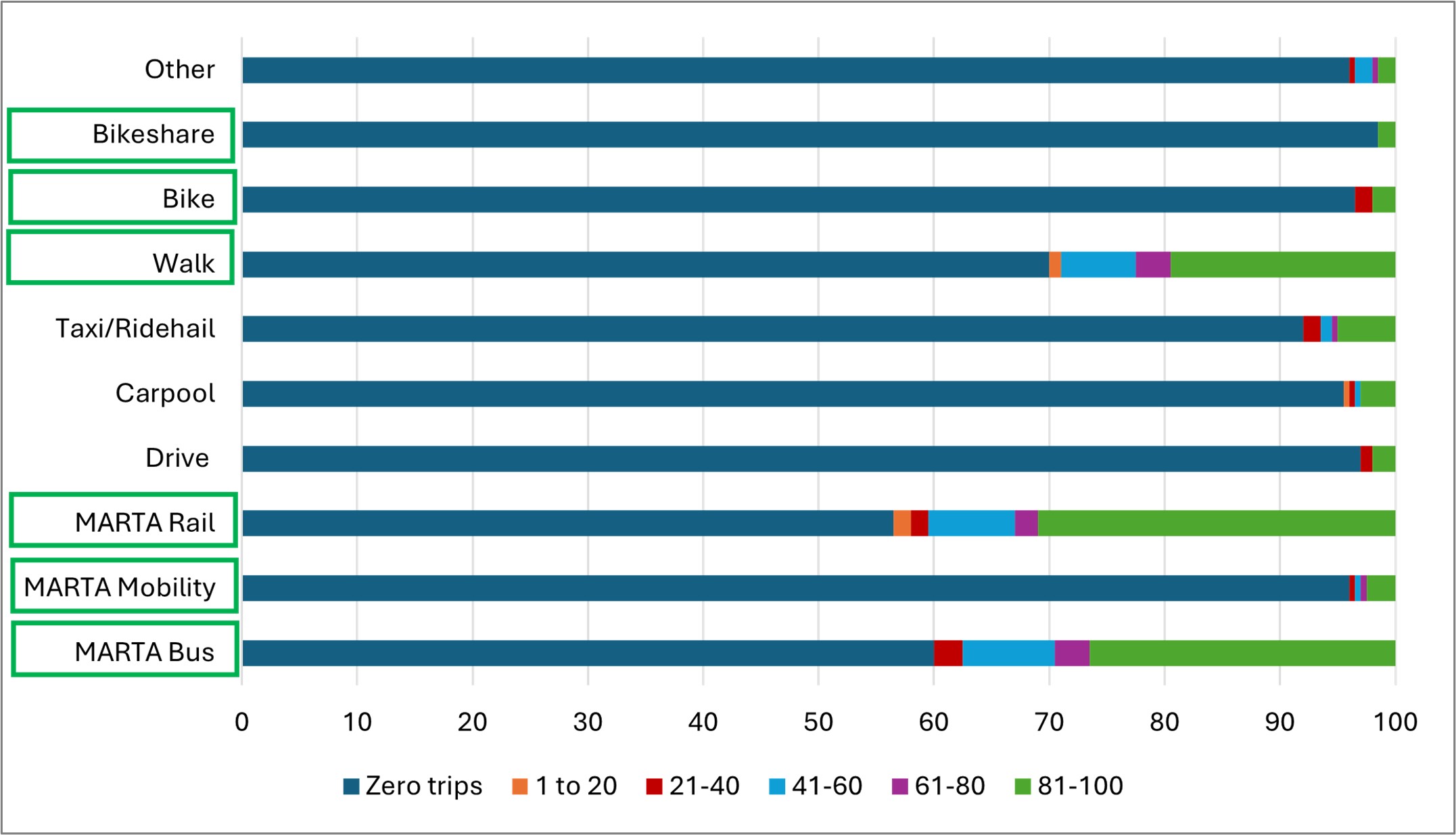
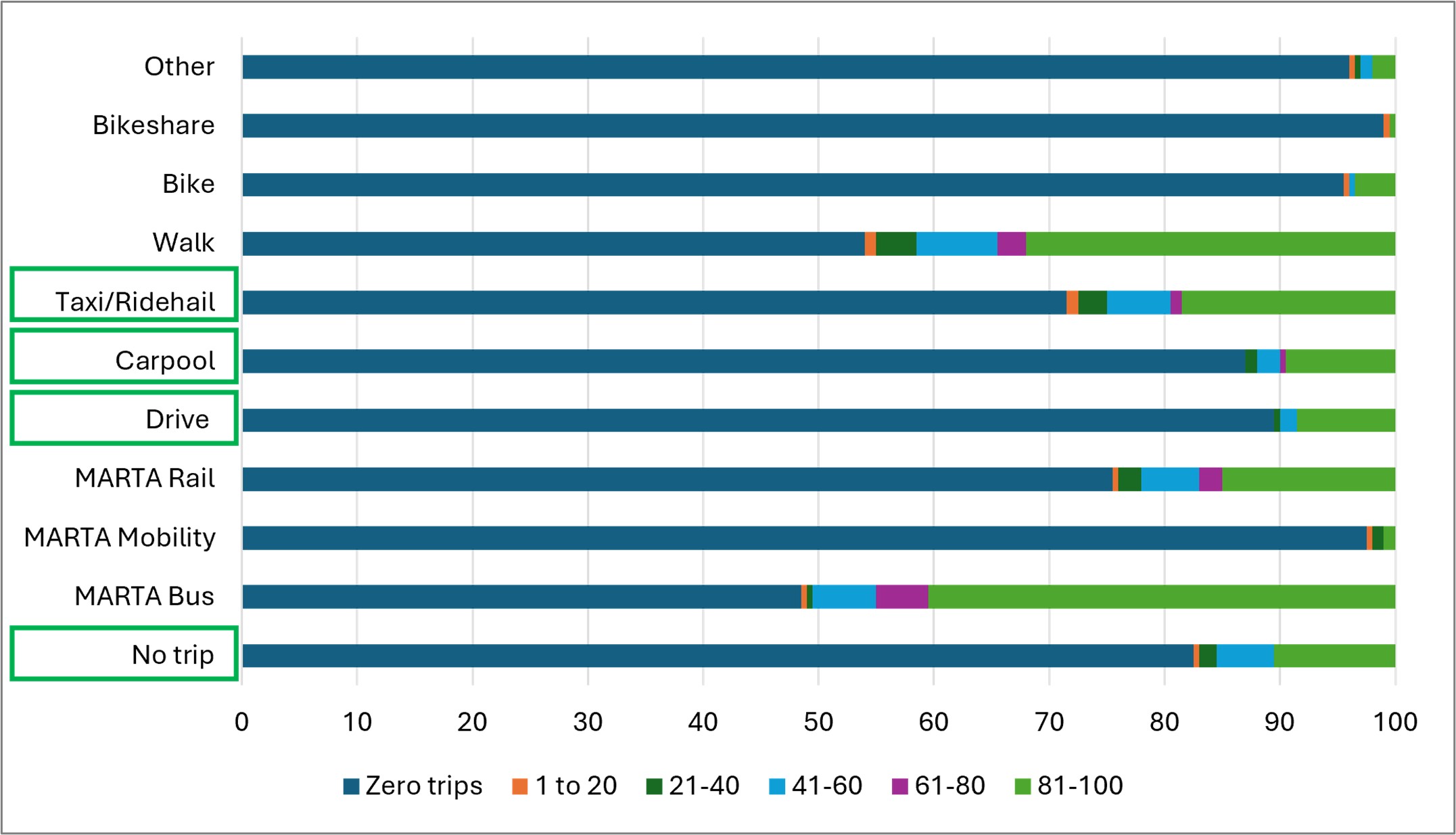
Table 1 shows the percentage of respondents reporting modes used in combination with Reach (top half) and that would be used if Reach were unavailable (bottom half). For example, 26.5% of respondents used MARTA bus on 81-100% of their Reach trips, showing high complementarity. Were Reach not available, 8.5% of respondents said they would have driven on 81-100% of their trips, and 10.5% of respondents would not have made 81-100% of their trips. The information in Table 1 is shown in Figure 2 and Figure 3 for readability.
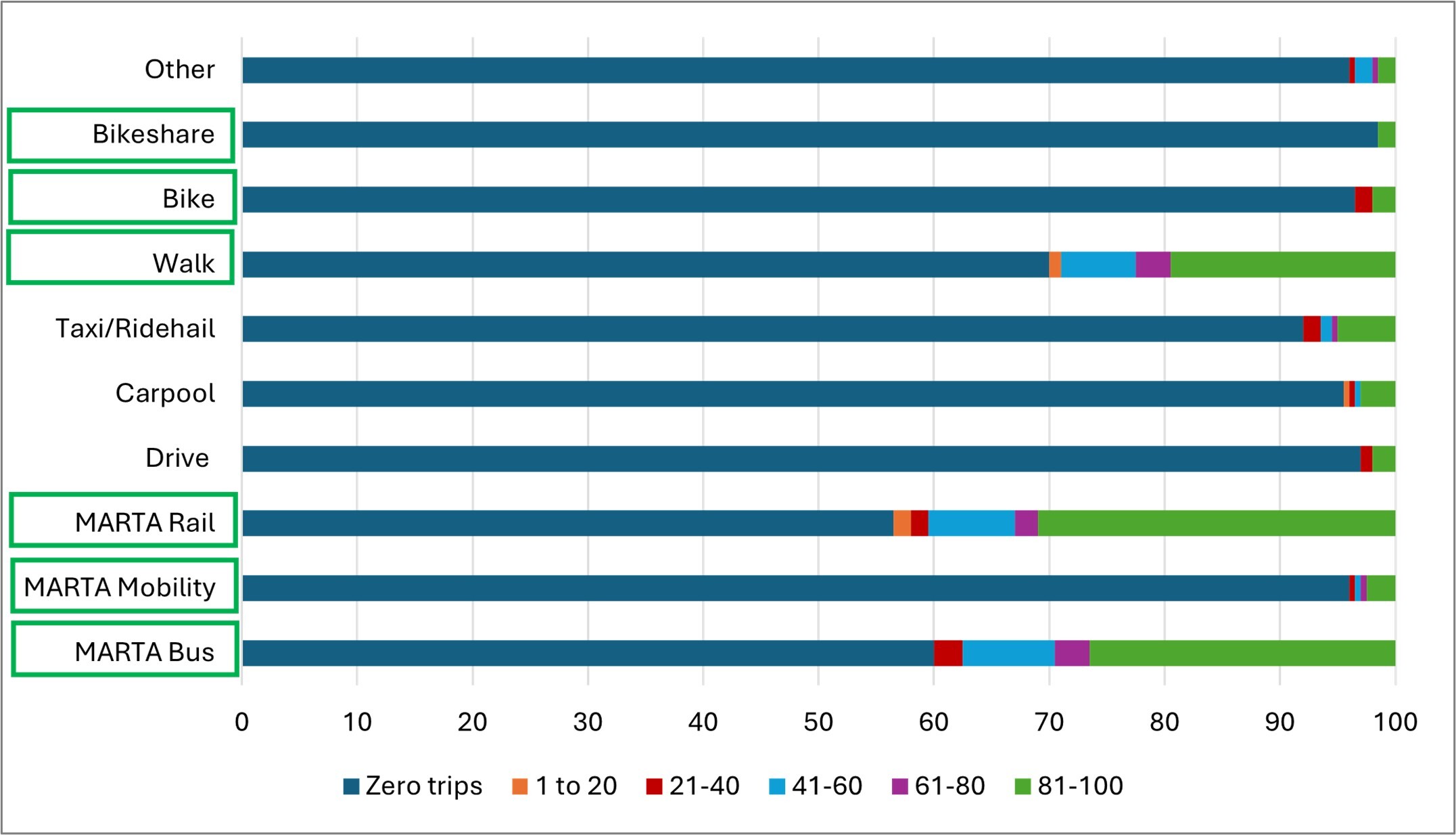
Some sustainable modes (walk, MARTA Rail and MARTA Bus) were used frequently alongside MARTA Reach on a single trip, whereas other sustainable modes such as biking, bikeshare and MARTA Mobility were not frequently used to complement MARTA Reach on a single trip. At the same time, 5% of respondents reported using taxi/ridehail on 81-100% of their Reach trips, showing low complementarity.

While many respondents would have used other MARTA transit modes if Reach were not available, Reach enabled some new trips and displaced unsustainable modes including taxi/ridehail and driving. Unsustainable modes such as taxi/ridehail, carpool, and drive were more strongly associated with substitution for microtransit than with complementarity. MARTA Bus and walk were among the most displaced modes. However, MARTA Bus also had a strong complementary relationship for some users (Figure 2).
Next, we examine reported changes in the use frequency of transit, taxi/ridehail, drive alone, bike/scoot, walk and paratransit for commute and non-commute trips. The frequency reported in the evaluation (after) survey is compared qualitatively to the frequency reported in the registration (before) survey. Three use levels for MARTA Reach (high, medium and never) were defined based on self-reported data from the surveys (see notes to Table 2). Fisher’s Exact Test p-values (two-sided) were calculated using the fisher.test package in R. Table 2 shows the change in the frequency of use of modes for which significant p-values were found. For commute trips, 22.58% of high Reach users and 33.33% of medium Reach users increased their use of transit, implying some degree of complementarity between microtransit and transit. The questions about frequency of use were the same for all modes except transit. The registration survey asked about transit use overall. The evaluation survey asked about three transit modes: MARTA Reach, MARTA bus/rail and other public transit (Georgia Regional Transportation Authority, CobbLinc, etc.). We considered the maximum frequency reported in the three categories in the evaluation survey as a proxy for overall transit use. This may underestimate transit use in the evaluation survey, and thereby change in usage, but we considered this the most conservative approach. We find a statistically significant association between MARTA Reach usage and changes in taxi/ride-hail and transit use for commute trips. In some cases, there are mixed shifts, i.e. increase and decrease within the same Reach usage group. For example, 53.33% of medium Reach users who use taxi/ridehail reported the same levels of taxi/ridehail usage whereas 33.33% of the same group reported a decrease. These patterns may occur due to user heterogeneity or differences in how microtransit interacts with other modes and constraints. Some riders may substitute Reach for ridehailing on certain trips, while others use it for new trips, leading to more overall travel (and perhaps more ridehailing). There may also be differences by trip purpose, time-of-day, and access or parking constraints.
For non-commute trips, transit is the only mode with a statistically significant association with MARTA Reach usage. High Reach users predominantly have the same transit use overall, while the medium user group decreased transit use, possibly due to substitution. Interestingly, the group that never used Reach predominantly increased transit use.
The limitations of this study include reliance on self-reported data, small cell sizes and the lack of a comparison group. The survey did not ask about primary mode, and due to the small sample size, we could not assign respondents to mode choice clusters. It is also possible that the difference between levels of Reach use reflect who the users are, or unobserved changes in external factors over the study period, such as seasonal changes, rather than the effect of Reach itself.
https://sam.isye.gatech.edu/projects/marta-reach-piloting-demand-multimodal-transit-atlanta
These surveys were administered using Qualtrics, to MARTA Reach users who provided their email addresses upon signing up.