
1. QUESTIONS
In many parts of the world, driving is necessary for teens to access education and employment opportunities. This is especially the case in auto-centric areas in the U.S. Graduated Driver Licensing laws in 29 U.S. states require teens to complete professional behind-the-wheel (BTW) training in addition to other instructions and practice before licensure (Walshe et al. 2024). However, individuals are responsible for the costs of BTW training, which costs an average of $462 in Ohio for the minimum eight-hour requirement. Studies have found that more affluent young drivers are more likely to obtain licenses early than less affluent ones (Dong, Wu, Jensen, et al. 2023; Dong, Wu, Walshe, et al. 2023; Vaca et al. 2021). Compared to urban teens, rural teens have fewer travel options other than driving. Their need for mobility independence might compel them to obtain licenses earlier than urban teens, who may have other mobility options that allow them to delay licensure to when they age out of GDL requirements (usually around age 18, as was the case in Ohio at the time of this study). In states that require BTW training, low-income rural teens face the hard choice of shouldering the financial burden of licensure or forgoing mobility independence. However, it remains unclear whether licensing pathways differ between young drivers in urban and rural areas, where car dependence and access to driver training vary substantially, and whether these differences are further stratified by financial status.
We compared the age of obtaining first driver’s license and the completion rates of GDL-mandated training between young drivers from high-poverty and low-poverty urban and rural Census tracts in Ohio. Under the assumption that young rural drivers have greater needs for driving, we proposed three hypotheses: H1. Young rural drivers obtain first license earlier than young urban drivers; H2. The difference in the age of obtaining first license between high- and low-poverty young drivers is smaller in rural areas than in urban areas. H3. The difference in GDL-mandated training completion between high- and low-poverty young drivers is smaller in rural areas than in urban areas. Our study was enabled by access to a driver licensing database provided by the Ohio Bureau of Motor Vehicles. The database includes deidentified, complete licensing records of 122,456 young drivers 16-24 y.o. in Ohio between 2017 and 2019, when GDL policy applied to those under 18 y.o. An understanding of the licensing pathways by young urban and rural drivers across poverty levels could inform targeted measures to enhance mobility for young drivers and narrow the urban/rural mobility gap.
2. METHODS
We used t-test, ordinary least squares regression, and descriptive statistics to test the three hypotheses using the deidentified dataset. The dataset did not include drivers’ income. We matched the drivers’ reported home addresses to Census tracts and used the tracts’ poverty rates as a measure for the drivers’ financial status. We classified tracts with poverty rates in the 75th percentile of tract-level poverty rates across Ohio as high-poverty tracts. The other tracts were classified as low-poverty tracts. We classified tracts as rural if they contained no urban areas as designated by the U.S. Census Bureau. Urban tracts are Census tracts that intersect a Census-defined urbanized area and may include varying levels of urbanization.
For H1, we used one-tailed t-test to examine whether the mean age (in years) of first licensure was lower for young rural drivers than for young urban drivers. For H2, we used OLS regression to predict the age of first licensure using the urban/rural classification of young drivers’ home Census tracts, the poverty status of young drivers’ home Census tracts, and the interaction between the urban/rural classification and the poverty status of young drivers’ home Census tracts. For H3, we used descriptive statistics to compare the share of young drivers who completed GDL-mandated training across four Census tract classes: urban high-poverty, urban low-poverty, rural high-poverty, and rural low-poverty.
3. FINDINGS
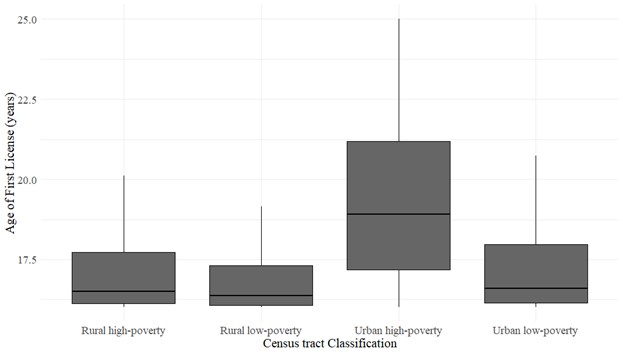
In general, young rural drivers obtained a driver’s license earlier than young urban drivers (Figure 1). One tailed t-test (t = -40.5, p-value = 0.000) indicates that the average age at which young rural drivers (17 y.o.) obtained first license was significantly younger than that for young urban drivers (17.7 y.o.) with a moderate effect size (r = 0.335).
_by_urban_rural_c.jpg)
The OLS model (Table 1) shows that in rural areas, the average difference in the age of first licensure between young drivers from high- and low-poverty tracts was 0.233 (p-value = 0.005). In comparison, the difference in the age of first licensure between young drivers from high- and low-poverty urban tracts was much bigger and more significant (1.702 + 0.233 = 1.935, p-value = 0.000).
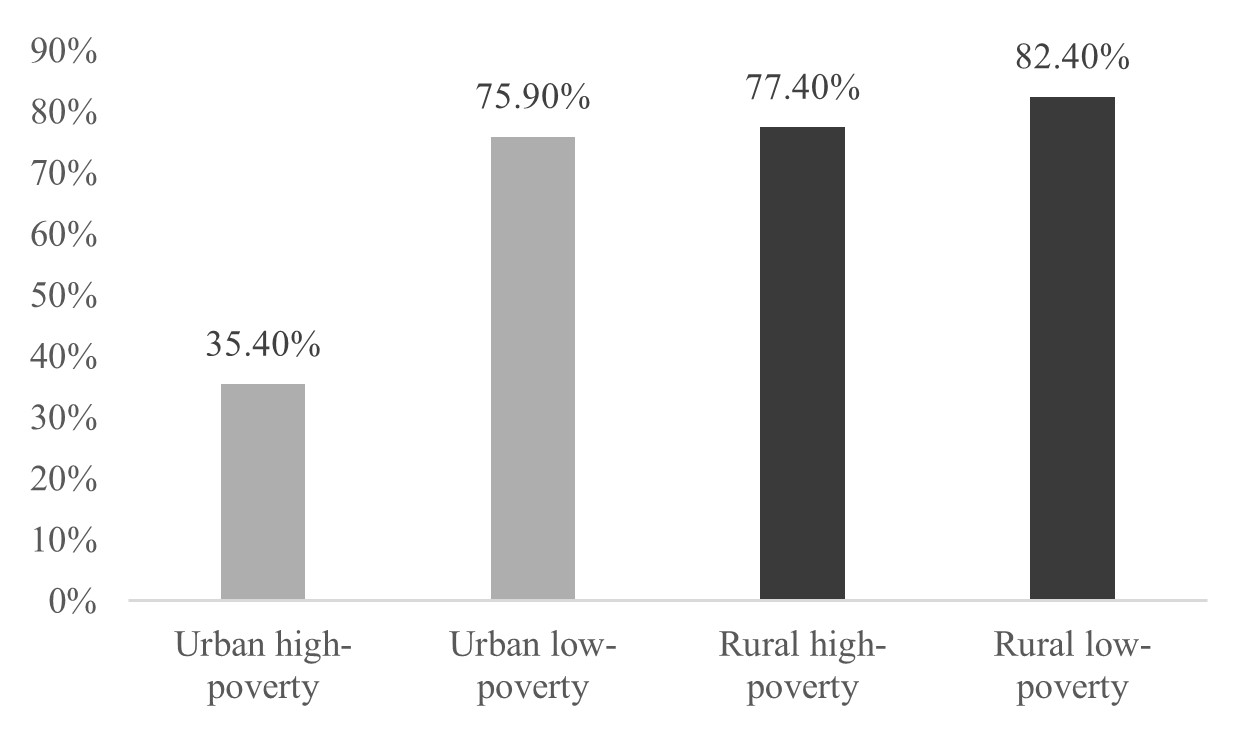
Regardless of poverty level, a higher percentage of young rural drivers completed GDL-mandated driver training than young urban drivers (Figure 2), indicating that a bigger share of young rural than young urban drivers intended to obtain a driver’s license before 18, when teens age out of GDL requirements. In rural areas, the share of young drivers in low-poverty tracts who completed GDL-mandated training was 5 percentage points higher than the share of young drivers in high-poverty tracts. In urban areas, the difference in shares between low- and high-poverty tracts was nearly 40 percentage points.
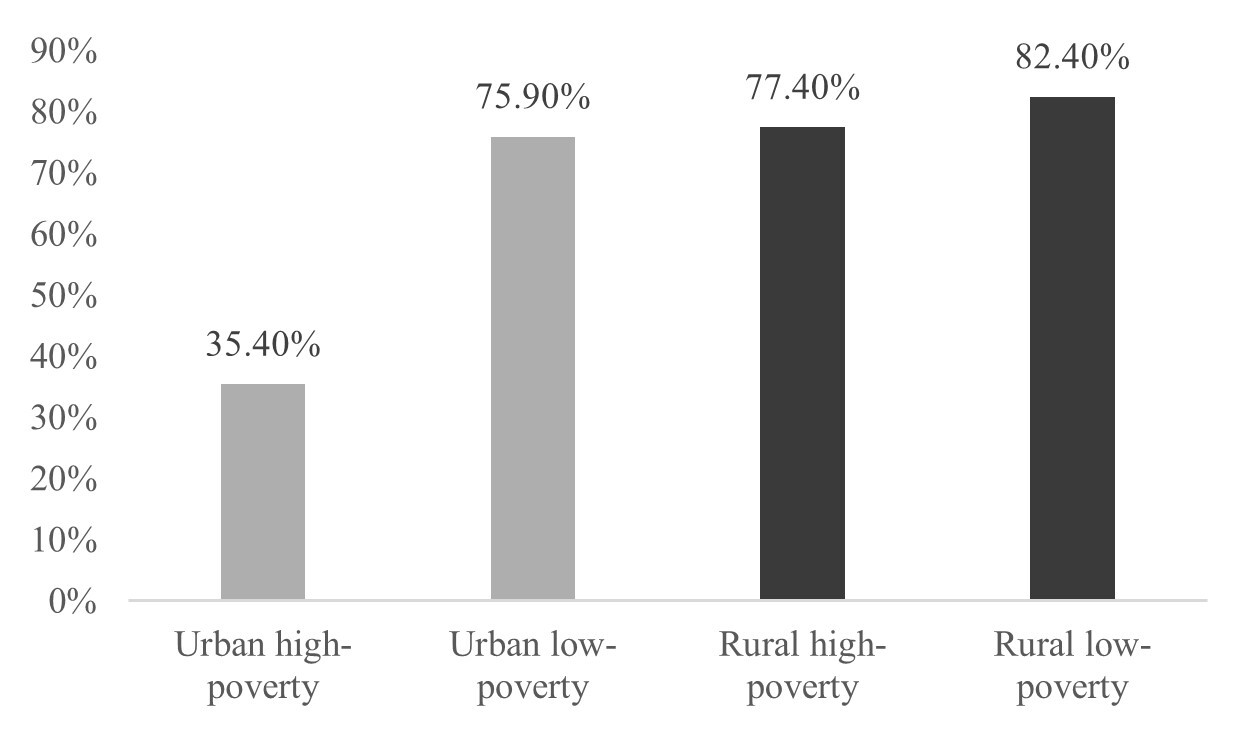
Our study shows that, on average, young rural drivers obtained their first license earlier than young urban drivers. The urban poverty gap is more than eight times the rural gap in terms of age of first licensure. Additionally, GDL-training completion rate was substantially lower in high-poverty tracts than in low-poverty tracts in urban areas, but comparable between high- and low-poverty rural tracts. Our findings in a state with GDL-mandated BTW training suggest that, possibly due to having few travel options beyond driving, young rural drivers in high-poverty areas might have a greater need for licensure, and their need might be less sensitive to poverty level than that for young urban drivers. This finding highlights the importance of licensure access support in high-poverty rural areas. This crucial understanding could inform strategies to reduce disparity in access to licensure and enhance mobility for young drivers.
Acknowledgments
The authors acknowledge Flaura Winston, Ph.D. (Division of General Pediatrics, Department of Pediatrics, University of Pennsylvania Perelman School of Medicine; Center for Injury Research and Prevention, Children’s Hospital of Philadelphia (CHOP) Research Institute, Philadelphia, Pennsylvania) who provided input to this research. The authors also acknowledge Shukai Cheng and Alex Gonzalez from the Department of Biomedical and Health Informatics at CHOP, and the Data Science and Biostatistics Unit at CHOP, who provided support in preparing and honest-brokering the data. Last but certainly not least, the authors acknowledge the Ohio Department of Public Safety who partners with CHOP and provided the data and funding support from the Ohio Traffic Safety Office and the National Highway Traffic Safety Administration (NHTSA).