
1. QUESTIONS
Newspaper coverage of road crashes shapes how risks are perceived, influence how blame is assigned, and may sway public opinion and guide political choices. These narratives reproduce and legitimize existing power structures, reflecting and reinforcing motonormativity — a societal bias that sustains car dominance and minimizes its nuisances (Walker et al. 2023).
Previous research identifies recurring biases in media reporting across five dimensions: focus, agency, grammatical voice, language, and narrative framing (Ralph et al. 2019; Goddard et al. 2019; Fevyer and Aldred 2022; Scheffels et al. 2019; Te Brömmelstroet 2020).
This study extends these analyses to French-speaking Switzerland and addresses the following questions: How do newspapers report collisions involving cyclists, and to what extent are biases present in these reports? Which dimensions of motonormativity appear in collision media reports?
We hypothesize that Swiss media discourses are strongly shaped by motonormativity. Despite the growing popularity of cycling and increasing political attention, creating physical and symbolic space for cycling remains a sensitive and contested issue (Rérat and Ravalet 2023; Widmer et al. 2024).
2. METHODS
Data collection
Articles were retrieved from the Swissdox.ch media database using the following query:
“(Cyclist OR bike/bicycle) AND (crash OR accident OR collision OR collide OR fall) AND (injured OR deceased) AND (driver OR motorist OR car OR vehicle)”[1]
The analysis focused on crashes between cyclists and motorists. Six major newspapers were selected: 24 Heures, Arcinfo, La Liberté, Le Matin, Le Nouvelliste, and La Tribune de Genève. All relevant articles published between 01.01.2020 and 31.12.2024 were included (n=204). The study did not assess the extent to which articles were influenced by police reports (Marshall 2024).
Coding and analytical framework
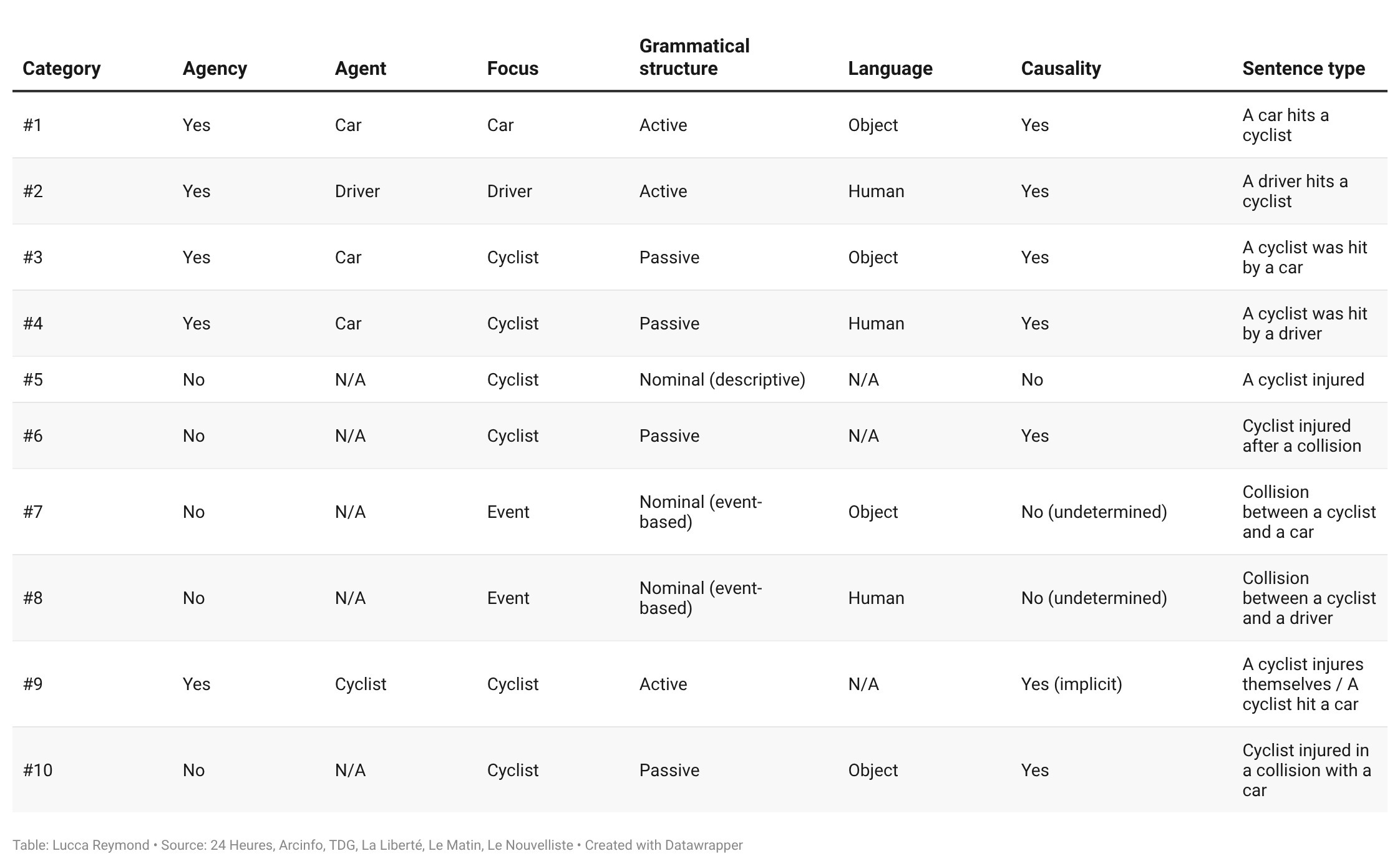
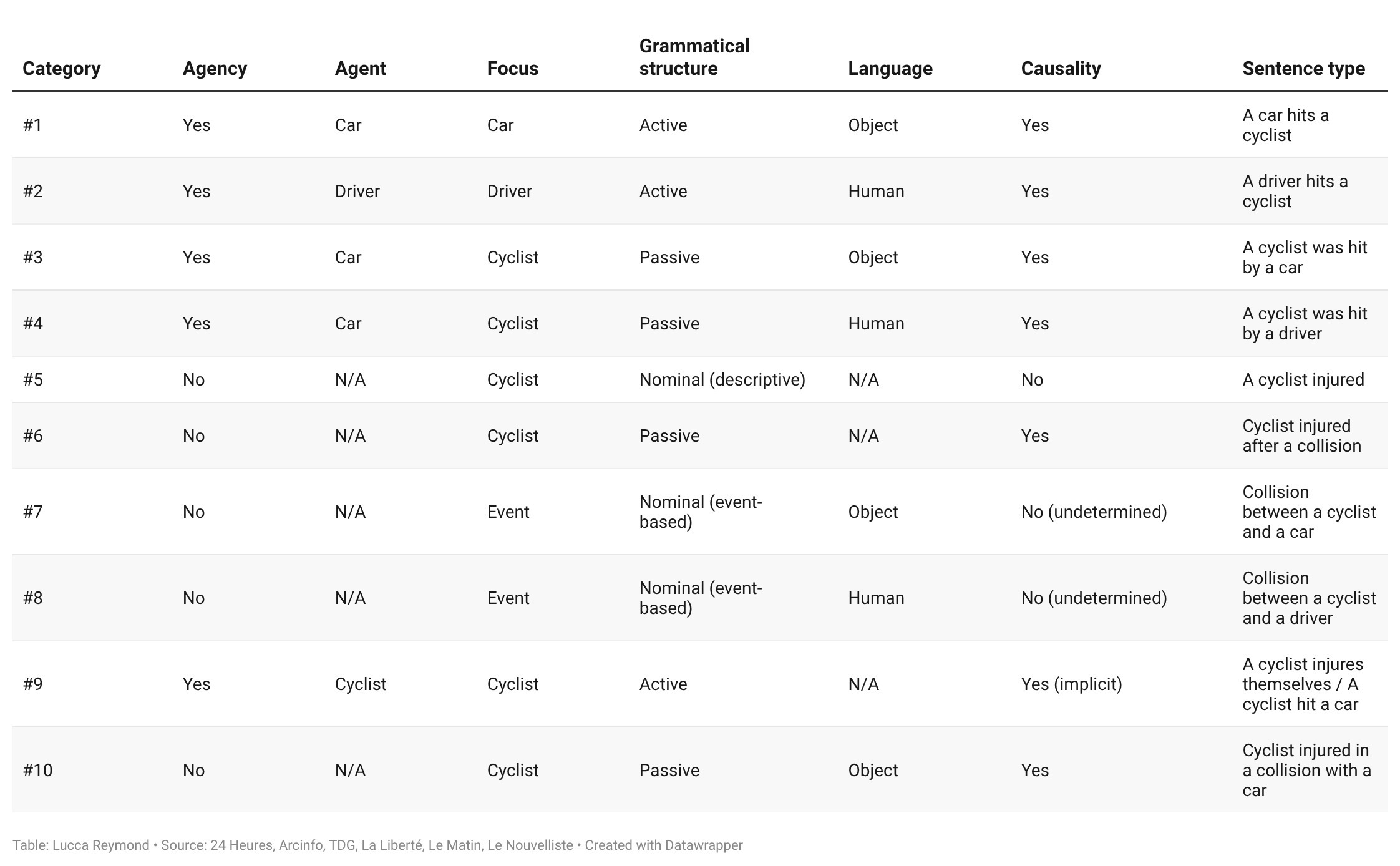
Two complementary coding schemes were applied. The first, at the sentence level, drew on Ralph et al. (2019) and Te Brömmelstroet (2020). Sentences were divided into headlines (n=179) and body text (n=311) and classified into ten categories across 6 dimensions (Table 1). Compared with previous work, we added a coding category for causality, distinguishing between explicit and undetermined causality.
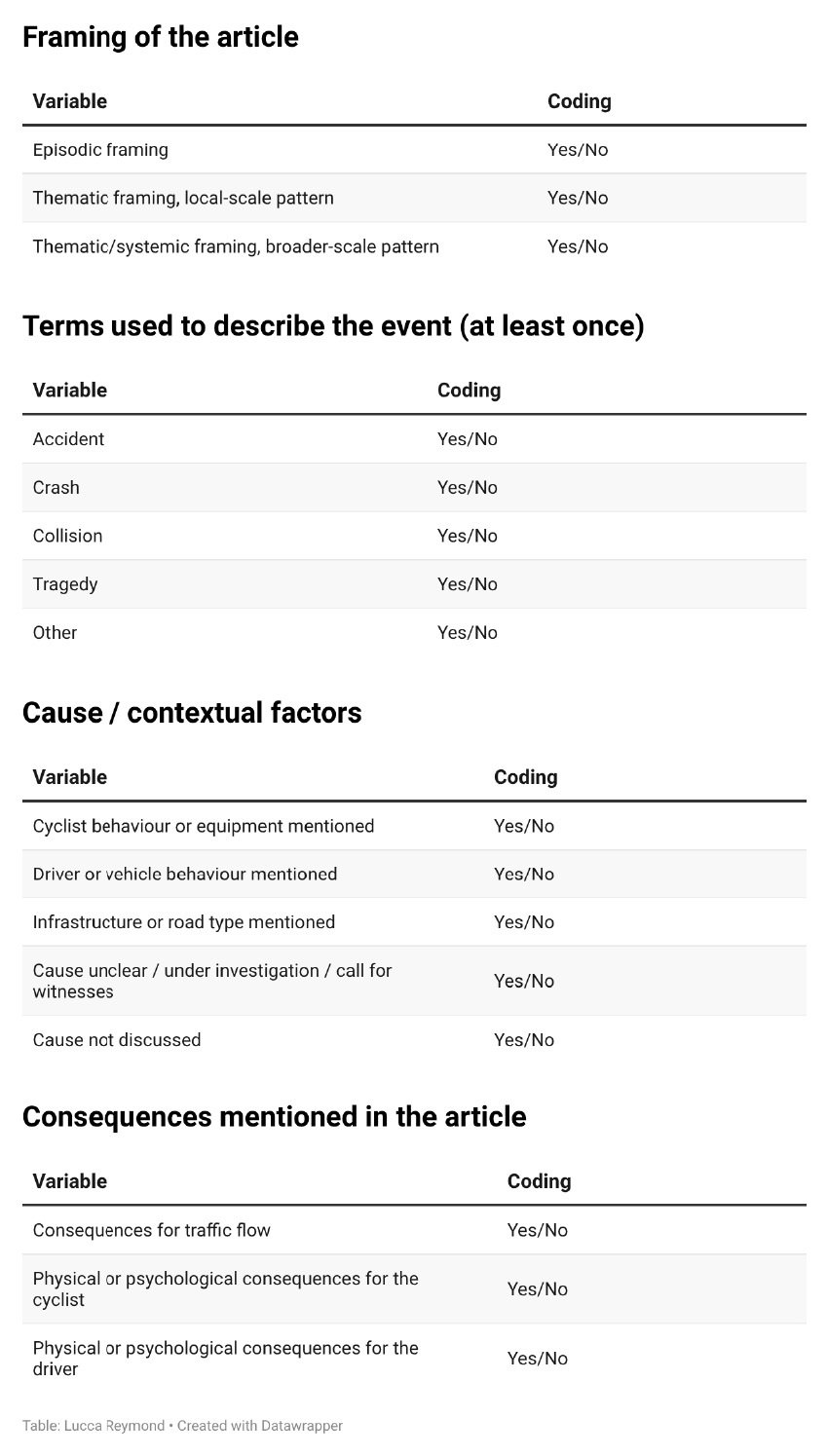
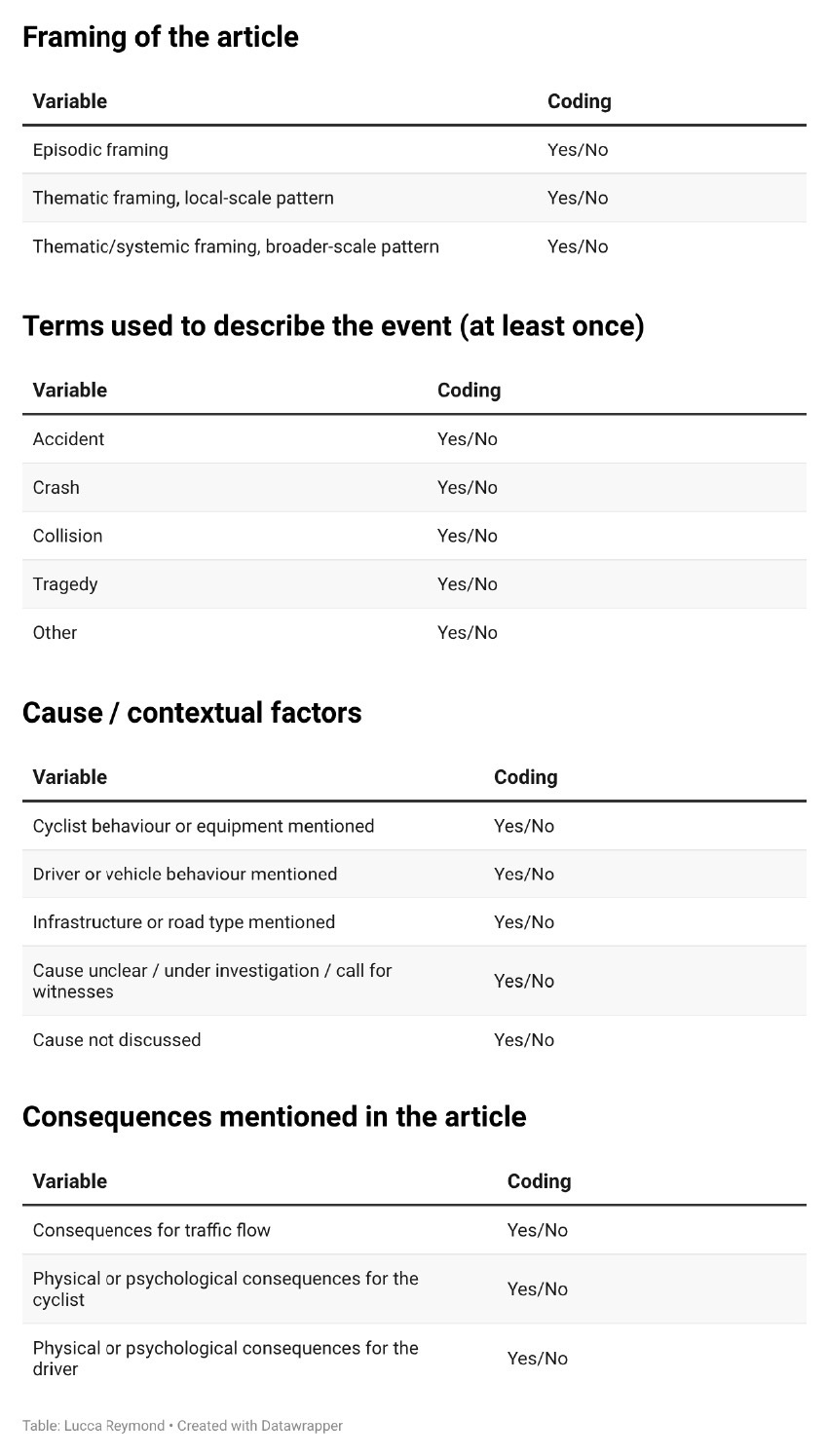
The second grid captured article-level framing (n=204), coding vocabulary describing the event, its consequences, and the presence or absence of contextual information. Articles were classified as episodic or systemic depending on whether the collision was framed as an isolated event or part of a broader issue.
3. FINDINGS
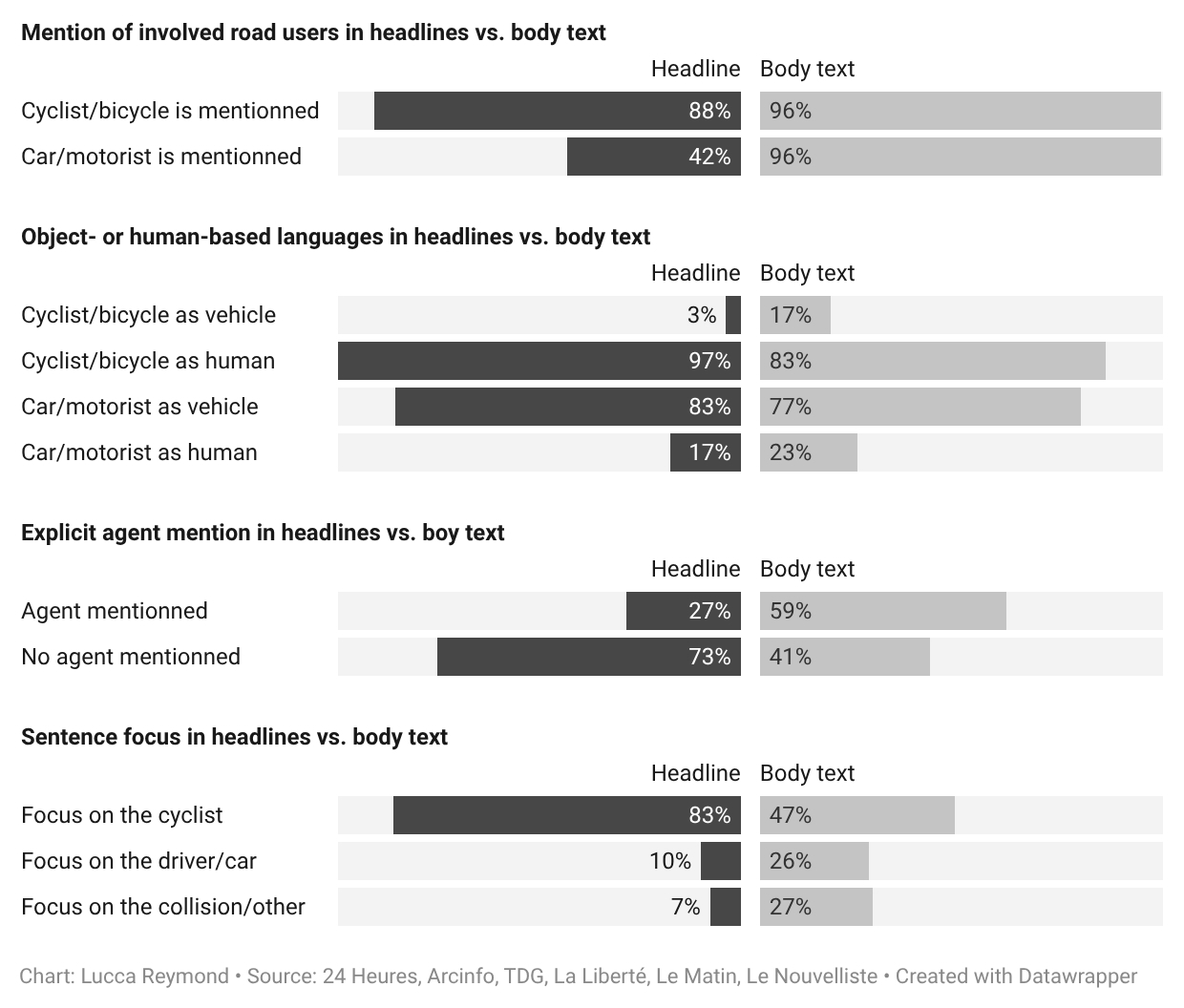
Only 27% of headlines and 59% of body-text sentences contained an explicit agent (Figure 1). This low level of agency dilutes responsibility and reinforces a fatalistic interpretation of collisions. Sentence type #10 (“A cyclist injured in a collision with a car”) illustrates this effect: The grammatical subject is the cyclist, the verb is in the passive voice, and the driver disappears entirely, concealing potential responsibility and framing the crash as unavoidable.
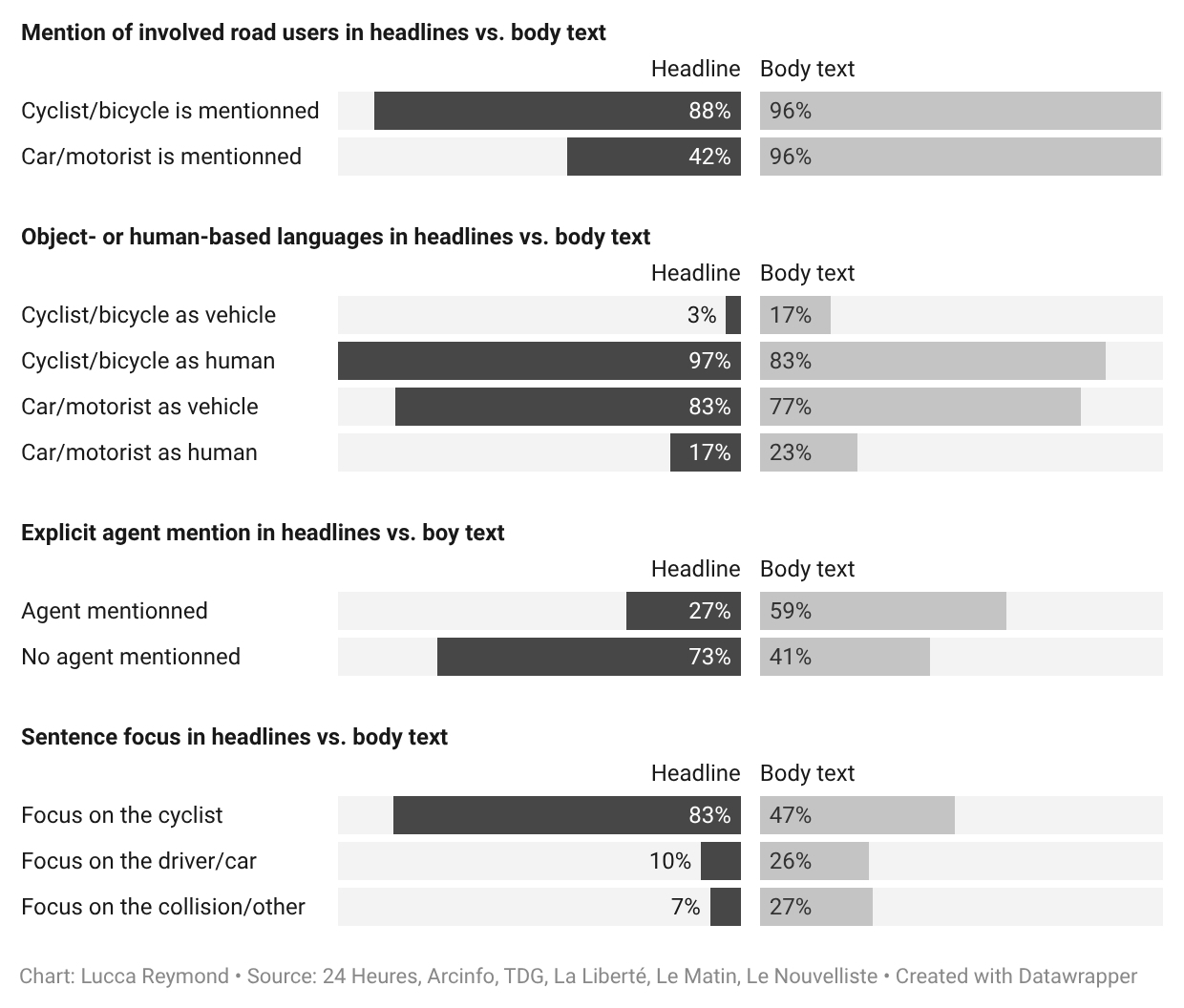
Cyclists are the primary focus of the narrative in 83% of headlines and 47% of body sentences. This overrepresentation directs attention toward the victim while relegating the motorist—when mentioned at all—to the background.
Language choices further shape blame attribution. Motorists appear in only 42% of the headlines, and when they do, they are usually depersonalized and referred to as vehicles (82%). Cyclists, by contrast, appear in 88% of headlines and are almost always described as humans; only 3% are mentioned through their bicycles. This asymmetry obscures the motorist’s role and reinforces a cyclist-centered narrative, even though official data show that cyclists are responsible for only one-third of the collisions they are involved in (Transitec et al. 2023).
Sentence type analysis
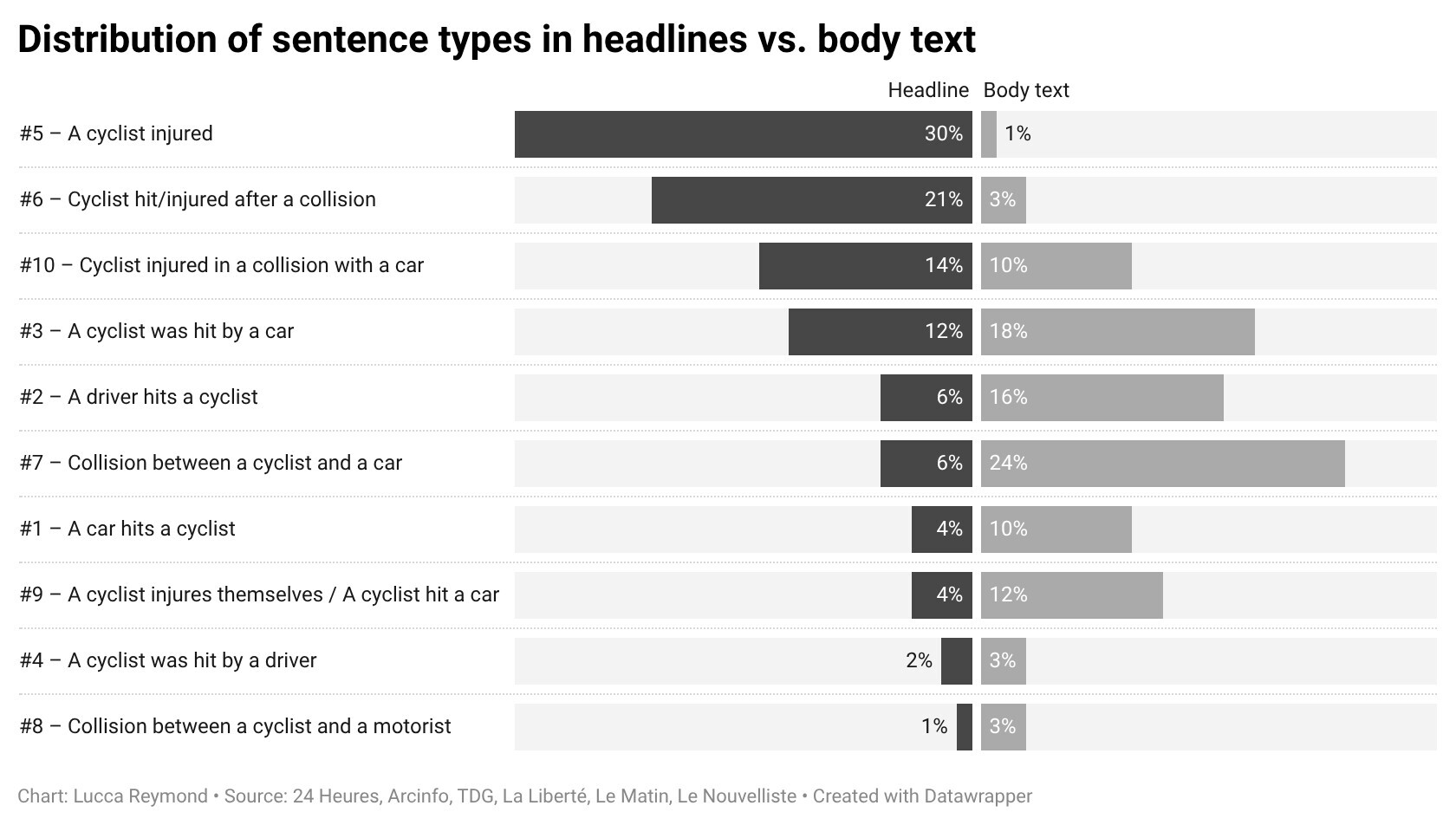
Categorizing sentences reveals how focus, agency, wording, and grammatical structure interact to shape narratives of responsibility (Figure 2). This is particularly consequential in headlines, which are often the only part of the article readers engage with or remember.
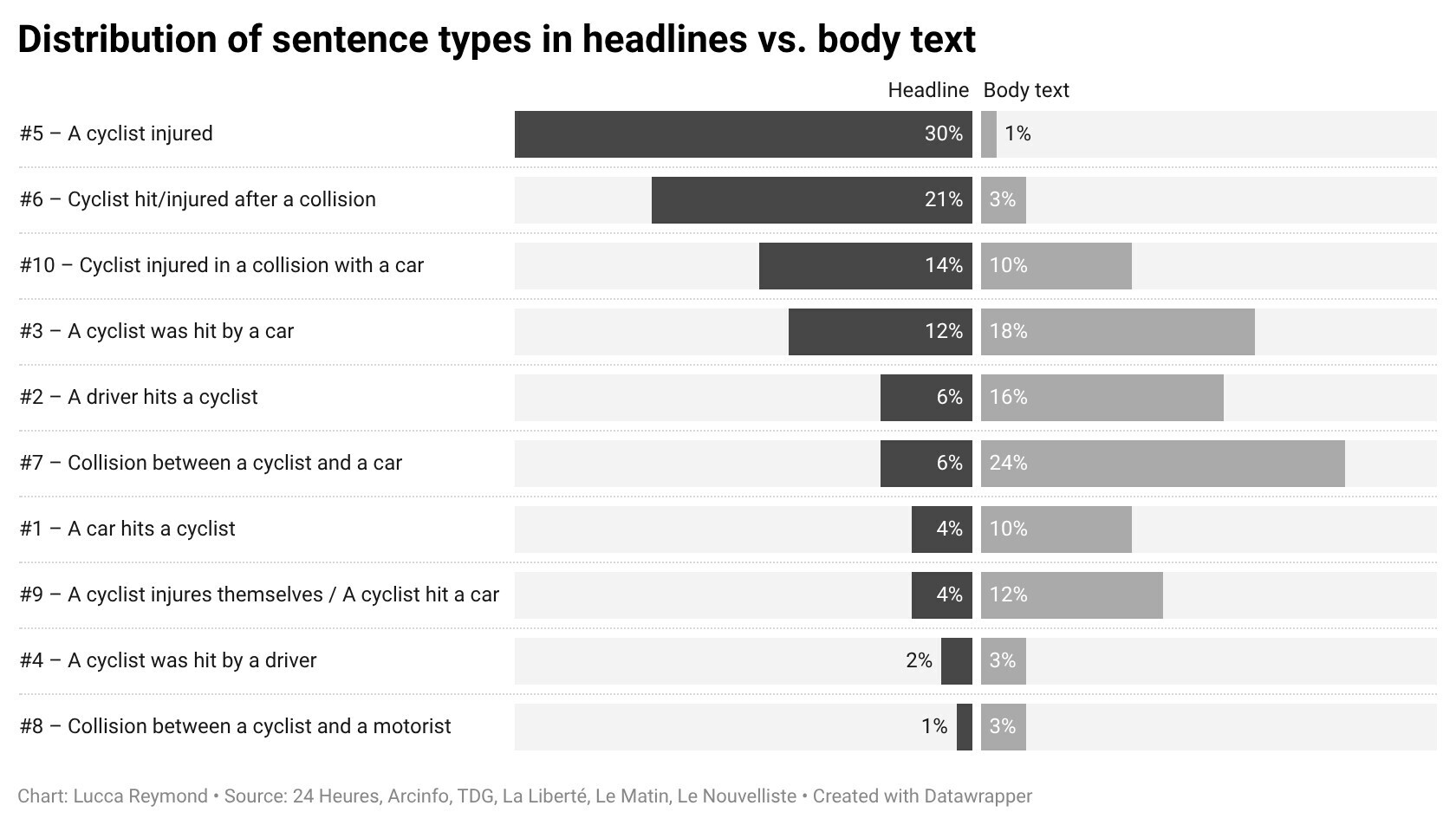
Type #5 (“A cyclist injured”) is the most frequent headline (30%). This non-agentive formulation, often passive or nominal, specifies neither the cause of the injury nor the involvement of another road user (e.g., “Cyclist in hospital”). It is followed by type #6 (“Cyclist injured after a collision”, 21%), which evokes a triggering event without naming another road user, and type #10 (“Cyclist injured in a collision with a car”, 14%), which introduces a second actor, the motorist, but reduces them to a vehicle. Only from type #3 (“A cyclist was hit by a car”, 12%) do we see a grammatical construction identifying an agent, even if still designated by the vehicle. Explicit agentive forms remain rare as in type #1 (“A car hits a cyclist”, 4%) and type #2 (“A driver hits a cyclist”, 6%). Overall, headlines adopt predominantly non-agentive structures, centered on the cyclist’s condition. While active constructions such as type #1 or type #2 explicitly assign causal agency, nominal or event-based formulations such as “A cyclist injured” (Type #5) or “Collision between a cyclist and a car” (Types #7–8) obscure or render causality undetermined.
In the body text, the distribution shifts toward more agentive formulations. Active structures such as type #2 (“A driver hits a cyclist”, 16%) or type #1 (“A car hits a cyclist”, 10%) are more common (e.g., “A motorist struck a cyclist”). Nevertheless, the most frequent form is still type #7 (“Collision between a cyclist and a car”, 24%), a neutral, non-agentive phrasing that names both users (although the car and not the motorist) but avoids assigning responsibility. By contrast, type #5 (“A cyclist injured”), dominant in headlines, becomes marginal in body text (1%), suggesting a more explanatory style once the article develops. Overall, however, passive voice and vehicle-based references to motorists continue to dominate, sustaining ambiguity around responsibility.
Lexical choices
Lexical choices strongly influence how collisions are framed. In headlines, 39% describe both the type of event and its consequences, 27% mention only the event — accident (29%) or collision (27%) — while 30% refer only to the consequences, and 5% omit the event entirely. These patterns show that most headlines rely on incomplete formulations that abstract the context or euphemize the outcome, which detaches collisions from their systemic dimension and fosters an episodic reading.
In body text, accident (74%) dominates over collision (48%), crash (24%), and tragedy (7%). The systematic use of accident[2], with its fatalistic connotation, presents crashes as unavoidable, and obscures human or institutional responsibility. Stronger or more critical terms such as tragedy remain marginal. This framing minimizes the seriousness of collisions and contributes to their normalization as isolated incidents rather than structural problems requiring political action.
Framing
Most articles (93%) adopt an episodic frame, presenting collisions as isolated events without systemic context. Only 7% adopt a thematic frame. Most of these situate crashes within broader regional or national patterns (9 articles), by referring to cumulative fatalities over a given period, while only a few explicitly reference to infrastructure (3) or laws and regulations (2).
This leaves almost no room to question the automobility system. Moreover, only one of the 204 articles included a quote from an expert outside the police. By relying almost exclusively on police sources, media narratives further limit the possibility of interrogating structural causes.
French-speaking Swiss media covering collisions between cyclists and car drivers reproduce discursive biases observed in other countries, revealing a transnational pattern shaped by motonormativity. Motorists are omitted or reduced to their vehicles; their role is blurred through passive voice, non-agentive phrasing, and objectifying language, while systemic causes are rarely mentioned. By invisibilizing car drivers and embedding the car as the legitimate mode of transport, these narratives further marginalize cyclists, who are vulnerable users in car-dominated environments. Making these biases visible is essential for challenging motonormativity and supporting safer, fairer, and more human-centered mobility.
In French: “(Cycliste OR Vélo) AND (choc OR accident OR collision OR percute OR chute) AND (blessé OR décédé) AND (conducteur OR automobiliste OR voiture OR véhicule)”. The exact wording was used, based on a Boolean search with manually defined lexical variants.
The British Medical Journal banned the term “accident” in 2003, noting that it misleadingly suggests inevitability and absence of blame (Davis and Pless 2001).