Loading [Contrib]/a11y/accessibility-menu.js

This website uses cookies

We use cookies to enhance your experience and support COUNTER Metrics for transparent reporting of readership statistics. Cookie data is not sold to third parties or used for marketing purposes.

Skip to main content
null
Findings
  • Menu
  • Articles
    • Energy Findings
    • Resilience Findings
    • Safety Findings
    • Transport Findings
    • Urban Findings
    • All
  • For Authors
  • Editorial Board
  • About
  • Blog
  • search
  • X (formerly Twitter) (opens in a new tab)
  • LinkedIn (opens in a new tab)
  • RSS feed (opens a modal with a link to feed)

RSS Feed

Enter the URL below into your favorite RSS reader.

https://findingspress.org/feed
ISSN 2652-8800
Transport Findings
January 13, 2026 AEST

Determinants of Wayfinding and Information Access for Migrants in Tunisia: A Study During the COVID-19 Pandemic

Aymen GHEDIRA, Ph.D,
Transportation hardshipMigrants exclusionWayfindingOrdred probit modelModal ShiftTunisiacovid-19
Copyright Logoccby-sa-4.0 • https://doi.org/10.32866/001c.154944
Findings
GHEDIRA, Aymen. 2026. “Determinants of Wayfinding and Information Access for Migrants in Tunisia: A Study During the COVID-19 Pandemic.” Findings, January. https:/​/​doi.org/​10.32866/​001c.154944.
Download all (2)
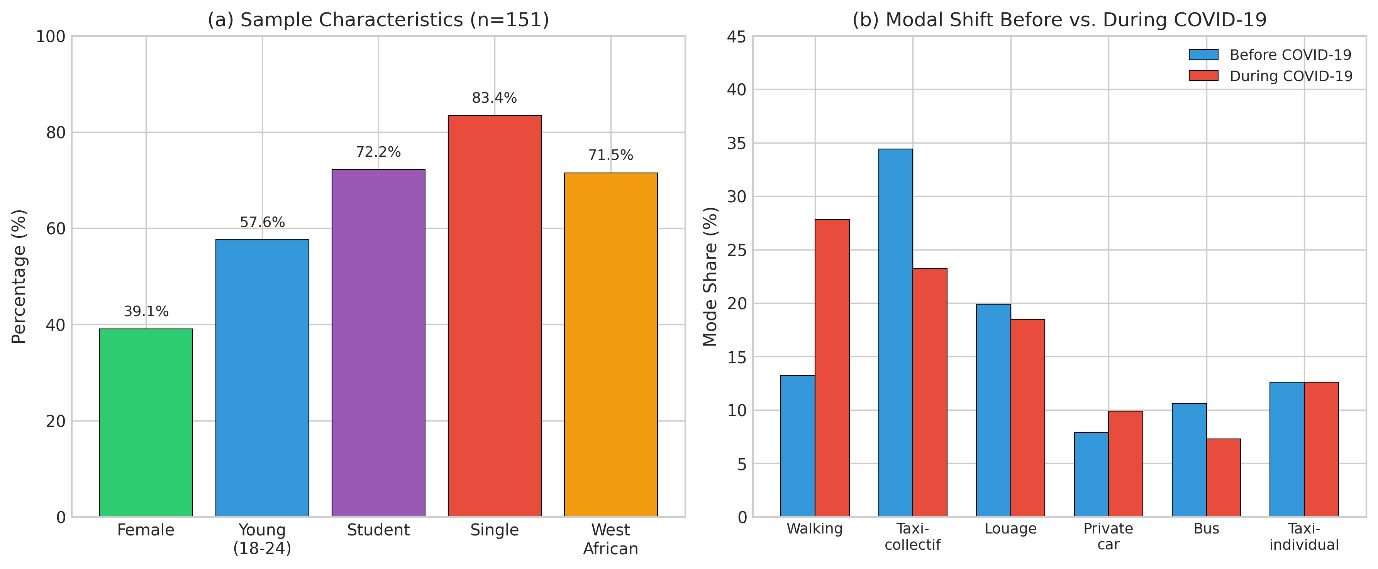
  • Figure 1. (a) Sample characteristics (n = 151). (b) Modal shift before versus during COVID-19.
    Download
  • Supplemental Information
    Download

Sorry, something went wrong. Please try again.

If this problem reoccurs, please contact Scholastica Support

Error message:

undefined

View more stats

Abstract

This study examines the determinants of wayfinding and information access difficulties experienced by Sub-Saharan African migrants in Tunisia during the COVID-19 pandemic. Using survey data from 151 migrants collected in June 2020, we employ ordered probit models to identify key factors associated with these challenges. West African origin significantly reduces the probability of easy wayfinding and information access. The pandemic was associated with a substantial modal shift toward walking and away from shared transport. Daily expenses increased by 17.5% despite reduced mobility. These findings highlight the informational and cognitive barriers faced by migrants, which were exacerbated by the pandemic context.

1. Questions

The COVID-19 pandemic triggered unprecedented global mobility restrictions, profoundly disrupting transportation systems and exacerbating existing inequalities (Sogbe 2021; Thombre and Agarwal 2021). Vulnerable populations, who rely heavily on public and shared transport, were disproportionately affected (McAuliffe 2022; Jenelius 2022). Among these, international migrants face a constellation of intersecting challenges including language barriers (Xu and Zhang 2022), limited social networks (Kearns and Whitley 2015), precarious legal status, and social exclusion (Krannich et al. 2024; Verlinghieri and Schwanen 2020). This study investigates the transportation hardship experienced by Sub-Saharan African migrants in Tunisia, a key transit and destination country in North Africa (IOM 2024; Hlioui 2024), during the initial wave of the pandemic.

This study addresses three questions: (1) How did the pandemic alter the transportation behaviours and modal choices of Sub-Saharan migrants in urban Tunisia? (2) What sociodemographic and geographic factors determine transportation hardship, specifically the ease of wayfinding and information access? (3) How did the pandemic impact the economic dimension of mobility, particularly daily expenditures and travel durations?

2. Methods

We employed a cross-sectional survey using econometric modeling (Washington et al. 2020) in Sousse, Tunisia, in June 2020. A non-probability purposive sample of 151 Sub-Saharan African migrants was recruited through the International Organization for Migration (IOM), yielding a 91.5% response rate. The sampling frame, “migrants engaged with the IOM in Sousse in June 2020,” significantly limits external validity (Kohlenberger et al. 2020). Ethical approval and informed consent were obtained. The survey captured sociodemographic and mobility patterns, with two ordinal dependent variables: Ease of Wayfinding and Ease of Information Access. The exact wording is in the Supplemental Information. We applied ordered probit models (Rizelioğlu, Demir, and Arslan 2024), verifying the parallel regressions assumption (Brant test in SI). We focus on marginal effects and acknowledge limitations, including potential recall bias (Su, Renda, and Zhao 2021) and the absence of instrumental variables for endogenous controls. A Wilcoxon signed-rank test was used for paired before-after measurements.

3. Findings

The analysis provides a multidimensional picture of how the COVID-19 crisis affected migrant mobility. The sample (n=151) was predominantly young (57.6%), male (60.9%), and student (72.2%), with a large majority from West African nations (71.5%).

Figure 1
Figure 1.(a) Sample characteristics (n = 151). (b) Modal shift before versus during COVID-19.

As shown in Figure 1, walking as a primary mode more than doubled (+14.6 pp), while shared taxis (-11.3 pp) and bus use (-3.3 pp) declined. This adaptation reflects both avoidance of crowded vehicles and reduced service availability (Fernandes 2023; Li, Xie, and Gong 2023). Similar modal shifts from public transport to active modes have been documented globally during the pandemic (Christoforou, Psarrou Kalakoni, and Gioldasis 2023; Myftiu et al. 2024). Despite reduced mobility, daily transportation expenditures increased significantly (+17.5%; Wilcoxon W = 2,278, p = 0.005), underscoring a critical hardship as individuals were forced into costlier alternatives.

Table 1.Ordered Probit Results
Variable Ease of
Wayfinding Coef.
Ease of
Wayfinding S.E.
Ease of Information
Access Coef.
Ease of Information
Access S.E.
Female 0.183 0.186 -0.077 0.185
Young (18-24) 0.235 0.238 -0.151 0.235
Student -0.337 0.271 -0.415 0.267
West African -0.742** 0.220 -0.595** 0.216
Daily expense (TND) 0.087* 0.050 0.006 0.049
Trip duration (min) -0.002 0.003 0.004 0.003
Threshold μ1 -1.824 0.421 -1.692 0.407
Threshold μ2 -0.847 0.352 -0.715 0.344
Threshold μ3 0.421 0.342 0.498 0.341
Log-likelihood -180.53 -193.48
AIC 379.1 405.0
BIC 406.2 432.1
N 151 151

The ordered probit models, with full results presented in Table 1, identify regional origin as the most powerful predictor of hardship. The coefficient for the “West African” indicator is negative and highly significant for both Ease of Wayfinding (β = -0.742, p < 0.01) and Ease of Information Access (β = -0.595, p < 0.01), indicating a strong association with increased difficulty. Student status, conversely, is associated with easier information access (β = -0.415), though this effect is not statistically significant for wayfinding. Pre-pandemic daily expense is also weakly associated with easier wayfinding.

Table 2.Marginal Effects for Ease of Wayfinding
Variable P(Difficulty) P(Some Difficulty) P(Easily) P(Very Easily)
West African 0.257** 0.091 -0.201** -0.147**
Student 0.074 -0.018 -0.101 0.101

To interpret the substantive magnitude of these findings, Table 2 presents the average marginal effects for the most impactful predictors. Being of West African origin is associated with a 25.7 percentage point increase in the probability of reporting “With Difficulty” for wayfinding and a 20.1 percentage point increase for information access. These large effects underscore acute navigational and informational barriers. Language barriers have been identified as a critical factor affecting both transportation access and spatial navigation for migrants (Farber et al. 2018; Xu and Zhang 2022). However, the “West African” indicator is a coarse proxy vulnerable to omitted-variable bias; it likely captures unobserved factors such as length of residence, language proficiency, documentation status, and discrimination experiences (Heidinger 2022) rather than a single causal mechanism. In contrast, student status is associated with a 14.5 percentage point decrease in the probability of reporting difficulty with information access, suggesting that educational attainment may confer advantages in navigating information systems. This protective effect was not significant for wayfinding, indicating that educational advantages operate primarily through informational rather than navigational channels.

The stark contrast between regional disparities (25.7 pp) and educational effects (14.5 pp) reveals that migrant origin substantially outweighs educational status as a predictor of transportation hardship. This study demonstrates that during the pandemic’s first wave, Sub-Saharan African migrants in Tunisia experienced significant modal shifts and increased economic burden, stratified by regional origin. The findings highlight the multidimensional nature of transportation-related social exclusion during crisis periods (Bruno, Kouwenberg, and van Oort 2024; Johnson et al. 2025).

Transportation barriers have been shown to significantly impact the settlement and integration of newcomers (Smith et al. 2022), with older migrants and those with limited language proficiency facing specific challenges (Dabelko-Schoeny et al. 2021; Mauldin et al. 2023). The economic burden documented in our study echoes findings from other contexts where vulnerable populations experienced heightened transportation costs during the pandemic (Alhassan et al. 2023).

Interventions targeting language barriers, discrimination, and social integration may be more impactful than education-focused policies for reducing hardship. Social networks play a crucial role in facilitating migrant integration and access to resources (Liu 2019), suggesting that policies supporting community connections could ameliorate transportation-related exclusion. Future research should employ direct measures of language proficiency, documentation status, and discrimination experiences to isolate specific mechanisms. Additionally, longitudinal studies tracking mobility changes beyond the initial pandemic wave, coupled with sensitivity analyses addressing recall bias, would strengthen causal inference. Understanding these barriers is critical for designing inclusive transportation systems that serve vulnerable migrant populations equitably (Casaglia 2021; González Arias and Aikin Araluce 2021).


Data and Code Availability Statement

The data, survey instrument, and analysis code for this study are available on demand.

Supplemental Information

Supplemental information for this article can be found at Determinants_of_Wayfinding_and_Information_Access_Supplemental_Information.pdf.

Submitted: December 22, 2025 AEST

Accepted: January 05, 2026 AEST

References

Alhassan, J. A. K., L. Hanson, S. Abonyi, and C. Neudorf. 2023. “Producing Vulnerability: A Qualitative Analysis of Health Equity Impacts of Budget Cuts to Intercity Public Transportation - Evidence from Saskatchewan, Canada.” Journal of Transport & Health 34:101715. https:/​/​doi.org/​10.1016/​j.jth.2023.101715.
Google Scholar
Bruno, M., M. Kouwenberg, and N. van Oort. 2024. “Addressing Transport Related Social Exclusion through Transportation Policy: A Novel Evaluation Method Applied to the Amsterdam Transport Region.” Transportation Research Interdisciplinary Perspectives 23:101177. https:/​/​doi.org/​10.1016/​j.trip.2024.101177.
Google Scholar
Casaglia, A. 2021. “Borders and Mobility Injustice in the Context of the COVID-19 Pandemic.” Journal of Borderlands Studies. https:/​/​doi.org/​10.1080/​08865655.2021.1918571.
Google Scholar
Christoforou, Z., A. M. Psarrou Kalakoni, and C. Gioldasis. 2023. “Mode Shifts from Public Transport to Bike-Sharing in the Era of COVID-19: Riding Back to Normality.” The Journal of Public Transportation 26:100071. https:/​/​doi.org/​10.1016/​j.jpubtr.2023.100071.
Google Scholar
Dabelko-Schoeny, H., A. Maleku, Q. Cao, K. White, and B. Ozbilen. 2021. “‘We Want to Go, but There Are No Options’: Exploring Barriers and Facilitators of Transportation among Diverse Older Adults.” Journal of Transport and Health 20:100994. https:/​/​doi.org/​10.1016/​J.JTH.2020.100994.
Google Scholar
Farber, S., A. Mifsud, J. Allen, M. J. Widener, and K. B. Newbold. 2018. “Transportation Barriers to Syrian Newcomer Participation and Settlement in Durham Region.” Journal of Transport Geography 68:1–10. https:/​/​doi.org/​10.1016/​J.JTRANGEO.2018.03.014.
Google Scholar
Fernandes, M. A. R. 2023. “Restriction of Public Transport Services as a Part of COVID-19 Containment Policies and User Responses.” In COVID-19 and Mobility, 145–62. Elsevier. https:/​/​doi.org/​10.1016/​b978-0-323-99770-6.00036-3.
Google Scholar
González Arias, A., and O. Aikin Araluce. 2021. “The Impact of the Covid-19 Pandemic on Human Mobility among Vulnerable Groups: Global and Regional Trends.” Journal of Poverty. https:/​/​doi.org/​10.1080/​10875549.2021.1985867.
Google Scholar
Heidinger, E. 2022. “Overcoming Barriers to Service Access: Refugees’ Professional Support Service Utilization and the Impact of Human and Social Capital.” Journal of International Migration and Integration. https:/​/​doi.org/​10.1007/​s12134-022-00939-0.
Google Scholar
Hlioui, A. 2024. “Sub-Saharan Migrants in Post-2011 Tunisia: A Cross-Disciplinary Study of the Dynamics of Media Representations and Policy Shifts.” Doctoral dissertation. https:/​/​tesidottorato.depositolegale.it/​handle/​20.500.14242/​165581.
IOM. 2024. “Migration in Tunisia: A Country Profile 2024.” International Organization for Migration.
Jenelius, E. 2022. “Impact on Public Transport.” Transport and Sustainability 14:381–403. https:/​/​doi.org/​10.1108/​s2044-994120220000017016.
Google Scholar
Johnson, L. L., O. Ebakivie, J. Everett, and S. Wynn. 2025. “Inclusive and Accessible Transportation for All: Strategies for Integrating Equity in Transportation Research.” Logistics 9 (2): 72. https:/​/​doi.org/​10.3390/​logistics9020072.
Google Scholar
Kearns, A., and E. Whitley. 2015. “Getting There? The Effects of Functional Factors, Time and Place on the Social Integration of Migrants.” Journal of Ethnic and Migration Studies 41 (13): 2145–68. https:/​/​doi.org/​10.1080/​1369183X.2015.1030374.
Google Scholar
Kohlenberger, J., I. Buber-Ennser, B. Rengs, and R. Hosner. 2020. “Surveying Syrians in Diaspora: Methodological Aspects for Planning and Implementing Longitudinal Studies.” In Surveying the Migrant/Refugee Crisis in Europe, 49–70. Springer. https:/​/​doi.org/​10.1007/​978-3-030-24451-4_3.
Google Scholar
Krannich, M. et al. 2024. “Social Exclusion of Migrants: The Role of Transportation.” Journal of Transport Geography 115:103518.
Google Scholar
Li, X., B. Xie, and D. Gong. 2023. “Effectiveness Analysis of Public Transit Pandemic Prevention Strategy Considering Traveler Risk Perception.” Sustainability 15 (6): 4961. https:/​/​doi.org/​10.3390/​su15064961.
Google Scholar
Liu, Z. 2019. “Supporting or Dragging? Effects of Neighbourhood Social Ties on Social Integration of Rural-to-Urban Migrants in China.” Housing Studies 34 (8): 1404–33. https:/​/​doi.org/​10.1080/​02673037.2019.1577955.
Google Scholar
Mauldin, R. L., S. P. Mattingly, J. Connolly, L. Thomas, and Z. Tarbet. 2023. “Transportation Behavior among Older Vietnamese Immigrants in the Dallas-Fort Worth Metroplex: Well-Being, Geospatial Mobility, and Potential Indicators for Ride Providers’ Geospatial Burden.” Transportation Research and Education Center. https:/​/​doi.org/​10.15760/​trec.290.
Google Scholar
McAuliffe, M. 2022. “COVID-19 and the Future of Migration.” Migration Policy Institute.
Myftiu, J., C. Gigliarano, E. Maggi, and A. Scagni. 2024. “University Commuting during the COVID-19 Pandemic: Changes in Travel Behaviour and Mode Preferences.” Research in Transportation Business & Management 52:101091. https:/​/​doi.org/​10.1016/​j.rtbm.2023.101091.
Google Scholar
Rizelioğlu, M., Ş. Demir, and T. Arslan. 2024. “Pandemic Insights: Analyzing Public Transport with Logit Models.” Proceedings of the Institution of Civil Engineers - Transport. https:/​/​doi.org/​10.1680/​jtran.23.00075.
Google Scholar
Smith, C., O. Myadar, N. Iroz-Elardo, M. Ingram, and A. Adkins. 2022. “Making of Home: Transportation Mobility and Well-Being among Tucson Refugees.” Journal of Transport Geography 103:103409. https:/​/​doi.org/​10.1016/​j.jtrangeo.2022.103409.
Google Scholar
Sogbe, E. 2021. “The Evolving Impact of Coronavirus (COVID-19) Pandemic on Public Transportation in Ghana.” Case Studies on Transport Policy 9 (4): 1607–14. https:/​/​doi.org/​10.1016/​J.CSTP.2021.08.010.
Google Scholar
Su, T., M. E. Renda, and J. Zhao. 2021. “Examining the Discrepancies between Self-Reported and Actual Commuting Behavior at the Individual Level.” Transportation Research Record 2675 (12): 1047–59. https:/​/​doi.org/​10.1177/​03611981211037240.
Google Scholar
Thombre, A., and A. Agarwal. 2021. “A Paradigm Shift in Urban Mobility: Policy Insights from Travel before and after COVID-19 to Seize the Opportunity.” Transport Policy 110:335–53. https:/​/​doi.org/​10.1016/​J.TRANPOL.2021.06.010.
Google Scholar
Verlinghieri, E., and T. Schwanen. 2020. “Transport and Mobility Justice: Evolving Discussions.” Journal of Transport Geography 87:102798. https:/​/​doi.org/​10.1016/​J.JTRANGEO.2020.102798.
Google Scholar
Washington, S. P. et al. 2020. Statistical and Econometric Methods for Transportation Data Analysis. 3rd ed. CRC Press.
Google Scholar
Xu, D., and Y. Zhang. 2022. “Immigrants’ Language Skills and Carpooling as Need-Based Social Networking: Evidence from Large-Scale National Survey Data.” Travel Behaviour and Society 29:306–18. https:/​/​doi.org/​10.1016/​j.tbs.2022.06.012.
Google Scholar

Powered by Scholastica, the modern academic journal management system