
1. Questions
The COVID-19 pandemic triggered unprecedented global mobility restrictions, profoundly disrupting transportation systems and exacerbating existing inequalities (Sogbe 2021; Thombre and Agarwal 2021). Vulnerable populations, who rely heavily on public and shared transport, were disproportionately affected (McAuliffe 2022; Jenelius 2022). Among these, international migrants face a constellation of intersecting challenges including language barriers (Xu and Zhang 2022), limited social networks (Kearns and Whitley 2015), precarious legal status, and social exclusion (Krannich et al. 2024; Verlinghieri and Schwanen 2020). This study investigates the transportation hardship experienced by Sub-Saharan African migrants in Tunisia, a key transit and destination country in North Africa (IOM 2024; Hlioui 2024), during the initial wave of the pandemic.
This study addresses three questions: (1) How did the pandemic alter the transportation behaviours and modal choices of Sub-Saharan migrants in urban Tunisia? (2) What sociodemographic and geographic factors determine transportation hardship, specifically the ease of wayfinding and information access? (3) How did the pandemic impact the economic dimension of mobility, particularly daily expenditures and travel durations?
2. Methods
We employed a cross-sectional survey using econometric modeling (Washington et al. 2020) in Sousse, Tunisia, in June 2020. A non-probability purposive sample of 151 Sub-Saharan African migrants was recruited through the International Organization for Migration (IOM), yielding a 91.5% response rate. The sampling frame, “migrants engaged with the IOM in Sousse in June 2020,” significantly limits external validity (Kohlenberger et al. 2020). Ethical approval and informed consent were obtained. The survey captured sociodemographic and mobility patterns, with two ordinal dependent variables: Ease of Wayfinding and Ease of Information Access. The exact wording is in the Supplemental Information. We applied ordered probit models (Rizelioğlu, Demir, and Arslan 2024), verifying the parallel regressions assumption (Brant test in SI). We focus on marginal effects and acknowledge limitations, including potential recall bias (Su, Renda, and Zhao 2021) and the absence of instrumental variables for endogenous controls. A Wilcoxon signed-rank test was used for paired before-after measurements.
3. Findings
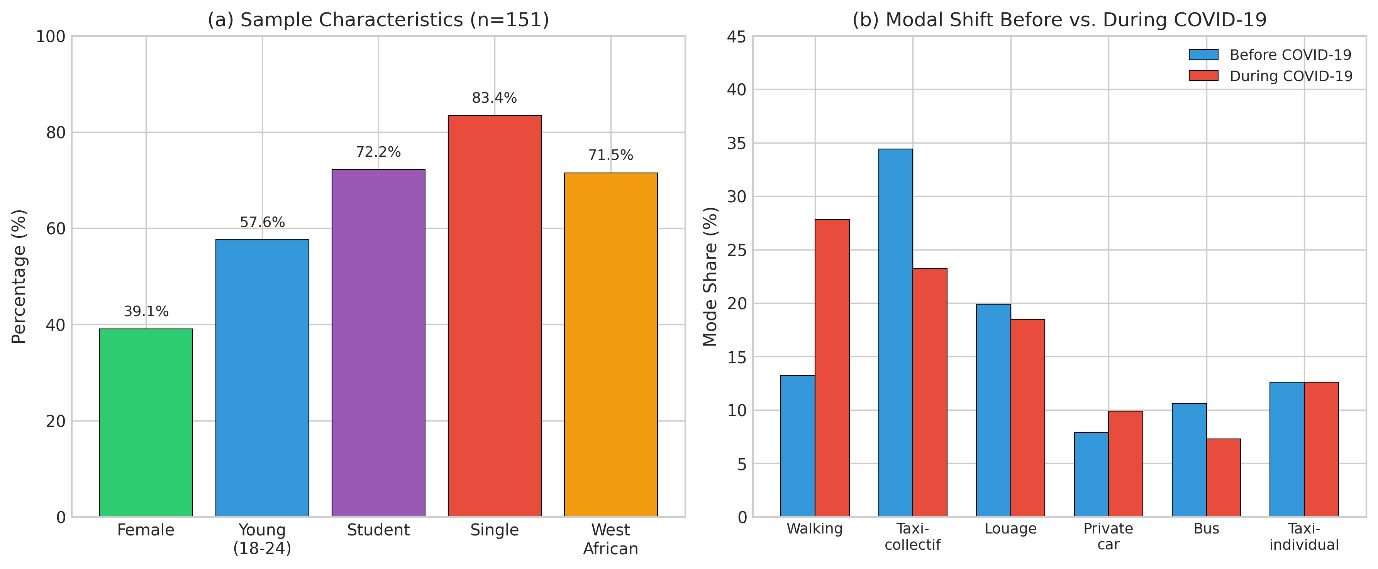
The analysis provides a multidimensional picture of how the COVID-19 crisis affected migrant mobility. The sample (n=151) was predominantly young (57.6%), male (60.9%), and student (72.2%), with a large majority from West African nations (71.5%).
_sample_characteristics_(n___151)._(b)_modal_shift_before_versus_during_covid-19.png)
As shown in Figure 1, walking as a primary mode more than doubled (+14.6 pp), while shared taxis (-11.3 pp) and bus use (-3.3 pp) declined. This adaptation reflects both avoidance of crowded vehicles and reduced service availability (Fernandes 2023; Li, Xie, and Gong 2023). Similar modal shifts from public transport to active modes have been documented globally during the pandemic (Christoforou, Psarrou Kalakoni, and Gioldasis 2023; Myftiu et al. 2024). Despite reduced mobility, daily transportation expenditures increased significantly (+17.5%; Wilcoxon W = 2,278, p = 0.005), underscoring a critical hardship as individuals were forced into costlier alternatives.
The ordered probit models, with full results presented in Table 1, identify regional origin as the most powerful predictor of hardship. The coefficient for the “West African” indicator is negative and highly significant for both Ease of Wayfinding (β = -0.742, p < 0.01) and Ease of Information Access (β = -0.595, p < 0.01), indicating a strong association with increased difficulty. Student status, conversely, is associated with easier information access (β = -0.415), though this effect is not statistically significant for wayfinding. Pre-pandemic daily expense is also weakly associated with easier wayfinding.
To interpret the substantive magnitude of these findings, Table 2 presents the average marginal effects for the most impactful predictors. Being of West African origin is associated with a 25.7 percentage point increase in the probability of reporting “With Difficulty” for wayfinding and a 20.1 percentage point increase for information access. These large effects underscore acute navigational and informational barriers. Language barriers have been identified as a critical factor affecting both transportation access and spatial navigation for migrants (Farber et al. 2018; Xu and Zhang 2022). However, the “West African” indicator is a coarse proxy vulnerable to omitted-variable bias; it likely captures unobserved factors such as length of residence, language proficiency, documentation status, and discrimination experiences (Heidinger 2022) rather than a single causal mechanism. In contrast, student status is associated with a 14.5 percentage point decrease in the probability of reporting difficulty with information access, suggesting that educational attainment may confer advantages in navigating information systems. This protective effect was not significant for wayfinding, indicating that educational advantages operate primarily through informational rather than navigational channels.
The stark contrast between regional disparities (25.7 pp) and educational effects (14.5 pp) reveals that migrant origin substantially outweighs educational status as a predictor of transportation hardship. This study demonstrates that during the pandemic’s first wave, Sub-Saharan African migrants in Tunisia experienced significant modal shifts and increased economic burden, stratified by regional origin. The findings highlight the multidimensional nature of transportation-related social exclusion during crisis periods (Bruno, Kouwenberg, and van Oort 2024; Johnson et al. 2025).
Transportation barriers have been shown to significantly impact the settlement and integration of newcomers (Smith et al. 2022), with older migrants and those with limited language proficiency facing specific challenges (Dabelko-Schoeny et al. 2021; Mauldin et al. 2023). The economic burden documented in our study echoes findings from other contexts where vulnerable populations experienced heightened transportation costs during the pandemic (Alhassan et al. 2023).
Interventions targeting language barriers, discrimination, and social integration may be more impactful than education-focused policies for reducing hardship. Social networks play a crucial role in facilitating migrant integration and access to resources (Liu 2019), suggesting that policies supporting community connections could ameliorate transportation-related exclusion. Future research should employ direct measures of language proficiency, documentation status, and discrimination experiences to isolate specific mechanisms. Additionally, longitudinal studies tracking mobility changes beyond the initial pandemic wave, coupled with sensitivity analyses addressing recall bias, would strengthen causal inference. Understanding these barriers is critical for designing inclusive transportation systems that serve vulnerable migrant populations equitably (Casaglia 2021; González Arias and Aikin Araluce 2021).
Data and Code Availability Statement
The data, survey instrument, and analysis code for this study are available on demand.
Supplemental Information
Supplemental information for this article can be found at Determinants_of_Wayfinding_and_Information_Access_Supplemental_Information.pdf.