
1. Questions
Spatial differences in the built environment and transport accessibility are known to shape daily travel behaviour and mobility outcomes. In the Israeli context, these differences are closely linked to long-standing patterns of residential segregation and uneven infrastructural investment, particularly between Jewish and Arab towns.
Ethnic identity is therefore not expected to influence travel behaviour directly. Rather, it reflects historically produced spatial conditions—such as land-use structure, transport provision, and access to urban opportunities—that systematically shape everyday mobility. From this perspective, ethnicity functions as a proxy for structural and spatial disadvantage rather than an independent causal factor.
The presence of Arab residents living in Jewish towns provides a rare empirical opportunity to examine how residential context is associated with mobility outcomes within the same metropolitan region. The analysis compares Jews living in Jewish towns (JJ), Arabs living in Jewish towns (AJ), and Arabs living in Arab towns (AA). Mixed cities are excluded due to their internal spatial heterogeneity, which limits the ability to assign a consistent residential context at the town level.
The study addresses two research questions:
-
Do Arabs living in Jewish towns exhibit travel behaviour patterns similar to Jews living in Jewish towns or to Arabs living in Arab towns?
-
To what extent do contextual factors—specifically household vehicle availability and neighbourhood density—attenuate observed mobility gaps between these groups?
2. Methods
Data Source
The analysis uses data from the 2016–2017 Tel Aviv Household Travel Survey, commissioned by Ayalon Highways and publicly available via OData Israel. The survey combines passive GPS tracking with detailed household and individual questionnaires, allowing precise measurement of daily travel behaviour. Household-level attributes are linked to individual respondents. Detailed documentation of data processing and weighting procedures is provided in the Supplementary Information (Section S1).
Sample and Group Definition
The final analytic sample includes 13,503 respondents residing in the Tel Aviv metropolitan area. Individuals are classified into three resident groups based on ethnic identity and town of residence: Jews living in Jewish towns (JJ), Arabs living in Jewish towns (AJ), and Arabs living in Arab towns (AA). Towns are classified according to official Central Bureau of Statistics designations. Mixed cities are excluded because their internal spatial heterogeneity makes it difficult to assign a consistent residential context at the town level. Jews residing in Arab towns are not analysed due to their very small representation in the dataset, which limits statistical reliability.
Outcomes and Predictors
Six travel outcomes are examined: total daily distance, commute distance, total daily travel time, commute time, mean travel speed, and the number of travel companions. Residential group indicators constitute the primary explanatory variables. Contextual factors include household vehicle availability and neighbourhood population density, both standardised as z-scores. All models control for age, gender, household size, and fuel-expense coverage. Full variable definitions are reported in the Supplementary Information (Section S3).
Analytical Strategy
The analysis follows a quasi-experimental, associational design. First, weighted analyses of covariance (ANCOVA) are used to estimate adjusted group differences in travel outcomes, reported as estimated marginal means (EMMs) with 95% confidence intervals. These estimates describe differences across resident groups after accounting for observed covariates.
Second, multiple regression models are estimated to examine whether contextual factors moderate observed group differences. Interaction terms between resident group and household vehicle availability, as well as between resident group and neighbourhood density, are included to assess how mobility gaps vary under different contextual conditions. All models apply survey weights and cluster standard errors at the household level. Complete model specifications and robustness checks are reported in the Supplementary Information (Sections S4–S6).
3. Findings
3.1. Group Differences in Travel Outcomes (Adjusted Means)
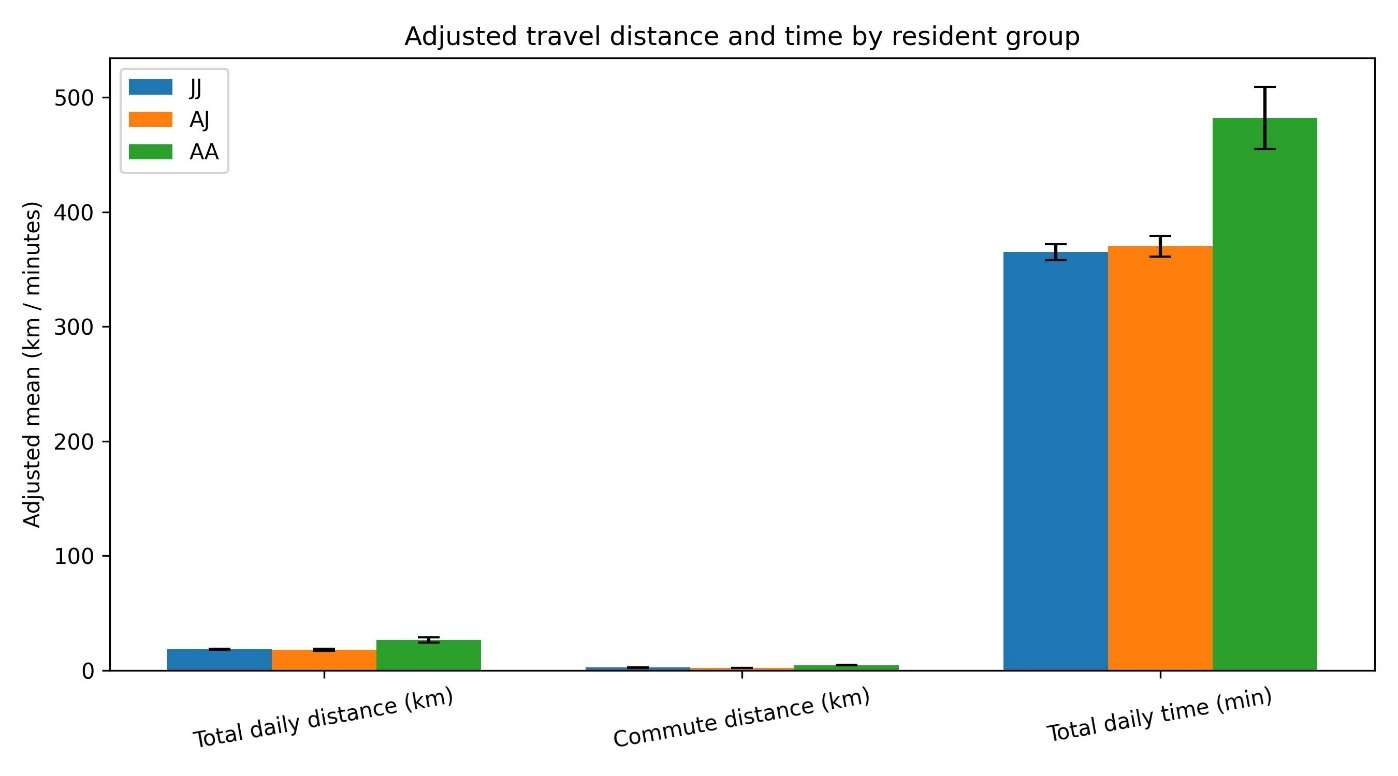
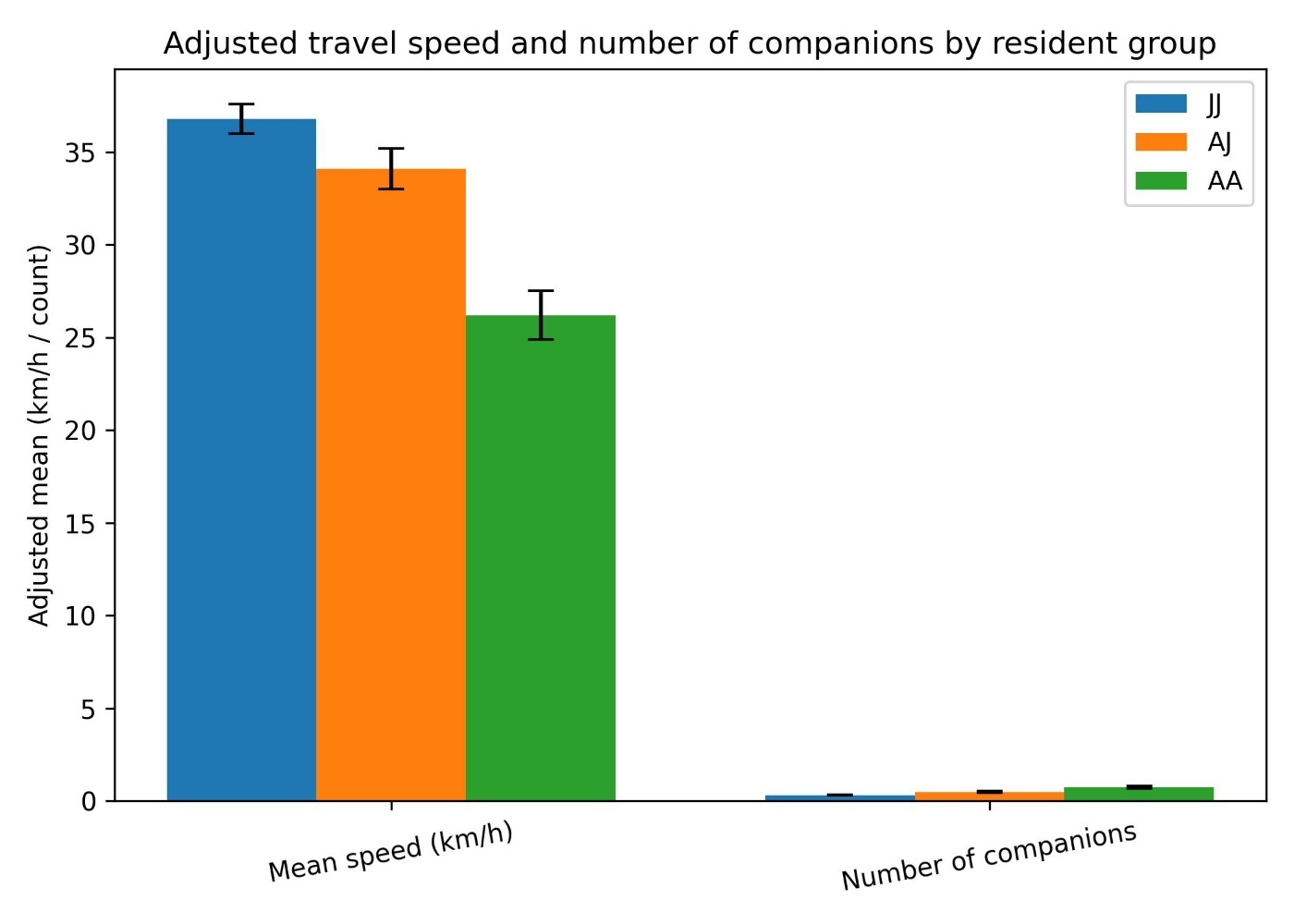
Adjusted group differences in travel behaviour are estimated using weighted analyses of covariance (ANCOVA). Figure 1a displays estimated marginal means (EMMs) with 95% confidence intervals for travel distance and time across the three resident groups: Jews living in Jewish towns (JJ), Arabs living in Jewish towns (AJ), and Arabs living in Arab towns (AA). Figure 1b presents corresponding adjusted means for travel speed and the number of travel companions.
.jpeg)
.jpeg)
Across all outcomes, AJ and JJ display closely aligned travel patterns, while AA differs substantially from both groups. For commute distance, JJ averages 2.30 km (95% CI: 2.22–2.38) and AJ averages 2.10 km (95% CI: 1.98–2.22), compared with 4.50 km for AA (95% CI: 4.12–4.88). Similar patterns are observed for total daily distance and total daily travel time: residents of Arab towns travel farther and spend more time traveling, while Arabs living in Jewish towns exhibit outcomes close to those of Jewish residents. Mean travel speed is lower in Arab towns than in Jewish towns, whereas the number of travel companions is higher among AA and AJ than among JJ. Full adjusted means for all six outcomes are reported in Supplementary Table S3.
3.2. Interaction Effects: Contextual Moderation
To examine whether contextual factors moderate observed group differences, interaction regression models are estimated including household vehicle availability and neighbourhood density. Table 1 reports coefficients from the primary interaction model for commute distance, while full models for additional outcomes are reported in Supplementary Tables S5–S6.
Results indicate that household vehicle availability and neighbourhood density are both significantly associated with commute distance. Higher vehicle availability is associated with longer commute distances overall; however, the interaction term indicates that greater vehicle availability attenuates the commute distance gap between residents of Arab towns and the JJ reference group. Similarly, higher neighbourhood density is associated with shorter commute distances and reduces the magnitude of the AA–JJ difference. In contrast, coefficients for the AJ group are small and mostly statistically non-significant, indicating limited evidence of contextual moderation for Arabs residing in Jewish towns.
3.3. Summary of Empirical Patterns
Taken together, the results document a consistent empirical pattern across multiple mobility indicators. Residents of Arab towns experience systematically longer and slower travel than residents of Jewish towns, while Arabs residing in Jewish towns exhibit mobility outcomes similar to those of Jewish residents. Differences between residents of Arab and Jewish towns are partially mitigated under conditions of higher household vehicle availability and greater neighbourhood density, but they are not fully eliminated.
ACKNOWLEDGMENTS
Diana Saadi acknowledges support from the Fine Fellowship, Technion.
We thank the Fair Transport Lab for access to the Tel Aviv Household Travel Survey.