Loading [Contrib]/a11y/accessibility-menu.js

This website uses cookies

We use cookies to enhance your experience and support COUNTER Metrics for transparent reporting of readership statistics. Cookie data is not sold to third parties or used for marketing purposes.

Skip to main content
null
Findings
  • Menu
  • Articles
    • Energy Findings
    • Resilience Findings
    • Safety Findings
    • Transport Findings
    • Urban Findings
    • All
  • For Authors
  • Editorial Board
  • About
  • Blog
  • covid-19
  • search
  • X (formerly Twitter) (opens in a new tab)
  • LinkedIn (opens in a new tab)
  • RSS feed (opens a modal with a link to feed)

RSS Feed

Enter the URL below into your favorite RSS reader.

https://findingspress.org/feed
ISSN 2652-8800
Transport Findings
December 30, 2025 AEST

A Gendered Analysis of the Mobility of Care Done by Bike in Victoria, Canada

Naeva Scott Bouris, Meghan Winters, BSc, MSc, Ph.D.,
mobility of caregendercyclingcargo bikeselectrificationbicyclee-bike
Copyright Logoccby-sa-4.0 • https://doi.org/10.32866/001c.154704
Findings
Scott Bouris, Naeva, and Meghan Winters. 2025. “A Gendered Analysis of the Mobility of Care Done by Bike in Victoria, Canada.” Findings, December. https:/​/​doi.org/​10.32866/​001c.154704.
Download all (3)
  • Figure 1. Data collection sites for observations of mobility of care by bike in Victoria, British Columbia.
    Download
  • Figure 2. Examples of common child-carrying cycle set-ups.
    Download
  • Figure 3. Comparison of electric cycle use amongst those carrying and not carrying children
    Download

Sorry, something went wrong. Please try again.

If this problem reoccurs, please contact Scholastica Support

Error message:

undefined

View more stats

Abstract

Women do a majority of mobility of care; in Canada they also tend to cycle less. We look at mobility of care by bike, specifically the gendered dimensions of child transportation and the equipment used to facilitate it. We observed 4026 people cycling in Victoria, Canada, 6.1% of whom were carrying children. The gender split was ~40:60 women: men, nearly identical for those with and without children. Electric cycle use was 2.5 times higher for those carrying children, and two-thirds were using cargo bikes. Findings show that mobility of care by bike is similar to overall bike use across genders and that cycling technologies appear important in uptake.

1. QUESTIONS

In Canadian cities, women make up only one-third of cyclists (Mitra and Nash 2019; Winters et al. 2023). Research focused on Canadian contexts has suggested that reasons for this disparity include concerns related to safety in low-cycling environments and cycling ability (Mitra and Nash 2019; Ravensbergen, Buliung, and Laliberté 2019). It may also be due to household and care-related responsibilities, for which women continue to take on larger shares of the load (Ravensbergen, Buliung, and Sersli 2020; Ravensbergen, Fournier, and El-Geneidy 2023; Yao, Blumenberg, and Wander 2024). These mobility of care trips may be more difficult to conduct via bike (Sersli et al. 2020). For cycling to be an option for more people for more trips, transportation planning and design needs to more explicitly consider women and families (Lam 2022). Limited research has been done that looks at mobility of care by bike. One indicator of mobility of care is transporting children by bike – especially carrying children on board using cargo bikes, trailers, bike seats, or the like. The increasing access to electric cycles may further support mobility of care by bike, and/or increase ridership amongst women (Carracedo and Mostofi 2022; Ling et al. 2017). Little is known about who does this type of travel and how they go about it.

In this context, we conducted observational research of people who cycle in Victoria, Canada, asking:

  1. What are the gendered patterns in who does mobility of care by bike?

  2. What equipment do they use for these trips?

2. METHODS

Study Area

Victoria, Canada is home to approximately 92,000 people (Statistics Canada 2022) and has relatively high rates of ridership, where about 12.8% of daily trips are made by bike (Capital Regional District [CRD] 2022). Victoria has made recent investments in an All Ages and Abilities cycling network, with the target of having 95% of Victoria residents living within 500 m of safe cycling infrastructure (Basu 2024; Blandy 2024).

Data collection

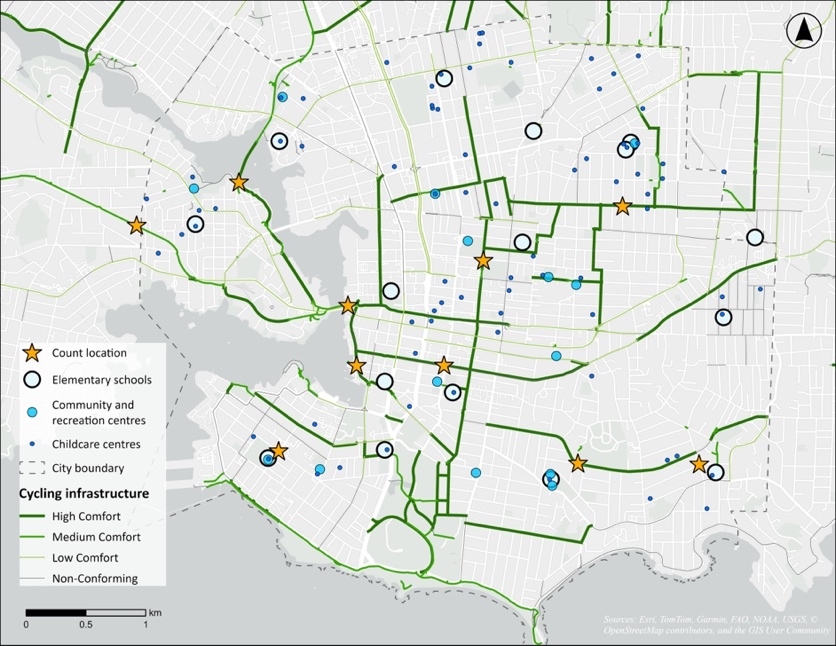
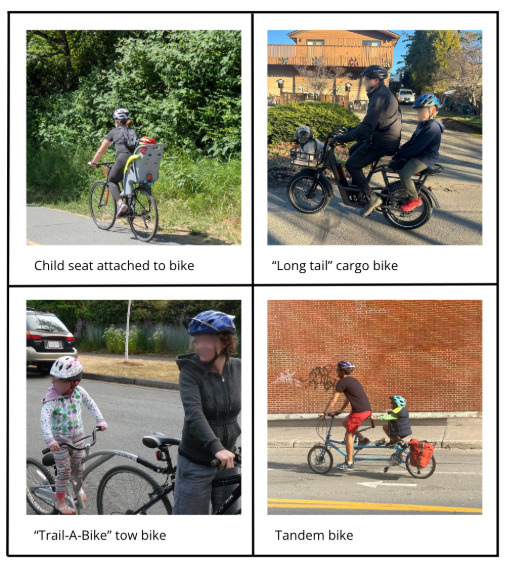
We recorded data on people cycling during morning commute hours (7:30AM to 9:30AM) in May/June and September/October 2025. We observed for a total of 30 hours at 10 locations along popular cycling routes and close to the destinations for children and families (schools, parks, childcare, community centres) (Figure 1). We classified cyclists by perceived gender (man, woman, other/unsure), electrification of cycle, and the type of child-carrying device used (cargo bike or other type of child-carrying device) if applicable (Figure 2).

Figure 1
Figure 1.Data collection sites for observations of mobility of care by bike in Victoria, British Columbia.

Data Sources: Cycling infrastructure, based on OSM-Canadian Bikeway Comfort and Safety (Can-BICS) data (2024) https://www.arcgis.com/home/item.html?id=efaf04c6e3914c059bfb7298e784a89c; Schools and communities centres, based on City of Victoria Open Data (https://opendata.victoria.ca/) and childcare centres from British Columbia Data Catalogue (https://catalogue.data.gov.bc.ca/).

Figure 2
Figure 2.Examples of common child-carrying cycle set-ups.

Source: Author’s images.

We relied on perceptions of gender for pragmatic reasons. This approach has been used in past research (Winters et al. 2023); however, we acknowledge that data collectors’ perceptions of cyclist gender may result in some misclassification, and also that using three categories for gender does not encompass the spectrum of diverse gender identities. We considered only those carrying children on board at the time as doing mobility of care, as this was easily observable. However, mobility of care can be more broadly defined, including return trips after child drop offs, trips where children may be riding alongside but not on board, or even other trips (without children) that support household needs or dependants (Sánchez de Madriaga 2013). Efforts that include intercept studies or interviews with caregivers can complement this observational research.

3. FINDINGS

We observed 4026 people cycling, 6.1% (n=244) of whom were carrying children on board. The observed gender split was: 39.5% women, 59.3% men, 1.2% other/unsure (Table 1). The observed proportion of women is somewhat higher than many Canadian cities (Mitra and Nash 2019; Winters et al. 2023). While Canada is a low-cycling country overall, the City of Victoria is considered a high-cycling city, by Canadian standards (Statistics Canada 2024). The relatively high proportion of women cycling observed in Victoria resonates with findings from a multi-country study that reported greater gender parity in cycling in regions with higher cycling rates (and even more women cycling than men, in countries like Japan and the Netherlands) (Goel et al. 2022)."

Table 1.Observations of people cycling in Victoria, BC, by gender, carrying children, and electrification, and type of cycle
Total (n) Gender Gender split
Women (n) Men (n) Other/ Unsure (n) % Women : % Men*
Overall (n=4026) 4026 1589 2387 50 39.5 : 59.3
Carrying children Yes 244 97 147 0 39.8 : 60.2
No 3782 1492 2240 50 39.5 : 59.2
Electrification Yes 1256 560 682 14 44.6 : 54.3
No 2770 1029 1705 36 37.1 : 61.6
Amongst those carrying children (n=244) 97 147
Electrification Yes 189 83 106
No 55 14 41
Cargo bike Yes 163 73 90
No 81 24 57

*Gender was based on observer perception. 50 people were categorized as other/unsure for gender and not included in the gender split calculations.

Notably, we found the gender split was nearly identical for those people carrying children on cycles (39.8% women; 60.2% men), with those not carrying children (39.5% women; 59.2% men). As women generally tend to do more mobility of care work (Ravensbergen, Buliung, and Sersli 2020), it may have been expected that a greater proportion of the people who were carrying children on bikes were women. However, women express greater concerns about physical challenges and safety, especially when cycling with children and/or in low-cycling countries (Aldred et al. 2017; Hosford et al. 2020; Sersli et al. 2020).

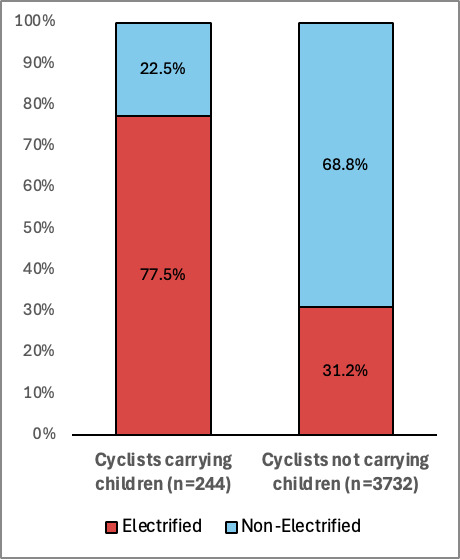
The physical challenges associated with cycling can be mediated by electric cycles. We saw that 31.2% of cycles were electrified overall, slightly higher for women (35.2% (560/1589) than men (28.6% (682/2387)). In terms of the equipment used by people carrying children, we saw that electrification was about 2.5 times higher for people carrying children, where over three-quarters of cycles were electrified (77.5% (189/244) (Figure 3). This was higher for women carrying children (85.6%) than for men (72.1%). Electric cycles have been found to help promote women’s cycling by facilitating domestic tasks such as carrying children or gear, reducing the time commitment associated with active transportation, and making cycling more physically accessible (Thomas 2022; Wild, Woodward, and Shaw 2021).

Figure 3
Figure 3.Comparison of electric cycle use amongst those carrying and not carrying children

Cargo bikes, characterized as having a built-in box or platform to carry children or goods, were the most common type of child-carrying cycle used, by two-thirds (66.8%) of people carrying children (75.3% of women carrying children, 61.2% of men). Cargo bikes, which are commonly used by parents in high-cycling countries such as the Netherlands and Denmark, provide caregivers with a flexible option to carry multiple children at once, accommodate children as they grow, and transport other goods and gear (Boterman 2020; Marincek D., Rérat, P., and Lurkin, V., 2024; Riggs and Schwartz 2018). Most cargo bikes were electrified (93.9% (153/163), 95.9% of women on cargo bikes, 92.2% of men).

These findings show that mobility of care by bike, specifically carrying children on board, is commonly done by both men and women, though the equipment used does vary. Understanding how to support this type of travel is crucial to guide future infrastructure development that is tailored to the needs of women and families, and to promote cycling for trip purposes beyond the commute.


ACKNOWLEDGEMENTS

We recognize Grace O’Regan for data collection efforts and Jaimy Fischer for mapping support. This work was supported by Winters’ CIHR/PHAC Applied Public Health Chair, Gender and Sex in Healthy Cities (Grant #471526).

Submitted: December 01, 2025 AEST

Accepted: December 22, 2025 AEST

References

Aldred, R., B. Elliott, J. Woodcock, and A. Goodman. 2017. “Cycling Provision Separated from Motor Traffic: A Systematic Review Exploring Whether Stated Preferences Vary by Gender and Age.” Transport Reviews 37 (1): 29–55. https:/​/​doi.org/​10.1080/​01441647.2016.1200156.
Google Scholar
Basu, B. 2024. “Victoria Named Itself the Cycling Capital of Canada. Does It Deserve the Title?” CBC News. February 8, 2024. https:/​/​www.cbc.ca/​news/​canada/​british-columbia/​victoria-cycling-capital-1.7109605.
Blandy, C. 2024. “Councillors Look to Officially Dub Victoria as ‘Cycling Capital of Canada.’” Victoria Buzz. February 6, 2024. https:/​/​victoriabuzz.com/​2024/​02/​councillors-look-to-officially-dub-victoria-as-cycling-capital-of-canada/​.
Boterman, W. R. 2020. “Carrying Class and Gender: Cargo Bikes as Symbolic Markers of Egalitarian Gender Roles of Urban Middle Classes in Dutch Inner Cities.” Social & Cultural Geography 21 (2): 245–64. https:/​/​doi.org/​10.1080/​14649365.2018.1489975.
Google Scholar
Capital Regional District [CRD]. 2022. “CRD Origin Destination Household Travel Survey.” Malatest & Associates Ltd. & David Kriger Consultants Inc. https:/​/​www.crd.ca/​media/​file/​crd-2022-origin-destination-household-travel-survey-report.
Carracedo, D., and H. Mostofi. 2022. “Electric Cargo Bikes in Urban Areas: A New Mobility Option for Private Transportation.” Transportation Research Interdisciplinary Perspectives 16:100705. https:/​/​doi.org/​10.1016/​j.trip.2022.100705.
Google Scholar
Goel, R., A. Goodman, R. Aldred, R. Nakamura, L. Tatah, L. M. T. Garcia, B. Zapata-Diomedi, et al. 2022. “Cycling Behaviour in 17 Countries across 6 Continents: Levels of Cycling, Who Cycles, for What Purpose, and How Far?” Transport Reviews 42 (1): 58–81. https:/​/​doi.org/​10.1080/​01441647.2021.1915898.
Google Scholar
Hosford, K., K. Laberee, D. Fuller, Y. Kestens, and M. Winters. 2020. “Are They Really Interested but Concerned? A Mixed Methods Exploration of the Geller Bicyclist Typology.” Transportation Research Part F: Traffic Psychology and Behaviour 75:26–36. https:/​/​doi.org/​10.1016/​j.trf.2020.09.018.
Google Scholar
Lam, T. 2022. “Towards an Intersectional Perspective in Cycling.” Active Travel Studies 2 (1). https:/​/​doi.org/​10.16997/​ats.1264.
Google Scholar
Ling, Z., C. R. Cherry, J. H. MacArthur, and J. X. Weinert. 2017. “Differences of Cycling Experiences and Perceptions between E-Bike and Bicycle Users in the United States.” Sustainability 9 (9): 1662. https:/​/​doi.org/​10.3390/​su9091662.
Google Scholar
Mitra, R., and S. Nash. 2019. “Can the Built Environment Explain Gender Gap in Cycling? An Exploration of University Students’ Travel Behavior in Toronto, Canada.” International Journal of Sustainable Transportation 13 (2): 138–47. https:/​/​doi.org/​10.1080/​15568318.2018.1449919.
Google Scholar
Ravensbergen, L., R. Buliung, and N. Laliberté. 2019. “Toward Feminist Geographies of Cycling.” Geography Compass 13 (7): e12461. https:/​/​doi.org/​10.1111/​gec3.12461.
Google Scholar
Ravensbergen, L., R. Buliung, and S. Sersli. 2020. “Vélomobilities of Care in a Low-Cycling City.” Transportation Research Part A: Policy and Practice 134:336–47. https:/​/​doi.org/​10.1016/​j.tra.2020.02.014.
Google Scholar
Ravensbergen, L., J. Fournier, and A. El-Geneidy. 2023. “Exploratory Analysis of Mobility of Care in Montreal, Canada.” Transportation Research Record 2677 (1): 1499–1509. https:/​/​doi.org/​10.1177/​03611981221105070.
Google Scholar
Riggs, W., and J. Schwartz. 2018. “The Impact of Cargo Bikes on the Travel Patterns of Women.” Urban, Planning and Transport Research 6 (1): 95–110. https:/​/​doi.org/​10.1080/​21650020.2018.1553628.
Google Scholar
Sánchez de Madriaga, I. 2013. “Mobility of Care: Introducing New Concepts in Urban Transport.” In Fair Shared Cities: The Impact of Gender Planning in Europe. Routledge.
Google Scholar
Sersli, S., M. Gislason, N. Scott, and M. Winters. 2020. “Riding Alone and Together: Is Mobility of Care at Odds with Mothers’ Bicycling?” Journal of Transport Geography 83:102645. https:/​/​doi.org/​10.1016/​j.jtrangeo.2020.102645.
Google Scholar
Statistics Canada. 2022. “Profile Table, Census Profile, 2021 Census of Population—Victoria, City (CY) [Census Subdivision], British Columbia.” Statistics Canada. https:/​/​www12.statcan.gc.ca/​census-recensement/​2021/​dp-pd/​prof/​details/​page.cfm?Lang=E&SearchText=victoria&GENDERlist=1&STATISTIClist=1&DGUIDlist=2021A00055917034&HEADERlist=0.
———. 2024. “More Canadians Commuting in 2024.” Statistics Canada. 2024. https:/​/​www150.statcan.gc.ca/​n1/​daily-quotidien/​240826/​dq240826a-eng.htm.
Thomas, A. 2022. “Electric Bicycles and Cargo Bikes—Tools for Parents to Keep on Biking in Auto-Centric Communities? Findings from a US Metropolitan Area.” International Journal of Sustainable Transportation 16 (7): 637–46. https:/​/​doi.org/​10.1080/​15568318.2021.1914787.
Google Scholar
Wild, K., A. Woodward, and C. Shaw. 2021. “Gender and the E-Bike: Exploring the Role of Electric Bikes in Increasing Women’s Access to Cycling and Physical Activity.” Active Travel Studies 0. https:/​/​doi.org/​10.16997/​ats.991.
Google Scholar
Winters, M., J. Beairsto, R. Mitra, K. Walker, M. Zanotto, K. Laberee, A. Soucy, et al. 2023. “Pedal Poll/Sondo Vélo 2021: A Community Science Project on Who Cycles in Canada.” Journal of Transport Health 30:101606. https:/​/​doi.org/​10.1016/​j.jth.2023.101606.
Google Scholar
Yao, Z., E. Blumenberg, and M. Wander. 2024. “Sex Differences in Child Care Travel.” Findings. https:/​/​doi.org/​10.32866/​001c.115790.
Google Scholar

Powered by Scholastica, the modern academic journal management system