
1. QUESTIONS
In Canadian cities, women make up only one-third of cyclists (Mitra and Nash 2019; Winters et al. 2023). Research focused on Canadian contexts has suggested that reasons for this disparity include concerns related to safety in low-cycling environments and cycling ability (Mitra and Nash 2019; Ravensbergen, Buliung, and Laliberté 2019). It may also be due to household and care-related responsibilities, for which women continue to take on larger shares of the load (Ravensbergen, Buliung, and Sersli 2020; Ravensbergen, Fournier, and El-Geneidy 2023; Yao, Blumenberg, and Wander 2024). These mobility of care trips may be more difficult to conduct via bike (Sersli et al. 2020). For cycling to be an option for more people for more trips, transportation planning and design needs to more explicitly consider women and families (Lam 2022). Limited research has been done that looks at mobility of care by bike. One indicator of mobility of care is transporting children by bike – especially carrying children on board using cargo bikes, trailers, bike seats, or the like. The increasing access to electric cycles may further support mobility of care by bike, and/or increase ridership amongst women (Carracedo and Mostofi 2022; Ling et al. 2017). Little is known about who does this type of travel and how they go about it.
In this context, we conducted observational research of people who cycle in Victoria, Canada, asking:
-
What are the gendered patterns in who does mobility of care by bike?
-
What equipment do they use for these trips?
2. METHODS
Study Area
Victoria, Canada is home to approximately 92,000 people (Statistics Canada 2022) and has relatively high rates of ridership, where about 12.8% of daily trips are made by bike (Capital Regional District [CRD] 2022). Victoria has made recent investments in an All Ages and Abilities cycling network, with the target of having 95% of Victoria residents living within 500 m of safe cycling infrastructure (Basu 2024; Blandy 2024).
Data collection
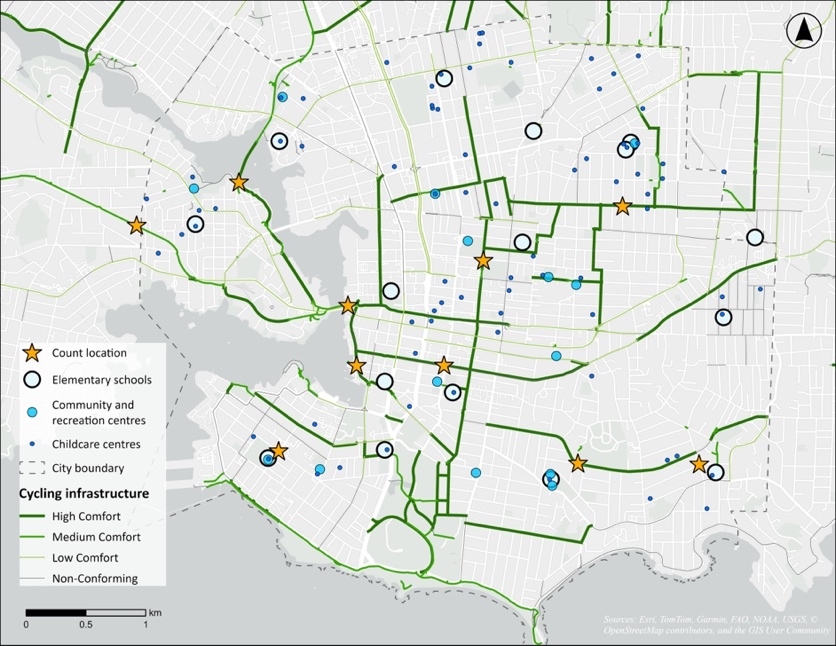
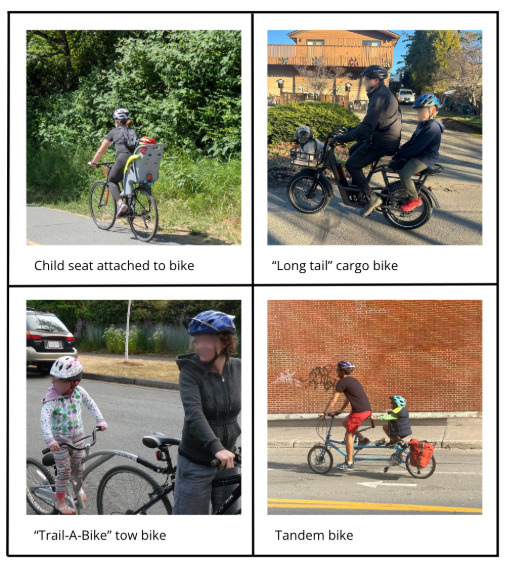
We recorded data on people cycling during morning commute hours (7:30AM to 9:30AM) in May/June and September/October 2025. We observed for a total of 30 hours at 10 locations along popular cycling routes and close to the destinations for children and families (schools, parks, childcare, community centres) (Figure 1). We classified cyclists by perceived gender (man, woman, other/unsure), electrification of cycle, and the type of child-carrying device used (cargo bike or other type of child-carrying device) if applicable (Figure 2).


We relied on perceptions of gender for pragmatic reasons. This approach has been used in past research (Winters et al. 2023); however, we acknowledge that data collectors’ perceptions of cyclist gender may result in some misclassification, and also that using three categories for gender does not encompass the spectrum of diverse gender identities. We considered only those carrying children on board at the time as doing mobility of care, as this was easily observable. However, mobility of care can be more broadly defined, including return trips after child drop offs, trips where children may be riding alongside but not on board, or even other trips (without children) that support household needs or dependants (Sánchez de Madriaga 2013). Efforts that include intercept studies or interviews with caregivers can complement this observational research.
3. FINDINGS
We observed 4026 people cycling, 6.1% (n=244) of whom were carrying children on board. The observed gender split was: 39.5% women, 59.3% men, 1.2% other/unsure (Table 1). The observed proportion of women is somewhat higher than many Canadian cities (Mitra and Nash 2019; Winters et al. 2023). While Canada is a low-cycling country overall, the City of Victoria is considered a high-cycling city, by Canadian standards (Statistics Canada 2024). The relatively high proportion of women cycling observed in Victoria resonates with findings from a multi-country study that reported greater gender parity in cycling in regions with higher cycling rates (and even more women cycling than men, in countries like Japan and the Netherlands) (Goel et al. 2022)."
Notably, we found the gender split was nearly identical for those people carrying children on cycles (39.8% women; 60.2% men), with those not carrying children (39.5% women; 59.2% men). As women generally tend to do more mobility of care work (Ravensbergen, Buliung, and Sersli 2020), it may have been expected that a greater proportion of the people who were carrying children on bikes were women. However, women express greater concerns about physical challenges and safety, especially when cycling with children and/or in low-cycling countries (Aldred et al. 2017; Hosford et al. 2020; Sersli et al. 2020).
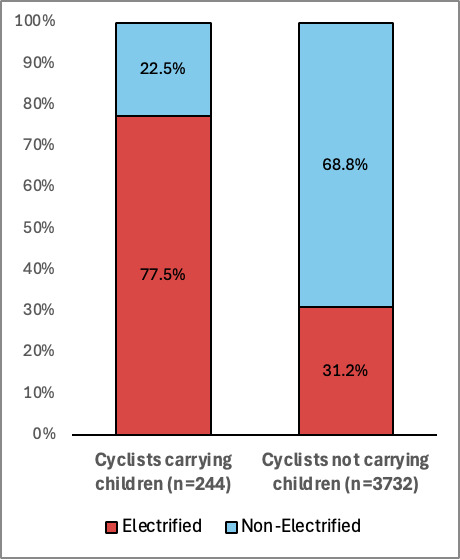
The physical challenges associated with cycling can be mediated by electric cycles. We saw that 31.2% of cycles were electrified overall, slightly higher for women (35.2% (560/1589) than men (28.6% (682/2387)). In terms of the equipment used by people carrying children, we saw that electrification was about 2.5 times higher for people carrying children, where over three-quarters of cycles were electrified (77.5% (189/244) (Figure 3). This was higher for women carrying children (85.6%) than for men (72.1%). Electric cycles have been found to help promote women’s cycling by facilitating domestic tasks such as carrying children or gear, reducing the time commitment associated with active transportation, and making cycling more physically accessible (Thomas 2022; Wild, Woodward, and Shaw 2021).

Cargo bikes, characterized as having a built-in box or platform to carry children or goods, were the most common type of child-carrying cycle used, by two-thirds (66.8%) of people carrying children (75.3% of women carrying children, 61.2% of men). Cargo bikes, which are commonly used by parents in high-cycling countries such as the Netherlands and Denmark, provide caregivers with a flexible option to carry multiple children at once, accommodate children as they grow, and transport other goods and gear (Boterman 2020; Marincek D., Rérat, P., and Lurkin, V., 2024; Riggs and Schwartz 2018). Most cargo bikes were electrified (93.9% (153/163), 95.9% of women on cargo bikes, 92.2% of men).
These findings show that mobility of care by bike, specifically carrying children on board, is commonly done by both men and women, though the equipment used does vary. Understanding how to support this type of travel is crucial to guide future infrastructure development that is tailored to the needs of women and families, and to promote cycling for trip purposes beyond the commute.
ACKNOWLEDGEMENTS
We recognize Grace O’Regan for data collection efforts and Jaimy Fischer for mapping support. This work was supported by Winters’ CIHR/PHAC Applied Public Health Chair, Gender and Sex in Healthy Cities (Grant #471526).