Loading [Contrib]/a11y/accessibility-menu.js

This website uses cookies

We use cookies to enhance your experience and support COUNTER Metrics for transparent reporting of readership statistics. Cookie data is not sold to third parties or used for marketing purposes.

Skip to main content
null
Findings
  • Menu
  • Articles
    • Energy Findings
    • Resilience Findings
    • Safety Findings
    • Transport Findings
    • Urban Findings
    • All
  • For Authors
  • Editorial Board
  • About
  • Blog
  • covid-19
  • search
  • X (formerly Twitter) (opens in a new tab)
  • LinkedIn (opens in a new tab)
  • RSS feed (opens a modal with a link to feed)

RSS Feed

Enter the URL below into your favorite RSS reader.

https://findingspress.org/feed
ISSN 2652-8800
Transport Findings
December 11, 2025 AEST

Serve All or Selectively Accept? A Triple Bottom Line Assessment of Demand-Responsive Transport Service Policies

Sapan Tiwari, Ph.D.,
Ride-sharing systemsDemand responsive transportService qualityTriple bottom lineAgent-based simulationMATSim
Copyright Logoccby-sa-4.0 • https://doi.org/10.32866/001c.151227
Findings
Tiwari, Sapan. 2025. “Serve All or Selectively Accept? A Triple Bottom Line Assessment of Demand-Responsive Transport Service Policies.” Findings, December. https:/​/​doi.org/​10.32866/​001c.151227.
Download all (3)
  • Fig. 1. (a) Hourly DRT demand distribution. (b) Spatial distribution of DRT demand in Greater Melbourne.
    Download
  • Figure 2. Performance comparison across service policies. (a) Rejection rate at different fleet sizes; (b) hourly difference in served trips; (c) spatial distribution of mean wait times under the serve-all policy; (d) spatial distribution of mean wait times under the selective-accept policy; (e) Lorenz curve showing equity in individual waiting times.
    Download
  • Figure 3. 3BL comparison of Serve-all and Selective-accept policies. Positive bars favour Serve-all; negative bars favour Selective-accept.
    Download

Sorry, something went wrong. Please try again.

If this problem reoccurs, please contact Scholastica Support

Error message:

undefined

View more stats

Abstract

Demand-responsive transport (DRT) systems struggle to strike a balance between universal accessibility and efficient, equitable service delivery. This study utilises MATSim to evaluate two distinct DRT policies in Greater Melbourne: a serve-all policy and a selective-acceptance policy. Results show that serving all requests improves accessibility but leads to longer waiting times, and improves equity when demand is high. Selective acceptance maintains better service quality, but at the cost of coverage and equity. The findings reveal clear trade-offs between efficiency, equity, and inclusivity in DRT operations.

1. Questions

Demand-responsive transport (DRT) systems face a core dilemma: accepting all trip requests to support inclusivity and accessibility, or selectively accepting requests to preserve efficiency and service quality (Schasché, Sposato, and Hampl 2022). Most DRT services adopt selective acceptance strategies to maintain service quality and control operating costs (Ho et al. 2018). But, DRT systems with serve-all policies maximise coverage, often compromising reliability and user satisfaction when demand exceeds capacity (Baier, Sörensen, and Schlüter 2024). This trade-off represents a broader Triple Bottom Line (3BL) challenge for sustainable DRT operations (Tiwari, Nassir, and Lavieri 2024b). While prior work has primarily optimised DRT from operational and cost–service perspectives (Narayanan, Chaniotakis, and Antoniou 2020), limited attention has been given to how request-acceptance policies shape system-wide performance at the metropolitan scale. Understanding this trade-off is crucial for a balance between social objectives, economic viability, and environmental efficiency. Therefore, the study addresses the following questions:

  1. How does serving all requests versus selective acceptance affect fleet productivity and system efficiency?

  2. What trade-offs emerge between accessibility, waiting times, and vehicle utilisation under each policy?

2. Methods

2.1. Simulation Framework and Study Setup

We employed MATSim, an open-source, agent-based transport simulation platform for large-scale transport modelling (Horni, Nagel, and Axhausen 2016), with dedicated modules for DRT operations in this study (J. Bischoff and Maciejewski 2016; Maciejewski and Nagel 2012).

We used the Greater Melbourne MATSim model (AToM) (Jafari et al. 2025), which has been used in earlier DRT studies (Tiwari, Nassir, and Lavieri 2025, 2024a, 2023b). A 10% synthetic population was used to maintain realistic travel patterns while ensuring computational efficiency, similar to earlier studies (Tiwari, Nassir, and Lavieri 2023a). Respective parameters were downscaled to maintain consistent congestion levels (Ben-Dor, Ben-Elia, and Benenson 2021). All private-car trips are converted into DRT requests to represent a future scenario of widespread on-demand mobility, resulting in 829,476 daily requests. This full car-to-DRT substitution serves as a stress-test to reveal policy trade-offs, although real-world adoption would be lower and relative differences between the policies should remain similar. Figure 1 shows the temporal and spatial distribution of demand, with two distinct peaks and high request density in the Melbourne CBD. Fleet sizes ranging from 2,500 to 25,000 vehicles, each with a capacity of four passengers, were tested.

Fig. 1
Fig. 1.(a) Hourly DRT demand distribution. (b) Spatial distribution of DRT demand in Greater Melbourne.

2.2. Policy Scenarios

  • Serve-all policy: All requests are accepted, representing universal service access.

  • Selective acceptance policy: Requests are only served if they satisfy predefined service quality constraints: a maximum waiting time of 10 minutes and a maximum total travel time: \[t_{\max} = \alpha \cdot t_{\text{direct}} + \beta, \tag{1}\] where \(t_{\text{direct}}\) is the direct car travel time, \(\alpha = 1.5\) is the detour factor, and \(\beta = 900\) s (Lu et al. 2024).

In both policies, requests are assigned in real time, and vehicle routes are dynamically updated through MATSim’s ride-matching strategy (Joschka Bischoff, Maciejewski, and Nagel 2017).

2.3. Equity Assessment

Service equity is evaluated using the Gini index (Dorfman 1979), with the Lorenz curve (Lorenz 1905) used to represent inequality graphically. For a sample of \(n\) observations \(x_1, \dots, x_n\), it is computed as

\[G = \frac{1}{2n^2\mu} \sum_{i=1}^{n} \sum_{j=1}^{n} |x_i - x_j|, \tag{2}\]

where \(\mu\) denotes the sample mean. We calculated the Gini index for both individual trip waiting times and zonal average waiting times.

2.4. Performance Comparison and 3BL Aggregation

To quantify policy trade-offs, we computed the percentage performance advantage of the Serve-all policy over Selective-accept for each indicator \(i\):

\[\begin{aligned} a_i &= \frac{(2b_i - 1)(S_i - C_i)}{w_i} \times 100,\\ b_i &= \begin{cases} 1, & \text{if higher is better},\\ 0, & \text{if lower is better}, \end{cases}\\ w_i &= \frac{S_i + C_i}{2}, \end{aligned}\tag{3}\]

Here \(S_i\) and \(C_i\) denote Serve-all and Selective-accept values, respectively; \(a_i>0\) indicates an advantage for Serve-all, while \(a_i<0\) indicates Selective-accept performs better. The binary term \(b_i\) encodes the preferred direction of improvement, and \(w_i\) represents the average magnitude of indicator \(i\), ensuring proportionate contribution. Aggregate trade-offs across each 3BL dimension \(d\) are then obtained as:

\[A_d=\frac{\sum_{i \in d} w_i a_i}{\sum_{i \in d} w_i} . \tag{4}\]

3. Findings

Figure 2(a) shows that Serve-all reduces rejection rates more quickly as fleet size increases, reaching the 5% benchmark at around 12,500 vehicles, whereas Selective-accept requires about 20,000 vehicles. Hence, 20,000-vehicle fleet was adopted as the baseline to ensure comparable service reliability across policies.

Figure 2
Figure 2.Performance comparison across service policies. (a) Rejection rate at different fleet sizes; (b) hourly difference in served trips; (c) spatial distribution of mean wait times under the serve-all policy; (d) spatial distribution of mean wait times under the selective-accept policy; (e) Lorenz curve showing equity in individual waiting times.

Figure 2(b) shows that the Serve-all scenario serves more trips throughout the day, particularly after the morning peak.

Figure 2(c)–(d) shows the zonal-average mean times (representing service quality) in both scenarios, with the Selective-accept scenario having lower wait times throughout the network.

Figure 2(e) shows lower inequality in individual waiting times under the Serve-all scenario, consistent with the lower Gini coefficients in Table 1. This indicates that, despite its operational strain, Serve-all provides a fairer distribution of waiting times compared to the Selective-accept scenario.

Table 1.Comparison of service performance indicator across scenarios
Performance indicator Description 3BL category Selective-accept Serve-⁠all
Service outcomes
Trips served Total number of served ride requests Economic (Operational) 790,995 829,405
Rejection rate (%) % rides rejected Social (Accessibility) 4.65% 0.03%
User experience
Avg. wait time (min) Mean passenger waiting time Social (Service Quality) 6.20 9.49
95th percentile wait (min) Wait time for 95th percentile request Social (Equity) 9.85 19.07
Trips with wait time < 15 min % requests served within 15 min Social (Accessibility) 100% 84.35%
Avg. in-vehicle time (min) Mean riding time in the vehicles Social (Service Quality) 22.83 21.45
Demand characteristics
Avg. occupancy Avg. number of passengers in a vehicle Environmental (Efficiency) 2.71 2.57
Fleet performance
Empty VKT ratio % km travelled empty Environmental (Efficiency) 9.45% 9.45%
VKT per trip VKT per served trip Environmental (Energy proxy) 9.36 9.34
Vehicle load Number of riders served per vehicle in a day Economic (Operational) 39.54 41.47
Revenue
Avg. fare ($) Average fare per passenger Economic 5.07 5.10
Total revenue (M$) Total revenue from all served rides Economic 4.01 4.23
Equity measures
Zonal Gini index Equity in zonal wait times Social (Equity) 0.194 0.144
Individual Gini index Equity in individual wait times Social (Equity) 0.327 0.270

Blue Colour: Economic,
Red colour: Social
Green Colour: Environmental

Table 1 and Figure 3 highlight trade-offs across the 3BL dimensions. From an economic perspective, Serve-all achieves higher operational productivity by serving more requests and serving more requests per vehicle. These outcomes translate into higher system-level revenue, reflecting a strong emphasis on maximising demand coverage and utilisation. Here, revenue reflects a neutral, comparative fare structure, and the system is not assumed to be either commercial or subsidised.
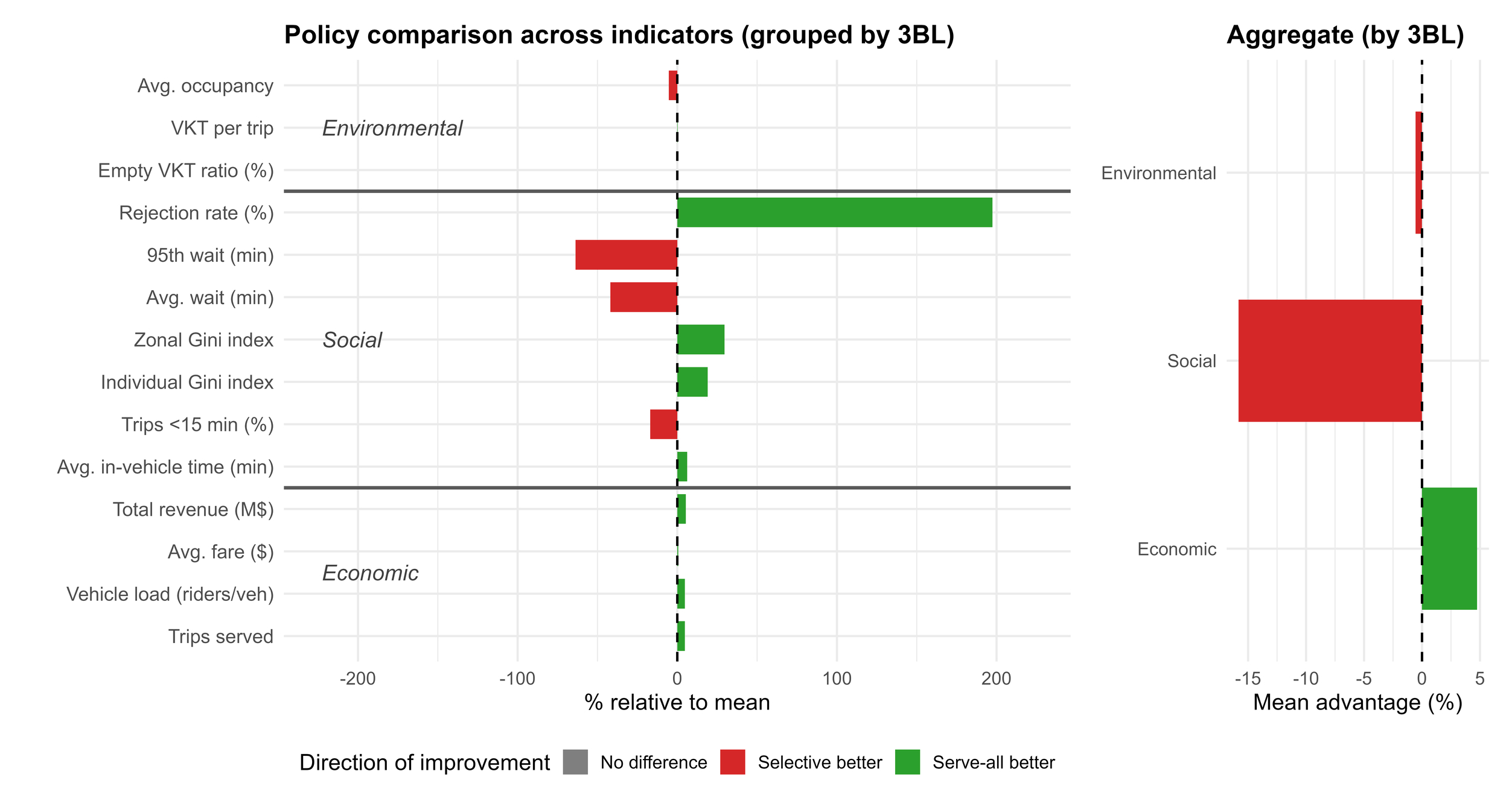
Figure 3
Figure 3.3BL comparison of Serve-all and Selective-accept policies. Positive bars favour Serve-all; negative bars favour Selective-accept.

However, this efficiency comes at a social cost, as Serve-all results in significantly longer waiting times, reducing the share of passengers served within 15 minutes from 100% to 84.35%. In contrast, Selective-accept maintains shorter, more predictable waiting times and demonstrates stronger service quality.

Environmental outcomes differ only slightly, with Selective-accept performing marginally better overall. Although both policies show comparable vehicle-kilometre-per-trip and empty-distance shares, Serve-all exhibits lower vehicle occupancy, as it accepts many low-compatibility requests that cannot be efficiently pooled, thereby reducing operational efficiency compared with the Selective-accept scenario.

Aggregated 3BL results in Figure 3 indicate that Serve-all achieves a marginal economic advantage, whereas Selective-accept performs notably better in the social dimension, reflecting reduced inequality and improved reliability. Environmental differences remain minor, with a slight edge for Selective-accept. Overall, the results highlight the inherent trade-off among economic, social and environmental dimensions in DRT operations.

Submitted: November 16, 2025 AEST

Accepted: November 26, 2025 AEST

References

Baier, Moritz Jon, Leif Sörensen, and Jan Christian Schlüter. 2024. “How Successful Is My DRT System? A Review of Different Parameters to Consider When Developing Flexible Public Transport Systems.” Transport Policy 159:130–42.
Google Scholar
Ben-Dor, Golan, Eran Ben-Elia, and Itzhak Benenson. 2021. “Population Downscaling in Multi-Agent Transportation Simulations: A Review and Case Study.” Simulation Modelling Practice and Theory 108:102233.
Google Scholar
Bischoff, J., and M. Maciejewski. 2016. “Simulation of City-Wide Replacement of Private Cars with Autonomous Taxis in Berlin.” Procedia Computer Science 83:237–44. https:/​/​doi.org/​10.1016/​j.procs.2016.04.121.
Google Scholar
Bischoff, Joschka, Michal Maciejewski, and Kai Nagel. 2017. “City-Wide Shared Taxis: A Simulation Study in Berlin.” In 2017 IEEE 20th International Conference on Intelligent Transportation Systems (ITSC), 275–80. IEEE.
Google Scholar
Dorfman, Robert. 1979. “A Formula for the Gini Coefficient.” The Review of Economics and Statistics, 146–49.
Google Scholar
Ho, S. C., W. Y. Szeto, Y. H. Kuo, J. M. Y. Leung, M. Petering, and T. W. H. Tou. 2018. “A Survey of Dial-a-Ride Problems: Literature Review and Recent Developments.” Transportation Research Part B: Methodological 111:395–421. https:/​/​doi.org/​10.1016/​j.trb.2018.02.001.
Google Scholar
Horni, A., K. Nagel, and K. W. Axhausen. 2016. The Multi-Agent Transport Simulation MATSim. Ubiquity Press. https:/​/​doi.org/​10.5334/​baw.
Google Scholar
Jafari, Afshin, Dhirendra Singh, Alan Both, Mahsa Abdollahyar, Lucy Gunn, Steve Pemberton, and Billie Giles-Corti. 2025. “Activity-Based and Agent-Based Transport Model of Melbourne: An Open Multi-Modal Transport Simulation Model for Greater Melbourne.” Journal of Intelligent Transportation Systems 29 (4): 417–34.
Google Scholar
Lorenz, M. O. 1905. “Methods of Measuring the Concentration of Wealth.” Publications of the American Statistical Association 9 (70): 209–19.
Google Scholar
Lu, Chengqi, Sapan Tiwari, Neema Nassir, and Kai Nagel. 2024. “Efficient Operation of Demand-Responsive Transport (DRT) Systems: Active Requests Rejection.” Procedia Computer Science 238:81–90.
Google Scholar
Maciejewski, M., and K. Nagel. 2012. “Towards Multi-Agent Simulation of the Dynamic Vehicle Routing Problem in MATSim.” In Lecture Notes in Computer Science, 7204:551–60. https:/​/​doi.org/​10.1007/​978-3-642-31500-8_57.
Google Scholar
Narayanan, Santhanakrishnan, Emmanouil Chaniotakis, and Constantinos Antoniou. 2020. “Shared Autonomous Vehicle Services: A Comprehensive Review.” Transportation Research Part C: Emerging Technologies 111:255–93.
Google Scholar
Schasché, Stephanie E., Robert G. Sposato, and Nina Hampl. 2022. “The Dilemma of Demand-Responsive Transport Services in Rural Areas: Conflicting Expectations and Weak User Acceptance.” Transport Policy 126:43–54.
Google Scholar
Tiwari, Sapan, N. Nassir, and P. S. Lavieri. 2023a. “A Hybrid Parallel-Sequential Insertion Heuristics for Shared Autonomous Vehicle Routing: A Melbourne Case Study.” In 2023 IEEE Engineering Informatics, 1–9. https:/​/​doi.org/​10.1109/​IEEECONF58110.2023.10520538.
Google Scholar
———. 2023b. “Testing Request Prioritization Strategies to Improve the Quality of a Shared Autonomous Vehicles Service: A Melbourne Case Study.” In Australasian Transport Research Forum 2023.
Google Scholar
———. 2024a. “Smart Insertion Strategies for Sustainable Operation of Shared Autonomous Vehicles.” Sustainability 16 (12): 5175. https:/​/​doi.org/​10.3390/​SU16125175.
Google Scholar
Tiwari, Sapan, Neema Nassir, and Patricia S. Lavieri. 2024b. “Review and Classification of Objectives in Dynamic Dial-a-Ride Systems: A Triple Bottom Line Approach of Sustainability.” Sustainability 16 (13): 5788. https:/​/​doi.org/​10.3390/​su16135788.
Google Scholar
Tiwari, Sapan, Neema Nassir, and Patricia Sauri Lavieri. 2025. “Ride-Hailing Vehicle Dispatching and Matching Strategies to Prioritize and Complement Public Transport Use.” Journal of Traffic and Transportation Engineering (English Edition).
Google Scholar

Powered by Scholastica, the modern academic journal management system