Loading [Contrib]/a11y/accessibility-menu.js

This website uses cookies

We use cookies to enhance your experience and support COUNTER Metrics for transparent reporting of readership statistics. Cookie data is not sold to third parties or used for marketing purposes.

Skip to main content
null
Findings
  • Menu
  • Articles
    • Energy Findings
    • Resilience Findings
    • Safety Findings
    • Transport Findings
    • Urban Findings
    • All
  • For Authors
  • Editorial Board
  • About
  • Blog
  • covid-19
  • search
  • X (formerly Twitter) (opens in a new tab)
  • LinkedIn (opens in a new tab)
  • RSS feed (opens a modal with a link to feed)

RSS Feed

Enter the URL below into your favorite RSS reader.

https://findingspress.org/feed
ISSN 2652-8800
Urban Findings
December 12, 2025 AEST

A Review of Percolation-like Transitions in Cities and Landscapes

Renan L. Fagundes, Yunfei Li, Fabiano L. Ribeiro, Diego Rybski,
percolationphase transitionurban systemslandscape criticalityReview
Copyright Logoccby-sa-4.0 • https://doi.org/10.32866/001c.150358
Findings
Fagundes, Renan L., Yunfei Li, Fabiano L. Ribeiro, and Diego Rybski. 2025. “A Review of Percolation-like Transitions in Cities and Landscapes.” Findings, December. https:/​/​doi.org/​10.32866/​001c.150358.
Download all (1)
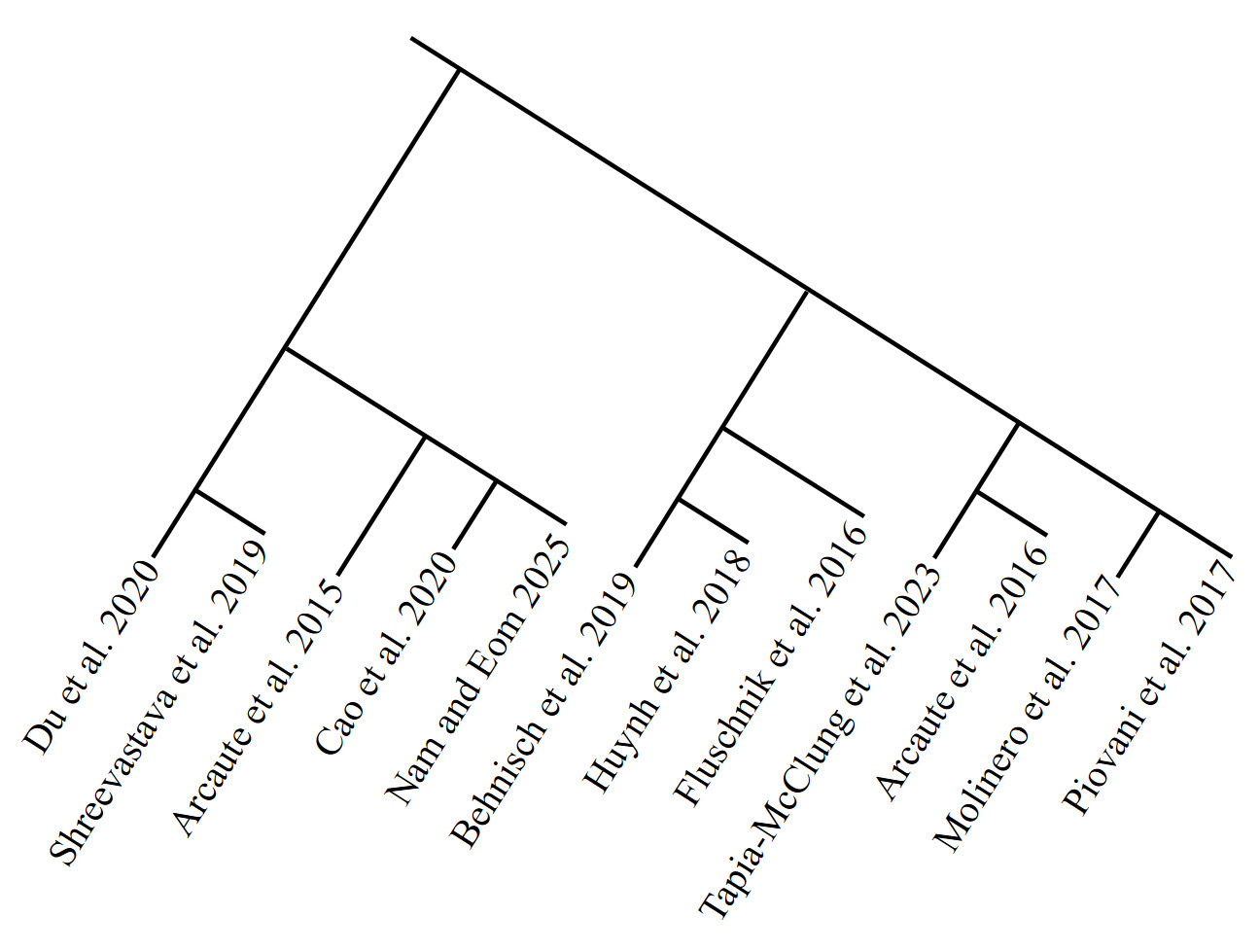
  • Figure 1. Hierarchical clustering (cladogram) of papers analyzing percolation-like transitions in the urban context. We processed the specific information (data, order parameter, control parameter), as detailed in Table 1, with TF-IDF vectorization and cosine similarity methods. E.g. Du et al. (2020) is more similar to Shreevastava, Rao, and McGrath (2019) than to Arcaute et al. (2015).
    Download

Sorry, something went wrong. Please try again.

If this problem reoccurs, please contact Scholastica Support

Error message:

undefined

View more stats

Abstract

We review papers analyzing percolation-like transitions in cities, urban systems, and landscapes. We organize their presentation according to (i) landscape ecology, (ii) city morphology and properties, (iii) modeling city growth, (iv) traffic dynamics, and (v) forests and vegetation. A closer look at the second group reveals that, overall, the works are limited to a small number of different control and order parameters. We hierarchically cluster the respective papers. Related to connectivity and fragmentation, percolation-like transitions arise in various complex, natural and artificial structures in cities and landscapes. More research is needed to better understand the differences between predictions from percolation theory and findings from real-world data.

In percolation theory, one studies the transition a structure can undergo between a connected and a fragmented phase, and its properties at and around this critical point. For an overview we refer to (Bunde and Havlin 1991; Stauffer and Aharony 1994; Isichenko 1992; Efros 1986, e.g.). For instance, randomly occupying the cells of a square grid, at the critical probability of, in this case, \(\approx\)0.59, abruptly a giant cluster emerges that extends from one side of the system to the other (Brockmann 2018). The control parameter is the variable that is being changed (e.g. the occupancy probability) and the transition is reflected in the order parameter, which is usually associated with macroscopic properties of the system (e.g. the probability that an occupied cell belongs to the giant cluster), and expected to diverge or become trivial (e.g., 1) at the transition. However, the strict theory applies only to the limit of infinite system size. In this example of occupying a grid, the cells are discrete. Another form is continuum percolation, where objects (typically circles) are placed in continuous space, eventually forming a percolating structure (Meester and Roy 2008; Balberg 2009; Mertens and Moore 2012, e.g.). While percolation theory has been developed using derivations and simulations of random processes, percolation-like transitions have also been observed in many empirical studies. Here we selectively review works carried out in the context of cities and urban systems and, more generally, in the context of landscape.

In landscape ecology, neutral models represent a sort of null hypothesis used to explain biodiversity patterns assuming all species are functionally equivalent (Gardner et al. 1987). The properties of these neutral models, including the number of clusters, size distribution, fractal dimension, separation between clusters, and correlation length (e.g. defined as mean distance between two sites on the same finite cluster, (Bunde and Havlin 1991)), can be compared with real-world data (Turner 1989; Gustafson and Parker 1992; Keitt, Urban, and Milne 1997, e.g.). Through modeling and empirical validation, such approaches are employed to explore general landscape structures (With and Crist 1995; With, Gardner, and Turner 1997; Saura and Martínez-Millán 2000; Riitters et al. 2007) to better understand processes related to land-cover patterns, habitat loss, influences on animal movement, species distribution, and the maintenance of landscape functions (McIntyre and Wiens 1999).

In Table 1 we list empirical works that treat percolation-like transitions in the urban context, providing details on the data and the variables of interest, see also Fig. 1. In the urban context, most works use the (a) clustering distance, (b) some sort of density, or (c) attributes of network edges as control parameters. As order parameter, the (i) cluster size(s), (ii) respective entropy, or (iii) number of clusters are used. For instance, an examination of the population density in UK wards reveals a transition in population and built area when population density varies (Arcaute et al. 2015). The authors suggest to consider this transition a proxy for defining cities. By varying the clustering distance, (Behnisch et al. 2019) demonstrate that the building locations in Germany form a giant cluster at the critical distance, which is related to the typical distance between neighboring buildings (Rozenfeld et al. 2008, see also). Yet, (Nam and Eom 2025) utilize population density in spatial units within cities to investigate how the number of clusters changes as the occupancy probability varies. (Bian, Yeh, and Zhang 2024) demonstrate the importance of percolating green corridors in cities. Further papers include (Molinero, Murcio, and Arcaute 2017; Piovani, Molinero, and Wilson 2017; Shreevastava, Rao, and McGrath 2019; Cao et al. 2020; Du et al. 2020, e.g.). Overall, the works represent examples in which understanding critical urban behavior can be a decisive data-driven approach to characterizing the morphology and functioning of the urban fabric.

Table 1.Selection of empirical studies investigating percolation-like transitions in the urban context. For each reference in the first column, we list the data analyzed as well as the order and control parameters. In all cases, the control parameter represents a threshold.
Authors Data Order parameter Control parameter
Arcaute et al. (2015) population density largest cluster area, population population density
Arcaute et al. (2016) road network clusters sizes clustering distance
Fluschnik et al. (2016) land-cover average cluster size clustering distance
Molinero, Murcio, and Arcaute (2017) road network entropy of cluster sizes angle between roads
Piovani, Molinero, and Wilson (2017) road network entropy of cluster sizes edge length
Huynh et al. (2018) bus stops locations largest cluster size, area clustering distance
Behnisch et al. (2019) building locations cluster sizes clustering distance
Shreevastava, Rao, and McGrath (2019) land surface temperature number of clusters temperature
Cao et al. (2020) nighttime light, population, road network entropy of cluster areas population density, road intersection density; day/night value
Du et al. (2020) air quality index fraction of the largest cluster air quality index
Tapia-McClung, Montejano-Escamilla, and Caudillo-Cos (2023) road network entropy of cluster areas clustering distance
Nam and Eom (2025) population density number of clusters occupancy probability
Figure 1
Figure 1.Hierarchical clustering (cladogram) of papers analyzing percolation-like transitions in the urban context. We processed the specific information (data, order parameter, control parameter), as detailed in Table 1, with TF-IDF vectorization and cosine similarity methods. E.g. Du et al. (2020) is more similar to Shreevastava, Rao, and McGrath (2019) than to Arcaute et al. (2015).

Percolation can also be employed for modeling of cities and their evolution (Bitner, Hołyst, and Fiałkowski 2009; Fragkias and Seto 2009; Murcio, Sosa-Herrera, and Rodriguez-Romo 2013, e.g.). The percolation front represents a special form of percolation. If the occupancy probability changes along space, then also percolation happens along this gradient – with a so-called percolation front around the critical concentration. This idea is explored for cities, where a radial gradient is combined with correlated noise, leading to clusters that resemble cities (H. Makse, Havlin, and Stanley 1995; H. A. Makse et al. 1998).

Another domain where percolation-like transitions are explored is traffic dynamics. For example, the car speed threshold that separates isolated local flows from global flows in a road network serves to characterize traffic efficiency (D. Li et al. 2015). Studies show that the volume (F. Wang et al. 2015) and the duration of traffic flow (Zeng et al. 2019) affect the characteristics of this transition, and that the relationship between the size of the residential area and the width of the roads influences traffic congestion (Utami et al. 2020). (Ambühl, Menendez, and González 2023) find correlations between traffic congestion percolation and average flow through the network. (R. Wang, Wang, and Li 2023) report that all mobility networks undergo abrupt transitions when reaching a universal critical threshold. As demonstrated by (Verbavatz and Barthelemy 2021), one-way roads can lead to a percolation-like transition belonging to a new universality class. (Cogoni and Busonera 2021) find stable traffic patterns that persist at specific times of the day during the week and on weekends. (Ebrahimabadi et al. 2023) describe that the distribution of the supply and demand sources within the urban landscape can exert a significant influence on the critical traffic rate within the city. In addition, (C. Fan, Jiang, and Mostafavi 2020) combined an epidemic model with percolation ideas to predict flooding in urban networks. Further research on traffic dynamics includes (Talebpour, Mahmassani, and Hamdar 2017; Guo et al. 2018; Olmos et al. 2018; Serok et al. 2019; Chen et al. 2025, e.g.).

Percolation ideas are also employed to analyze forests and vegetation. In particular, (Saravia, Doyle, and Bond-Lamberty 2018) and (Taubert et al. 2018) show that regions with the highest rates of deforestation are closer to a critical threshold of fragmentation, and if fragmentation continues, consequences such as species loss and degradation of ecosystem services cannot be reversed. Similarly, some vegetation patterns in saturated environments, such as rain-forest, may benefit from being close to criticality (Villegas et al. 2024). In relation to forest fires, (Perestrelo et al. 2022) propose a percolation model to predict the phase transition during fire regimes.

Studies of settlement or vegetation connectivity can be subsumed under landscape criticality. Research on percolation theory is still progressing and advances are being made in various directions (Araújo et al. 2014; Saberi 2015; J. Fan, Meng, and Saberi 2019; M. Li et al. 2021; Sun et al. 2023; Schorcht et al. 2025, e.g.). Percolation theory provides a unifying framework for analyzing phase transitions in urban and landscape systems. From traffic resilience and urban sprawl to vegetation dynamics, critical thresholds offer actionable insights. While percolation theory is primarily based on randomness, real-world systems usually exhibit more complex (spatial) properties. Future research could be dedicated to bridge these two and to a better understanding of their differences.


Acknowledgements

We thank A.-K. Brenner, J.W. Kantelhardt, H. Samaniego, and W. Xu for usefull comments. R.L. Fagundes and Y. Li acknowledge financial support from the German Research Foundation (DFG) for the UPon (#451083179) project. R.L. Fagundes and D. Rybski thank Leibniz Association for funding the project “Landscape Criticality in the Anthropocene – Biodiversity, Renewables and Settlements” (CriticaL). D. Rybski additionally appreciates financial support through the DFG project Gropius (#511568027). F. L. Ribeiro thanks CNPq (grant numbers 403139/2021-0 and 424686/2021-0) and Fapemig (grant number APQ-00829-21 and APQ-06541-24) for financial support.

Submitted: September 01, 2025 AEST

Accepted: November 25, 2025 AEST

References

Ambühl, L., M. Menendez, and M. C. González. 2023. “Understanding Congestion Propagation by Combining Percolation Theory with the Macroscopic Fundamental Diagram.” Commun. Phys. 6 (26). https:/​/​doi.org/​10.1038/​s42005-023-01144-w.
Google Scholar
Araújo, N., Peter Grassberger, Byungnam Kahng, K. J. Schrenk, and Robert M. Ziff. 2014. “Recent Advances and Open Challenges in Percolation.” Eur. Phys. J. Spec. Top. 223:2307–21. https:/​/​doi.org/​10.1140/​epjst/​e2014-02266-y.
Google Scholar
Arcaute, Elsa, Erez Hatna, Peter Ferguson, Hyejin Youn, Anders Johansson, and Michael Batty. 2015. “Constructing Cities, Deconstructing Scaling Laws.” J. R. Soc. Interface 12 (102): 20140745. https:/​/​doi.org/​10.1098/​rsif.2014.0745.
Google Scholar
Arcaute, Elsa, Carlos Molinero, Erez Hatna, Roberto Murcio, Camilo Vargas-Ruiz, A. Paolo Masucci, and Michael Batty. 2016. “Cities and Regions in Britain through Hierarchical Percolation.” R. Soc. Open Sci. 3 (4): 150691. https:/​/​doi.org/​10.1098/​rsos.150691.
Google Scholar
Balberg, Isaac. 2009. “Continuum Percolation.” In Encyclopedia of Complexity and Systems Science, 1443–75. New York, NY: Springer New York. https:/​/​doi.org/​10.1007/​978-0-387-30440-3_95.
Google Scholar
Behnisch, M., M. Schorcht, S. Kriewald, and D. Rybski. 2019. “Settlement Percolation: A Study of Building Connectivity and Poles of Inaccessibility.” Landscape Urban Plan. 191:103631. https:/​/​doi.org/​10.1016/​j.landurbplan.2019.103631.
Google Scholar
Bian, F., A. G. O. Yeh, and J. Zhang. 2024. “Percolating Spatial Scale Effects on the Landscape Connectivity of Urban Greenspace Network in Beijing, China.” Landsc. Ecol. Eng. 20:33–51. https:/​/​doi.org/​10.1007/​s11355-023-00578-2.
Google Scholar
Bitner, Agnieszka, Robert Hołyst, and Marcin Fiałkowski. 2009. “From Complex Structures to Complex Processes: Percolation Theory Applied to the Formation of a City.” Phys. Rev. E 80:037102. https:/​/​doi.org/​10.1103/​PhysRevE.80.037102.
Google Scholar
Brockmann, Dirk. 2018. “Barista’s Secret.” https:/​/​www.complexity-explorables.org/​explorables/​baristas-secret/​.
Bunde, Armin, and Shlomo Havlin. 1991. Fractals and Disordered Systems. Springer Berlin, Heidelberg. https:/​/​doi.org/​10.1007/​978-3-642-84868-1.
Google Scholar
Cao, Wenpu, Lei Dong, Lun Wu, and Yu Liu. 2020. “Quantifying Urban Areas with Multi-Source Data Based on Percolation Theory.” RSE 241:111730. https:/​/​doi.org/​10.1016/​j.rse.2020.111730.
Google Scholar
Chen, Rui, Jiazhen Liu, Yong Li, and Yuming Lin. 2025. “Unveiling Multistability in Urban Traffic through Percolation Theory and Network Analysis.” Entropy 27 (7). https:/​/​doi.org/​10.3390/​e27070668.
Google Scholar
Cogoni, Marco, and Giovanni Busonera. 2021. “Stability of Traffic Breakup Patterns in Urban Networks.” Phys. Rev. E 104:L012301. https:/​/​doi.org/​10.1103/​PhysRevE.104.L012301.
Google Scholar
Du, Ruijin, Jingjing Li, Gaogao Dong, Lixin Tian, Ting Qing, Guochang Fang, and Yujuan Dong. 2020. “Percolation Analysis of Urban Air Quality: A Case in China.” Phys. A 541:123312. https:/​/​doi.org/​10.1016/​j.physa.2019.123312.
Google Scholar
Ebrahimabadi, Sasan, Ali Hosseiny, Jingfang Fan, and Abbas Ali Saberi. 2023. “Geometry of Commutes in the Universality of Percolating Traffic Flows.” Phys. Rev. E 108:054311. https:/​/​doi.org/​10.1103/​PhysRevE.108.054311.
Google Scholar
Efros, A. L. 1986. Physics and Geometry of Disorder: Percolation Theory. Science for Everyone. Mir Publishers Moscow.
Google Scholar
Fan, Chao, Xiangqi Jiang, and Ali Mostafavi. 2020. “A Network Percolation-Based Contagion Model of Flood Propagation and Recession in Urban Road Networks.” Sci. Rep. 10 (1): 13481. https:/​/​doi.org/​10.1038/​s41598-020-70524-x.
Google Scholar
Fan, Jingfang, Jun Meng, and Abbas Ali Saberi. 2019. “Percolation Framework of the Earth’s Topography.” Phys. Rev. E 99 (February):022304. https:/​/​doi.org/​10.1103/​PhysRevE.99.022304.
Google Scholar
Fluschnik, T., S. Kriewald, A. G. C. Ros, B. Zhou, D. E. Reusser, J. P. Kropp, and D. Rybski. 2016. “The Size Distribution, Scaling Properties and Spatial Organization of Urban Clusters: A Global and Regional Percolation Perspective.” ISPRS Int. J. Geo-Inf. 5 (7): 110. https:/​/​doi.org/​10.3390/​ijgi5070110.
Google Scholar
Fragkias, Michail, and Karen C. Seto. 2009. “Evolving Rank-Size Distributions of Intra-Metropolitan Urban Clusters in South China.” Comput. Environ. Urban Syst. 33 (3): 189–99. https:/​/​doi.org/​10.1016/​j.compenvurbsys.2008.08.005.
Google Scholar
Gardner, Robert H., Bruce T. Mime, Monica G. Turner, and Robert V. O’Neil. 1987. “Neutral Models for the Analysis of Broad-Scale Landscape Pattern.” Landscape Ecol. 1 (1): 19–28. https:/​/​doi.org/​10.1007/​BF02275262.
Google Scholar
Guo, Shengmin, Ruoqian Wu, Qingfeng Tong, Guanwen Zeng, Jian Yang, Long Chen, Tongyu Zhu, Weifeng Lv, and Daqing Li. 2018. “Is City Traffic Damaged by Torrential Rain?” Phys. A 503:1073–80. https:/​/​doi.org/​10.1016/​j.physa.2018.08.044.
Google Scholar
Gustafson, Eric J., and George R. Parker. 1992. “Relationships between Landcover Proportion and Indices of Landscape Spatial Pattern.” Landsc. Ecol. 7 (2): 101–10. https:/​/​doi.org/​10.1007/​BF02418941.
Google Scholar
Huynh, Hoai Nguyen, Evgeny Makarov, Erika Fille Legara, Christopher Monterola, and Lock Yue Chew. 2018. “Characterisation and Comparison of Spatial Patterns in Urban Systems: A Case Study of U.S. Cities.” J. Comput. Sci. 24:34–43. https:/​/​doi.org/​10.1016/​j.jocs.2017.12.001.
Google Scholar
Isichenko, M. B. 1992. “Percolation, Statistical Topography, and Transport in Random Media.” Rev. Mod. Phys. 64:961–1043. https:/​/​doi.org/​10.1103/​RevModPhys.64.961.
Google Scholar
Keitt, T. H., D. L. Urban, and B. T. Milne. 1997. “Detecting Critical Scales in Fragmented Landscapes.” Conserv. Ecol. 1 (1). http:/​/​www.consecol.org/​vol1/​iss1/​art4/​.
Google Scholar
Li, Daqing, Bowen Fu, Yunpeng Wang, Guangquan Lu, Yehiel Berezin, H. Eugene Stanley, and Shlomo Havlin. 2015. “Percolation Transition in Dynamical Traffic Network with Evolving Critical Bottlenecks.” Proc. Natl. Acad. Sci. U.S.A 112 (3): 669–72. https:/​/​doi.org/​10.1073/​pnas.1419185112.
Google Scholar
Li, Ming, Run-Ran Liu, Linyuan Lü, Mao-Bin Hu, Shuqi Xu, and Yi-Cheng Zhang. 2021. “Percolation on Complex Networks: Theory and Application.” Phys. Rep. 907:1–68. https:/​/​doi.org/​10.1016/​j.physrep.2020.12.003.
Google Scholar
Makse, H., S. Havlin, and H. Eugene Stanley. 1995. “Modeling Urban Growth Patterns.” Nature 337 (19): 608–12. https:/​/​doi.org/​10.1038/​377608a0.
Google Scholar
Makse, Hernán A., José S. Andrade Jr., Michael Batty, Shlomo Havlin, and H. Eugene Stanley. 1998. “Modeling Urban Growth Patterns with Correlated Percolation.” Phys. Rev. E 58 (6): 7054. https:/​/​doi.org/​10.1103/​PhysRevE.58.7054.
Google Scholar
McIntyre, Nancy E., and John A. Wiens. 1999. “Interactions between Habitat Abundance and Configuration: Experimental Validation of Some Predictions from Percolation Theory.” Oikos 86 (1): 129–37. https:/​/​doi.org/​10.2307/​3546577.
Google Scholar
Meester, R., and R. Roy. 2008. Continuum Percolation. New York: Cambridge University Press. https:/​/​doi.org/​10.1017/​CBO9780511895357.
Google Scholar
Mertens, Stephan, and Cristopher Moore. 2012. “Continuum Percolation Thresholds in Two Dimensions.” Phys. Rev. E 86:061109. https:/​/​doi.org/​10.1103/​PhysRevE.86.061109.
Google Scholar
Molinero, Carlos, Roberto Murcio, and Elsa Arcaute. 2017. “The Angular Nature of Road Networks.” Sci. Rep. 7 (4312): 4312. https:/​/​doi.org/​10.1038/​s41598-017-04477-z.
Google Scholar
Murcio, Roberto, Antonio Sosa-Herrera, and Suemi Rodriguez-Romo. 2013. “Second-Order Metropolitan Urban Phase Transitions.” Chaos Soliton Fract. 48:22–31. https:/​/​doi.org/​10.1016/​j.chaos.2013.01.001.
Google Scholar
Nam, Yunwoo, and Young-Ho Eom. 2025. “Percolation Analysis of Spatiotemporal Distribution of Population in Seoul and Helsinki.” Phys. Rev. E 111:014305. https:/​/​doi.org/​10.1103/​PhysRevE.111.014305.
Google Scholar
Olmos, Luis E., Serdar Çolak, Sajjad Shafiei, Meead Saberi, and Marta C. González. 2018. “Macroscopic Dynamics and the Collapse of Urban Traffic.” Proc. Natl. Acad. Sci. U.S.A 115 (50): 12654–61. https:/​/​doi.org/​10.1073/​pnas.1800474115.
Google Scholar
Perestrelo, Sara Aleixo, Maria Clara Grácio, Nuno de Almeida Ribeiro, and Luís Mário Lopes. 2022. “A Multi-Scale Network with Percolation Model to Describe the Spreading of Forest Fires.” Mathematics 10 (4): 588. https:/​/​doi.org/​10.3390/​math10040588.
Google Scholar
Piovani, Duccio, Carlos Molinero, and Alan Wilson. 2017. “Urban Retail Location: Insights from Percolation Theory and Spatial Interaction Modeling.” PLoS One 12 (10): 1–13. https:/​/​doi.org/​10.1371/​journal.pone.0185787.
Google Scholar
Riitters, Kurt H., Peter Vogt, Pierre Soille, Jacek Kozak, and Christine Estreguil. 2007. “Neutral Model Analysis of Landscape Patterns from Mathematical Morphology.” Landsc. Ecol. 22:1033–43. https:/​/​doi.org/​10.1007/​s10980-007-9089-3.
Google Scholar
Rozenfeld, H. D., D. Rybski, J. S. Andrade Jr., M. Batty, H. E. Stanley, and H. A. Makse. 2008. “Laws of Population Growth.” Proc. Natl. Acad. Sci. U. S. A. 105 (48): 18702–7. https:/​/​doi.org/​10.1073/​pnas.0807435105.
Google Scholar
Saberi, Abbas Ali. 2015. “Recent Advances in Percolation Theory and Its Applications.” Phys. Rep. 578:1–32. https:/​/​doi.org/​10.1016/​j.physrep.2015.03.003.
Google Scholar
Saravia, Leonardo, Santiago Doyle, and Ben Bond-Lamberty. 2018. “Power Laws and Critical Fragmentation in Global Forests.” Sci. Rep. 8 (17766). https:/​/​doi.org/​10.1038/​s41598-018-36120-w.
Google Scholar
Saura, S., and J. Martínez-Millán. 2000. “Landscape Patterns Simulation with a Modified Random Clusters Method.” Landsc. Ecol. 15 (7): 661–78. https:/​/​doi.org/​10.1023/​a:1008107902848.
Google Scholar
Schorcht, Martin, Martin Behnisch, Anna-Katharina Brenner, Tobias Krüger, Renan L. Fagundes, Wenjing Xu, Larissa Beumer, Thomas Müller, and Diego Rybski. 2025. “Settlement Percolation: Global Maps of Critical Distances.” ⁠in ⁠prep.
Google Scholar
Serok, Nimrod, Orr Levy, Shlomo Havlin, and Efrat Blumenfeld-Lieberthal. 2019. “Unveiling the Inter-Relations between the Urban Streets Network and Its Dynamic Traffic Flows: Planning Implication.” Environ. Plan. B 46 (7): 1362–76. https:/​/​doi.org/​10.1177/​2399808319837982.
Google Scholar
Shreevastava, Anamika, P. Suresh C. Rao, and Gavan S. McGrath. 2019. “Emergent Self-Similarity and Scaling Properties of Fractal Intra-Urban Heat Islets for Diverse Global Cities.” Phys. Rev. E 100:032142. https:/​/​doi.org/​10.1103/​PhysRevE.100.032142.
Google Scholar
Stauffer, D., and A. Aharony. 1994. Introduction to Percolation Theory: Second Edition (2nd Ed.). Taylor & Francis. https:/​/​doi.org/​10.1201/​9781315274386.
Google Scholar
Sun, Yu, Teng Liu, Shang Wang, Jun Meng, Yongwen Zhang, Saini Yang, Xiaosong Chen, et al. 2023. “Regional Greening as a ‘Positive’ Tipping Phenomenon.” arXiv Preprint arXiv:2312.03963. https:/​/​doi.org/​10.48550/​arXiv.2312.03963.
Google Scholar
Talebpour, Alireza, Hani S. Mahmassani, and Samer H. Hamdar. 2017. “Effect of Information Availability on Stability of Traffic Flow: Percolation Theory Approach.” Transp. Res. Proc. 23:81–100. https:/​/​doi.org/​10.1016/​j.trpro.2017.05.006.
Google Scholar
Tapia-McClung, Rodrigo, Jorge Alberto Montejano-Escamilla, and Camilo Alberto Caudillo-Cos. 2023. “Defining City Boundaries through Percolation Theory: The Case of the Mexican Urban System.” Econ. Soc. Territ. 23 (73): 753–78. https:/​/​doi.org/​10.22136/​est20232087.
Google Scholar
Taubert, Franziska, Rico Fischer, Jürgen Groeneveld, Sebastian Lehmann, Michael Müller, Edna Roedig, Thorsten Wiegand, and Andreas Huth. 2018. “Global Patterns of Tropical Forest Fragmentation.” Nature 554:519–22. https:/​/​doi.org/​10.1038/​nature25508.
Google Scholar
Turner, Monica Goigel. 1989. “Landscape Ecology: The Effect of Pattern on Process.” Annu. Rev. Ecol. Syst. 20:171–97. https:/​/​www.jstor.org/​stable/​2097089.
Google Scholar
Utami, Fisca Dian, Dui Yanto Rahman, Desyana Olenka Margaretta, Euis Sustini, and Mikrajuddin Abdullah. 2020. “Landscape Geometry-Based Percolation of Traffic in Several Populous Cities around the World.” J. King Saud Univ. Sci. 32 (6): 2701–9. https:/​/​doi.org/​10.1016/​j.jksus.2020.06.004.
Google Scholar
Verbavatz, Vincent, and Marc Barthelemy. 2021. “From One-Way Streets to Percolation on Random Mixed Graphs.” Phys. Rev. E 103:042313. https:/​/​doi.org/​10.1103/​PhysRevE.103.042313.
Google Scholar
Villegas, P., T. Gili, G. Caldarelli, and A. Gabrielli. 2024. “Evidence of Scale-Free Clusters of Vegetation in Tropical Rainforests.” Phys. Rev. E 109 (4): L042402. https:/​/​doi.org/​10.1103/​PhysRevE.109.L042402.
Google Scholar
Wang, Feilong, Daqing Li, Xiaoyun Xu, Ruoqian Wu, and Shlomo Havlin. 2015. “Percolation Properties in a Traffic Model.” Europhys. Lett. 112 (3): 38001. https:/​/​doi.org/​10.1209/​0295-5075/​112/​38001.
Google Scholar
Wang, Ruoxi, Qi Wang, and Nan Li. 2023. “Percolation Transitions in Urban Mobility Networks in America’s 50 Largest Cities.” Sustain. Cities Soc. 91:104435. https:/​/​doi.org/​10.1016/​j.scs.2023.104435.
Google Scholar
With, Kimberly A., and Thomas O. Crist. 1995. “Critical Thresholds in Species’ Responses to Landscape Structure.” Ecology 76 (8): 2446–59. https:/​/​doi.org/​10.2307/​2265819.
Google Scholar
With, Kimberly A., Robert H. Gardner, and Monica G. Turner. 1997. “Landscape Connectivity and Population Distributions in Heterogeneous Environments.” Oikos 78 (1): 151–69. https:/​/​doi.org/​10.2307/​3545811.
Google Scholar
Zeng, Guanwen, Daqing Li, Shengmin Guo, Liang Gao, Ziyou Gao, H. Eugene Stanley, and Shlomo Havlin. 2019. “Switch between Critical Percolation Modes in City Traffic Dynamics.” Proc. Natl. Acad. Sci. U.S.A 116 (1): 23–28. https:/​/​doi.org/​10.1073/​pnas.1801545116.
Google Scholar

Powered by Scholastica, the modern academic journal management system