Loading [MathJax]/jax/output/SVG/jax.js

This website uses cookies

We use cookies to enhance your experience and support COUNTER Metrics for transparent reporting of readership statistics. Cookie data is not sold to third parties or used for marketing purposes.

Skip to main content
null
Findings
  • Menu
  • Articles
    • Energy Findings
    • Resilience Findings
    • Safety Findings
    • Transport Findings
    • Urban Findings
    • All
  • For Authors
  • Editorial Board
  • About
  • Blog
  • covid-19
  • search
  • X (formerly Twitter) (opens in a new tab)
  • LinkedIn (opens in a new tab)
  • RSS feed (opens a modal with a link to feed)

RSS Feed

Enter the URL below into your favorite RSS reader.

http://localhost:54526/feed
ISSN 2652-8800
Transport Findings
November 14, 2025 AEST

Are Adolescents’ Decisions to Cycle to School Linked to Their Parents’ Cycling Behaviour?

Sapan Tiwari, Ph.D., Nikhil Chand, Afshin Jafari, Ph.D.,
AdolescentsMode ChoiceBicycle ridingParental Influence
Copyright Logoccby-sa-4.0 • https://doi.org/10.32866/001c.147116
Findings
Tiwari, Sapan, Nikhil Chand, and Afshin Jafari. 2025. “Are Adolescents’ Decisions to Cycle to School Linked to Their Parents’ Cycling Behaviour?” Findings, November. https:/​/​doi.org/​10.32866/​001c.147116.
Download all (2)
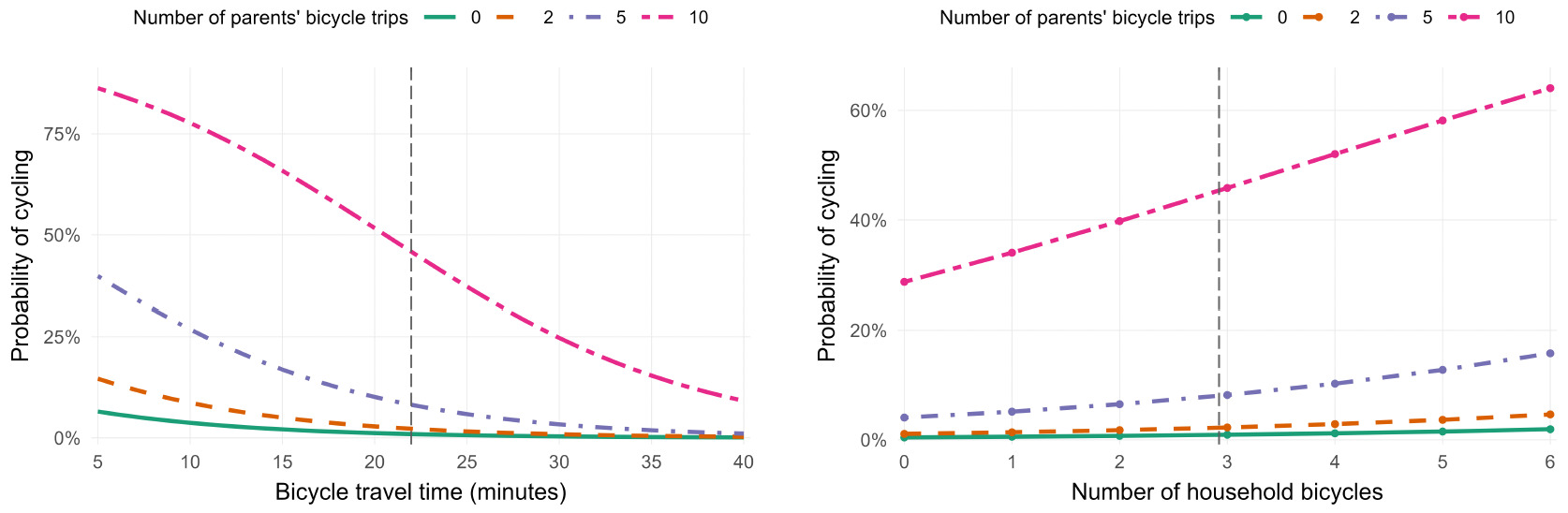
  • Figure 1. Probability of adolescents cycling to school by (a) bicycle travel time and (b) number of household bicycles, for different numbers of parents’ daily bicycle trips.
    Download
  • Supplementary
    Download

Sorry, something went wrong. Please try again.

If this problem reoccurs, please contact Scholastica Support

Error message:

undefined

View more stats

Abstract

This study examines whether adolescents are more likely to cycle to school when their parents do, and whether this influence differs between female and male adolescents. Using 3,017 school trips from the Victorian Integrated Survey for Travel and Activity (VISTA), separate multinomial logit models were estimated for each group. Findings show that parental cycling significantly increases adolescents’ likelihood of cycling, with a stronger effect for females. These findings demonstrate that parental behaviour plays a crucial role in shaping active school travel.

1. Questions

Cycling offers an accessible way for adolescents to be physically active and contributes to healthier and more sustainable cities (Loh et al. 2022). Yet cycling rates among adolescents have declined in many regions, especially the car-dominant settings (Schmassmann, Baehler, and Rérat 2024). Adolescence marks a period of growing independence, but parents remain key decision-makers who often shape or constrain these choices (Woldeamanuel 2016). Parental influence operates both through perceptions and through behaviour, and their perception of safety and infrastructure is decisive in determining whether adolescents engage in active travel (Klos et al. 2023; Sukmayasa, Soza-Parra, and Ettema 2025). There is also evidence that adolescents are more likely to cycle when cycling is already part of family routines and mobility practices (Luo and Dai 2025). While travel socialisation includes broader social, cultural, and environmental factors, this study focuses specifically on parents’ cycling behaviour (Panter, Jones, and Van Sluijs 2008). However, there is limited evidence on this from low-cycling countries such as Australia. Therefore, this study aims to address two guiding questions:

  1. How is adolescents’ likelihood of cycling to school related to their parents’ cycling behaviour in Greater Melbourne?

  2. Does this relationship differ between male and female adolescents in Greater Melbourne?

2. Methods

Trips from Victorian Integrated Survey for Travel and Activity (VISTA)[1] (2012-2020) were used to estimate mode-choice for adolescents (aged 11–17) in Greater Melbourne. VISTA is a household travel survey that collects all trips made by all household members across a detailed one-day travel diary. It includes socio-demographic and household information, and fine-grained origin–destination (OD) data at the Mesh Block (MB) level[2]. All school trips were extracted, resulting in 3,017 observations across four alternatives: car, Public Transport (PT), walking, and cycling.

Travel times were estimated using the r5 routing engine via the r5r package in R, which combines Open Street Map (OSM) and General Transit Feed Specification (GTFS) data and applies the RAPTOR algorithm for PT routing (Pereira et al. 2021) (see Supplementary Material). Driving and walking times were based on road speed limits and pedestrian networks. Cycling times were derived using the network-based impedance model from Jafari, Pemberton, et al. (2025). For PT travel cost, the average fare in Greater Melbourne (2012–2020) was AUD 4 per trip (AUD 8 per day). Driving costs were calculated using ATAP distance-based fuel consumption rates[3] and average fuel prices in Victoria (2012–2020) from the Australian Institute of Petroleum[4].

Mode choice behaviour was analysed using a Multinomial Logit (MNL) model. Explanatory variables included travel time, monetary cost, household vehicle availability, and parental cycling activity (number of cycling trips by parents on the survey day). Each variable enters the utility function with an estimated coefficient (weight), representing its contribution to mode utility. The utility of an individual i choosing mode j is:

U(m)ij=ASCj+βTT,jTij+βmoney (CijHi)δcost j+βCANCiδcar j+(βparent xparent ,i+βBANBi+γ(m)βsex Si)δbike j

Where:

U(m)ij is the utility of mode j for individual i under model m;

ASCj is the alternative-specific constant for mode j;

Tij is the travel time for individual i by mode j;

CijHi is the monetary cost of mode j for individual i, Cij, divided by individual i’s household income, Hi;

xparent,i is the number of cycling trips made by parents of individual i in a day;

NBi and NCi are the number of bicycles and cars in the household, respectively;

Si is the sex of individual i (1 = male, 0 = female);

γ(m) equals 1 if Model m=1, and 0 otherwise;

δcostj=1 if mode j is PT or car, and 0 otherwise;

δbikej=1 if mode j is bike, and 0 otherwise;

δcarj=1 if mode j is car, and 0 otherwise.

The estimated parameters are βTT,j (travel time), βmoney,j (monetary cost), βparent (coefficient on parental cycling behaviour), βBA (bike availability), and βCA (car availability).

Alongside the main model, two sex-specific models were estimated, excluding sex as an attribute (Models 2 and 3). Predictive probabilities were then calculated as the percentage change in cycling likelihood resulting from variations in specific attributes, while keeping others constant.

3. Findings

Cycling is used by 3.87% of adolescents (117 out of 3,017) for school trips, with a clear gender gap, with male adolescents cycling nearly three times more than females (5.66% (90 out of 1573) vs. 1.90% (27 out of 1444)) (Table 1).

Table 1.Mode shares and summary statistics across different scenario thresholds
Variables All adolescents
(n=3017)
Male adolescents
(n=1573)
Female adolescents
(n=1444)
Mean SD Mean SD Mean SD
Mode Shares (%)
Cycling 3.87 - 5.66 - 1.90 -
Driving 56.58 - 53.12 - 60.3 -
PT 21.21 - 22.47 - 19.84 -
Walking 18.32 - 18.73 - 17.86 -
Individual Charactertistics
Sex (1 = male) 0.521 0.499 - - - -
Household Charactertistics
Bike Ownership (avg.) 2.84 2.02 2.92 2.05 2.88 2.01
Car Ownership (avg.) 2.03 0.86 2.00 0.86 2.02 0.83
Weekly Income (AUD) 2355.7 1590.33 2373.9 1566.2 2329.2 1581.2

The model results confirm the strong influence of parental cycling on adolescents’ mode, with clear gender differences (Table 2). In Model 1, βparent=0.450 indicates that parental cycling behaviour substantially increases the likelihood of cycling. The inclusion of βsex=1.104 in Model 1 confirms that males are more likely to cycle overall.

Table 2.Estimated mode choice parameters across different models
Coefficient Model 1 Model 2: Female Model 3: Male
ASCPT -1.535*** [-1.848, -1.223] -1.379*** [-1.836, -0.922] -1.668*** [-2.105, -1.230]
ASCbike -2.841*** [-3.540, -2.143] -2.534*** [-3.833,-1.235] -1.866*** [-2.553, -1.179]
ASCwalk 2.105*** [ 1.756, 2.454] 2.414*** [ 1.888, 2.940] 1.854*** [ 1.384, 2.324]
βTT,car -0.057*** [-0.069, -0.045] -0.053*** [ -0.071, -0.035] -0.063*** [ -0.079, -0.046]
βTT,PT 0.001 [-0.001, 0.004] 0.001 [-0.005, 0.006] 0.002 [-0.002, 0.005]
βTT,bike -0.118*** [-0.151, -0.086] -0.171*** [ -0.264, -0.077 ] -0.109*** [ -0.144, -0.074]
βTT,walk -0.084*** [-0.094, -0.075] -0.093*** [ -0.109, -0.078] -0.078*** [ -0.090, -0.066]
βparent 0.450*** [ 0.199, 0.700] 0.649** [ 0.219, 1.079] 0.303* [-0.037, 0.643]
βmoney 6.499 [-17.345, 30.344] 10.561 [-18.371, 39.493] -3.541 [-45.875, 38.793]
βCA 0.225*** [ 0.115, 0.335] 0.299*** [ 0.132, 0.467] 0.156* [ 0.008, 0.304]
βBA 0.248*** [ 0.149, 0.346] 0.293** [ 0.079, 0.507] 0.225*** [ 0.114, 0.337]
βsex 1.104*** [ 0.586, 1.622] - -
R2 0.392 0.4379 0.3539
LL -1866.95 -834.99 -1024.13
AIC 3757.91 1691.99 2070.26

Notes: Coefficients are reported with 95% confidence intervals in brackets. Significance levels: (∗∗∗p<0.001, (∗∗p<0.01, (∗p<0.05, (⋅p<0.10.

In sex-specific models, the effect is larger and statistically stronger among females (βparent=0.649), while it is weaker and only marginally significant for male adolescents (βparent=0.303), suggesting that parental cycling has a greater impact on female adolescents.

Other attributes behave as expected. Travel time has a negative effect across modes, with females more sensitive to cycling time. Cost is not a significant factor for adolescents, unlike the findings for adults in Greater Melbourne (Jafari, Singh, et al. 2025).

Fig. 1(a) shows that the probability of cycling declines as bicycle travel time increases. However, higher parental cycling behaviour shifts the curves upward, indicating that adolescents exposed to more parental cycling activity are more likely to cycle, even for longer trips. The dashed line marks the sample-average travel time. In Fig. 1(b), the probability of cycling increases with household bicycle ownership, with a noticeably stronger effect under a higher number of cycling trips by parents.

Figure 1
Figure 1.Probability of adolescents cycling to school by (a) bicycle travel time and (b) number of household bicycles, for different numbers of parents’ daily bicycle trips.

Overall, findings suggest that adolescents are more likely to cycle when cycling is present in their household environment (Tiwari et al. 2025; Schmassmann, Baehler, and Rérat 2024).


Acknowledgements

Afshin Jafari and Sapan Tiwari are supported by an RMIT Vice-Chancellor’s Research Fellowship. Nikhil Chand is supported by an Australian Government Research Training Program Scholarship.


  1. Victorian Integrated Survey of Travel and Activity (VISTA), Victorian Government: https://www.vic.gov.au/victorian-integrated-survey-travel-and-activity

  2. Mesh Blocks are the smallest geographic areas defined by the Australian Bureau of Statistics (ABS) and form the building blocks for the larger regions of the Australian Statistical Geography Standard (ASGS).

  3. https://www.atap.gov.au/sites/default/files/pv2_road_parameter_values.pdf

  4. https://aip.com.au/aip-annual-retail-price-data

Submitted: October 22, 2025 AEST

Accepted: November 11, 2025 AEST

References

Jafari, Afshin, Steve Pemberton, Sapan Tiwari, Tayebeh Saghapour, Nikhil Chand, Belen Zapata-Diomedi, and Billie Giles-Corti. 2025. “Modelling the Impact of Lower Speed Limits on Residential Streets for Cyclist Level of Traffic Stress and Car Travel Time in Greater Melbourne.” Journal of Cycling and Micromobility Research 6:100085. https:/​/​doi.org/​10.1016/​j.jcmr.2025.100085.
Google Scholar
Jafari, Afshin, Dhirendra Singh, Alan Both, Mahsa Abdollahyar, Lucy Gunn, Steve Pemberton, and Billie Giles-Corti. 2025. “Activity-Based and Agent-Based Transport Model of Melbourne: An Open Multi-Modal Transport Simulation Model for Greater Melbourne.” Journal of Intelligent Transportation Systems 29 (4): 417–34.
Google Scholar
Klos, Leon, Tanja Eberhardt, Carina Nigg, Claudia Niessner, Hagen Waesche, and Alexander Woll. 2023. “Perceived Physical Environment and Active Transport in Adolescents: A Systematic Review.” Journal of Transport & Health 33:101689.
Google Scholar
Loh, Venurs, Shannon Sahlqvist, Jenny Veitch, Lukar Thornton, Jo Salmon, Ester Cerin, Jasper Schipperijn, and Anna Timperio. 2022. “From Motorised to Active Travel: Using GPS Data to Explore Potential Physical Activity Gains among Adolescents.” BMC Public Health 22 (1): 1512.
Google Scholar
Luo, Weicong, and Li Dai. 2025. “The Role of Mothers’ Past Transport Behaviour and Environmentally Friendly Mindset in Their Children’s Sustainable Transport Choices in Early Adulthood.” Journal of Urban Mobility 8:100155.
Google Scholar
Panter, Jenna R., Andrew P. Jones, and Esther M. F. Van Sluijs. 2008. “Environmental Determinants of Active Travel in Youth: A Review and Framework for Future Research.” International Journal of Behavioral Nutrition and Physical Activity 5 (1): 34.
Google Scholar
Pereira, Rafael H. M., Marcus Saraiva, Daniel Herszenhut, Carlos Kaue Vieira Braga, and Matthew Wigginton Conway. 2021. “R5r: Rapid Realistic Routing on Multimodal Transport Networks with r 5 in r.” Findings.
Google Scholar
Schmassmann, Aurélie, Daniel Baehler, and Patrick Rérat. 2024. “The Contrasted Evolution of Cycling during Youth. Determinants of Bicycle Ownership and Use.” International Journal of Sustainable Transportation 18 (2): 103–14.
Google Scholar
Sukmayasa, I Made, Jaime Soza-Parra, and Dick Ettema. 2025. “Determinants of Travel Mode Access for Adolescents in Developing Countries: A Literature Review.” Transport Reviews 45 (2): 194–215.
Google Scholar
Tiwari, Sapan, Afshin Jafari, Nikhil Chand, and Billie Giles-Corti. 2025. “Role of Traffic Stress and Family Influence in Cycling Mode Choice.” In Australasian Transport Research Forum (ATRF) 2025.
Google Scholar
Woldeamanuel, Mintesnot. 2016. “Younger Teens’ Mode Choice for School Trips: Do Parents’ Attitudes toward Safety and Traffic Conditions along the School Route Matter?” International Journal of Sustainable Transportation 10 (2): 147–55.
Google Scholar

Powered by Scholastica, the modern academic journal management system